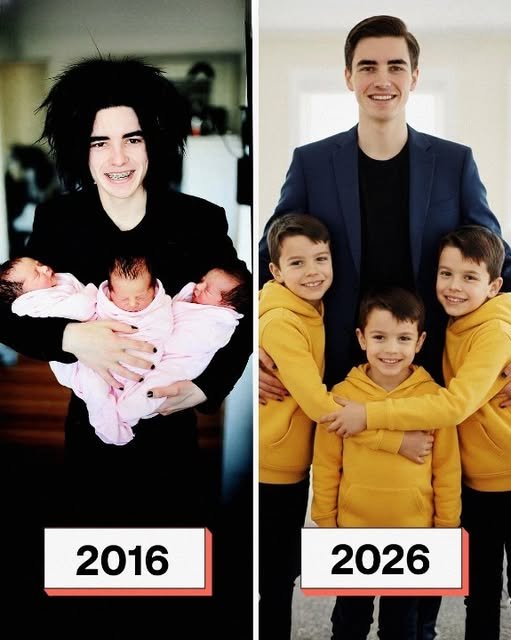
I was eighteen years old when the world collapsed into a singular, overwhelming mission: survival. My mother had just passed away, leaving behind a legacy of love and three tiny, fragile lives that could barely breathe on their own. Triplets. They were still wired to the complex machinery of the NICU, their translucent skin and frantic heartbeats a testament to a life that had begun far too soon. In the blink of an eye, I wasn’t just a teenager mourning a parent; I was a guardian, a provider, and the only shield three helpless infants had against an indifferent world.
People often asked where our father was during those early, harrowing years. It was a question I had spent more than a decade answering in the silence of my own mind. My father, James, was the kind of man who occupied a room with a loud, abrasive presence and exited it with a quiet, cowardly disappearance. He stayed just long enough to ensure his presence left a scar, then vanished before the weight of responsibility could ever touch his shoulders. During my adolescence, I was his favorite target for a peculiar brand of casual cruelty. He mocked my clothes, my music, and my very identity with a grin that never reached his eyes. To him, I wasn’t a son; I was entertainment, a “shadow” he tried to diminish at every opportunity. My mother was my only protector, the woman who shielded me from his verbal barbs until the day the doctor delivered the news that would change everything: she was carrying triplets.
The moment the word “triplets” hung in the air of the ultrasound room, the exit became my father’s only focus. He didn’t leave all at once, but the erosion of his presence was steady. Late nights at work turned into unexplained absences, which eventually dissolved into a total desertion. I stayed by my mother’s side as she navigated a pregnancy that was as terrifying as it was miraculous. Then, the health complications began—a quiet appointment, a doctor who chose to sit down, and a diagnosis that signaled the end. That was the day my father left for good. No note, no goodbye, just a vacancy where a man should have been.
The triplets were born early, tiny and vulnerable, as if they knew the world they were entering was already missing its anchors. My mother spent her final months memorizing their faces, standing by their incubators with a desperate intensity, as if she could transfer her own life force into them through sheer will. When she died a year later, the funeral was a small, somber affair. I found myself glancing at the back door of the chapel, half-expecting my father to stage a dramatic, repentant return. He never showed.
A week after we buried her, social services arrived at our door. The caseworker was kind, reminding me that at eighteen, I wasn’t obligated to sacrifice my youth for my brothers. She told me I had my whole life ahead of me. I looked past her into the nursery, where three cribs stood in a row—three sleeping babies who had already been abandoned by everyone else. “I can do it,” I told her. And so, I grew up overnight. It wasn’t a heroic transformation; it was a bone-deep, exhausting grind. My life became a blur of minimum-wage shifts, night feedings, and online classes squeezed into the margins of the day. I remember sitting on the kitchen floor at 3:00 AM, one baby screaming into the hollow silence of the house, my hands shaking from sheer fatigue. I whispered to the dark that I didn’t know what I was doing, but the boys trusted me anyway. They grew, and I grew with them, through soccer practices, flu shots, and the endless balancing of a meager budget. Every sacrifice was made in the quiet, without an audience, until eleven years had passed.
Then came the knock on the door that I had both dreaded and expected. He stood on the porch like a faded ghost—older, diminished, but carrying that same air of unearned entitlement. “Cade,” he said, using my name as if he still had the right to it. He claimed he had come to explain, holding out a thick envelope sealed with yellowed tape. He told me our mother had made him promise to deliver it. I let him inside, not out of affection, but to keep our private shame off the front porch. He stood awkwardly in my living room, surrounded by photos of the boys he had never known, muttering that they looked “good.”
I opened the envelope to find legal documents and a letter in my mother’s unmistakable, efficient handwriting. She had known she was dying, and she had known the character of the man she had married. The letter revealed a final, desperate gambit: she had placed her inheritance into a trust for the boys, accessible only by their legal guardian and strictly for their care. She had written to him, pleading with him to step up, essentially trying to bribe him into being a father with the promise of a trust fund.
I folded the letter slowly, the realization hitting me like a physical blow. “She knew,” I said quietly. “She knew the only way you’d even consider coming back was if there was money involved. She tried to bribe you into being a father, and even then, you didn’t want them.” He tried to stumble through an excuse about needing time to get his life together, but the calculation in his eyes gave him away. He wasn’t there for the boys. He was there because he was sick, buried in medical bills, and looking for a payday. He actually had the audacity to suggest that I “handle” his debts using the boys’ money—essentially asking me to pay him to stay away.
In that moment, a cold clarity settled over me. For years, I had wondered what kind of man could leave his children in their hour of greatest need. I realized he wasn’t a mystery; he was just small. He was a man who saw his children as leverage and his son as a bank. I opened the front door wide and told him the truth: he would get no money, no forgiveness, and no place in our lives. He had left because he was selfish, and he had returned because he was greedy. The boy he used to bully was gone; in his place stood the man who had done the work he was too cowardly to face.
He walked away into the dusk, glancing back at the warm, lit house that he would never truly belong to. That night, after I checked on my three brothers—now healthy, happy, and thriving—I locked the trust papers away with our most vital records. One day, the boys will ask about the man in the old photographs. And when they do, I will tell them the truth. They will know that family isn’t defined by the blood that abandons you, but by the hands that stay to hold you when the world turns cold. They will know exactly who stayed when things got hard, and who only returned when they thought there was something left to take.