My name is Trevor Stone, and for most of my adult life I believed control was the same thing as security. I built companies from nothing, negotiated deals across continents, and filled my life with glass walls and steel certainty. At forty one, I owned a penthouse overlooking Seattle Bay, a portfolio worth more than I ever expected, and a wife whose music could make entire concert halls fall silent. From the outside, it looked like perfection. From the inside, it was a story that would tear itself open in the middle of the night.
My wife Brielle was a composer and violinist whose name glowed on theater posters and charity invitations. She loved beauty, silence, candlelight, and warm tea cups cradled between her hands. When she became pregnant with twins, she wrote a melody meant only for them. She told me that every child deserved a private song, something that belonged only to their heart. I laughed at the idea back then, proud but distracted, certain there would always be time for such tenderness later.
There was not.
Brielle died five days after giving birth. The hospital called it an unexpected complication, the kind of phrase that sounds clean and official while leaving a crater behind. I held her hand as her skin cooled, unable to understand how someone so alive could vanish within hours. When I brought the twins home, I entered a world where every hallway echoed, every room felt too large, and every breath tasted like metal.
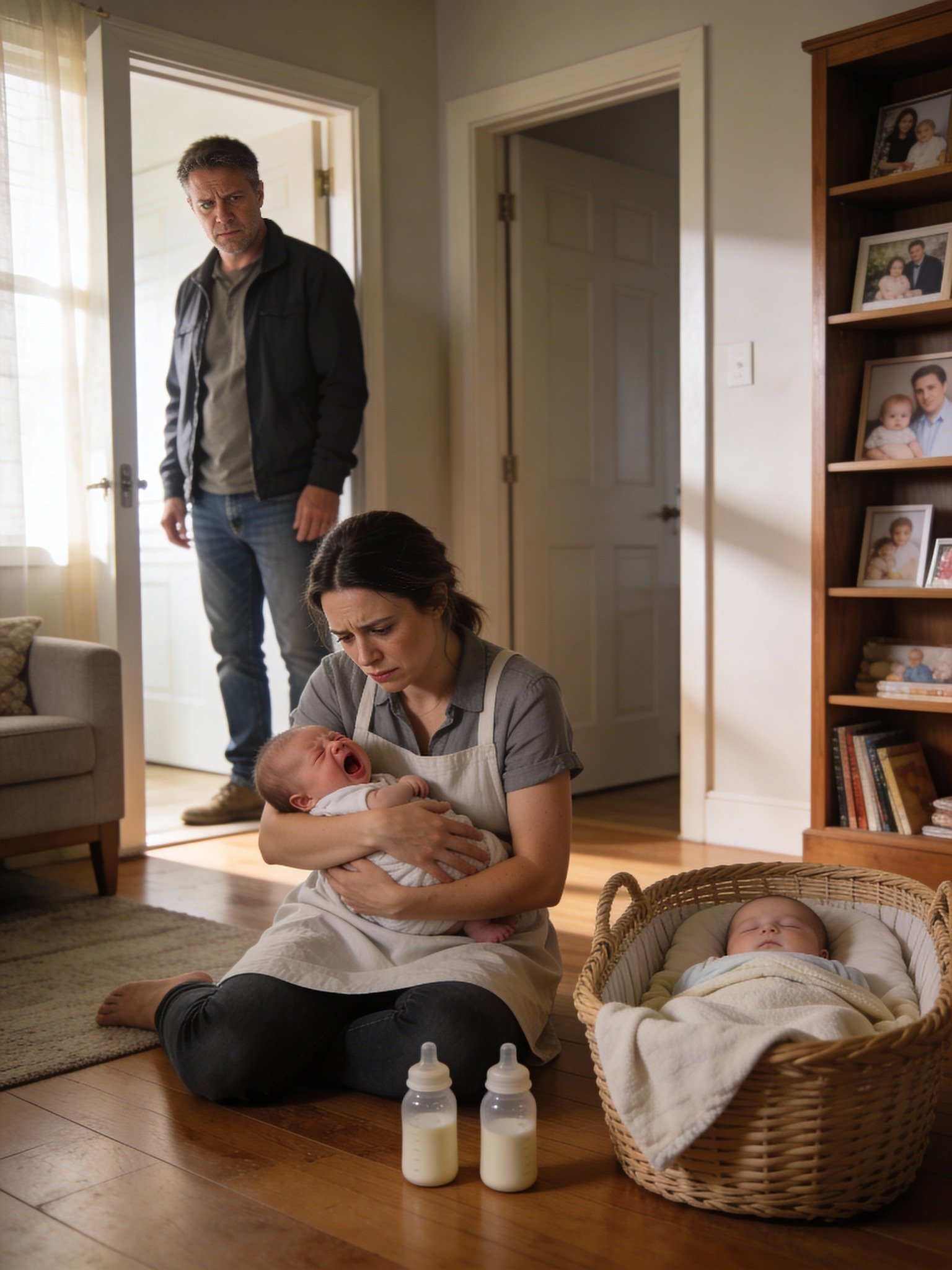
One of the twins, Aaron, slept easily and rarely cried. The other, Isaiah, screamed with a frantic pitch that never seemed to end. His tiny body shook as if something inside him was fighting to escape. Doctors ran tests and found nothing unusual. A pediatric specialist eventually told me it was severe infant distress and suggested medication to help him rest. I agreed because I was desperate and exhausted and lost inside grief.
My sister in law, Felicia Barnes, moved into the penthouse soon after the funeral. She wore grief like theater, arriving with black silk dresses, expensive perfume, and a voice that always sounded just a little too smooth. She said she wanted to help with the babies, to give them family, to help me manage my life. She was Brielle’s older sister, and I believed I owed her trust.
Grace joined us a month later. She was a quiet nursing student who answered an agency posting for night infant care. She was young, careful with her words, and almost invisible in a house built for spectacle. She asked only for a small room near the nursery and permission to stay with the twins during nights. It seemed harmless. I agreed without much thought.
Felicia disliked her immediately.
One evening during dinner Felicia leaned toward me and said, “She sits in the nursery in the dark for hours. It is strange behavior, Trevor. You never know what kind of people you invite into your home.”
I frowned but dismissed it. Grace had been gentle with the babies, especially Isaiah. His screaming softened whenever she held him. Still, seeds of suspicion were planted, watered by grief and sleeplessness.
A week later, I hired a security firm to install discreet cameras throughout the penthouse. They were small, silent, nearly invisible. I told myself it was for safety, for the twins, for peace of mind. I did not tell Grace about them. I did not tell Felicia either. I simply watched the technicians drill and wire and test while telling myself that knowledge was protection.
For two weeks I did not look at the footage. Work demanded my attention, and the house remained quiet enough. Then one stormy night, thunder rolling over the bay, I woke unable to breathe. I reached for my tablet and opened the security application.
The nursery camera came alive in soft gray night vision.
Grace sat on the floor between the two cribs. She was not asleep. She held Isaiah against her bare chest, skin to skin, wrapped in a blanket. She swayed slowly, humming a tune that curled through the microphone. My heart lurched because I recognized the melody. It was Brielle’s private song. No recording of it existed. No sheet music. Only memory.
Grace whispered to Isaiah, “You are safe, little heart. Your mother sang this for you before the world turned dark.”
My eyes burned, but the feed shifted to something worse.
The nursery door opened. Felicia entered quietly, holding a small glass dropper and a baby bottle. She approached Aaron’s crib and tilted the dropper toward the bottle.

Grace stood up immediately, still holding Isaiah.
“Stop,” Grace said. “I switched the bottles earlier. That one has only water. What you put in the other bottle is still in the trash. I saw it yesterday.”
Felicia froze, then smiled in a way that made my stomach twist.
“You are only hired help,” Felicia said. “No one will believe a girl with no family name. The doctors already think Isaiah is unstable. Once Trevor accepts he cannot handle both children, custody will come to me. The trust follows. The company follows. Everything follows.”
Grace’s voice shook but did not break.
“I was on duty in the hospital the night Brielle died,” she said. “She told me she was afraid of you. She said if anything happened to her, someone had to watch over her children. I promised I would. I changed my job, my records, my life to stand here. I will not leave them.”
Felicia stepped forward and raised her hand.
I did not think. I ran.
The hallway blurred as I sprinted, my bare feet striking cold marble. I burst into the nursery and caught Felicia’s wrist before her hand landed.
She gasped. Grace stepped back, clutching Isaiah. Aaron began to cry.
I looked into Felicia’s eyes and said quietly, “The cameras record everything. Security is on their way. The police are already being called.”
Felicia went pale. Grace sank to the floor, breathing hard, still rocking the baby.
When the authorities arrived and led Felicia away, the penthouse finally fell silent again. The storm outside had passed, leaving only rain tapping against glass. I sat on the nursery floor beside Grace, surrounded by cribs and soft blankets and the scent of milk.
Isaiah slept peacefully against Grace’s shoulder. For the first time since birth, he was not crying.
I spoke without looking at her.
“How did you know Brielle’s song.”
Grace smiled sadly.
“She sang it to them when they were still in the hospital. She told me that love is a kind of medicine that cannot be written on charts. I did not want her children to forget her voice.”
I closed my eyes. In that moment, I realized how blind I had been. I built a fortress of money and glass, but never learned how to build a home of trust. I doubted the wrong person. I invited a predator inside while suspecting the guardian who stayed in the dark to keep my children alive.
The investigation that followed revealed everything. Felicia had altered medication instructions, influenced doctors with false reports, and attempted to position herself as the only responsible adult. The sedative found in Isaiah’s system explained his distress. The forged documents for trust control were already prepared. Without Grace, the story would have ended with me broken and my children in the hands of someone who saw them as property.
Weeks later, after court hearings and medical recovery, the twins grew healthier. Isaiah began to laugh. Aaron learned to clap his hands. The penthouse felt less like a tomb and more like a place where life could return.
I offered Grace a choice.
“You saved my children. I will never treat you as an employee again. Stay. Help me build something worthy of Brielle’s name.”
We created a foundation dedicated to protecting children in vulnerable family environments. Grace became its director, finishing her nursing degree while guiding programs that trained caregivers and monitored infant health in high risk homes.
Every evening we sat in the nursery. No cameras. No screens. Just the three of us and two growing boys. Grace hummed Brielle’s melody, and sometimes I joined in, clumsy but honest.
One night Aaron asked, “Daddy, why does Isaiah have a special song.”
I answered, “Because your mother loved you both so much that her music stayed even when she could not.”
Isaiah leaned against my shoulder. Grace watched with quiet satisfaction.
I learned that wealth cannot replace attention. Surveillance cannot replace trust. And grief, if left unchecked, can make you hand your future to the wrong hands.
The penthouse still stands over Seattle Bay, glass reflecting sky and sea, but inside it now lives laughter, bedtime stories, warm lamps, and the soft hum of a lullaby written by a woman whose love refused to die.
I once believed control kept people safe. Now I know that real safety is built by those who care when no one is watching.
And every night, when the twins fall asleep to Brielle’s song, I whisper into the quiet room, “Thank you,” to the woman I lost, to the girl who became our guardian, and to the children who taught me how to begin again.