My father passed away on a gray Thursday afternoon in early October, after years of living with a heart that no longer wanted to carry him through the world. His death was not sudden, yet it split my life open with a violence I had not prepared for. I am Meredith Collins, and at the moment they pronounced him gone, something essential inside me collapsed in silence.
The funeral was held the very next day in a small town cemetery outside Cedar Falls, Iowa, a place where the wind always seemed to whisper through the trees no matter the season. I stood beside my mother in a black dress that felt too thin for the cold, watching strangers offer condolences while my mind drifted somewhere far away, locked inside memories I could barely touch.
My husband, Brian Collins, stood beside me but might as well have been a stranger. His posture was stiff, his eyes restless, and every few minutes he glanced down at his phone as if waiting for permission to escape. When relatives tried to speak to him, he nodded politely but never truly engaged, his attention already elsewhere.
Less than half an hour after my father was lowered into the ground, Brian leaned toward me and whispered that he had an urgent work matter he needed to handle. He did not wait for a response. He simply walked away, keys in hand, without once turning back to look at me or my mother or the grave that had just swallowed my father.
I did not know it then, but he was not leaving for business at all. By the time the sun had set, he was already on a plane with another woman, someone he had been hiding from me for months. My father had barely been buried, and my marriage had already betrayed me in its own quiet way.
That night I returned to my childhood home, the same house where my father once taught me how to ride a bike and where he used to fall asleep watching late night news. I lay awake in my old bedroom, still dressed in black, staring at the ceiling fan as it turned slowly above me. Grief kept my body rigid and my thoughts painfully sharp.
At three in the morning, my phone vibrated on the nightstand.
The message came from an unknown number, and for a moment I considered ignoring it, until I read the words that made my chest seize.
“My daughter, it is me. Do not be afraid. Come to the cemetery quietly. I need to speak with you.”
For a few seconds, logic deserted me completely. My heart raced, my hands went cold, and a sharp wave of nausea rolled through my stomach. Then reason returned, slow but firm. My father was dead. That meant someone else had his phone, or someone was cruel enough to pretend they did.
Fear quickly gave way to anger, followed by a deeper, more unsettling dread. The message used a phrase my father had always said when he wanted to speak privately, a phrase almost no one else knew. That detail alone meant this was not a random act.

I got dressed without waking my mother, slipped my keys into my coat pocket, and left the house quietly. I did not call the police yet, not because I was fearless, but because I needed to understand who was trying to pull me into this moment and why.
The cemetery was nearly empty when I arrived, bathed in weak yellow light from a few old streetlamps. I parked near the gate and stood still for a moment, listening. The night was quiet, too quiet, until I noticed something ahead.
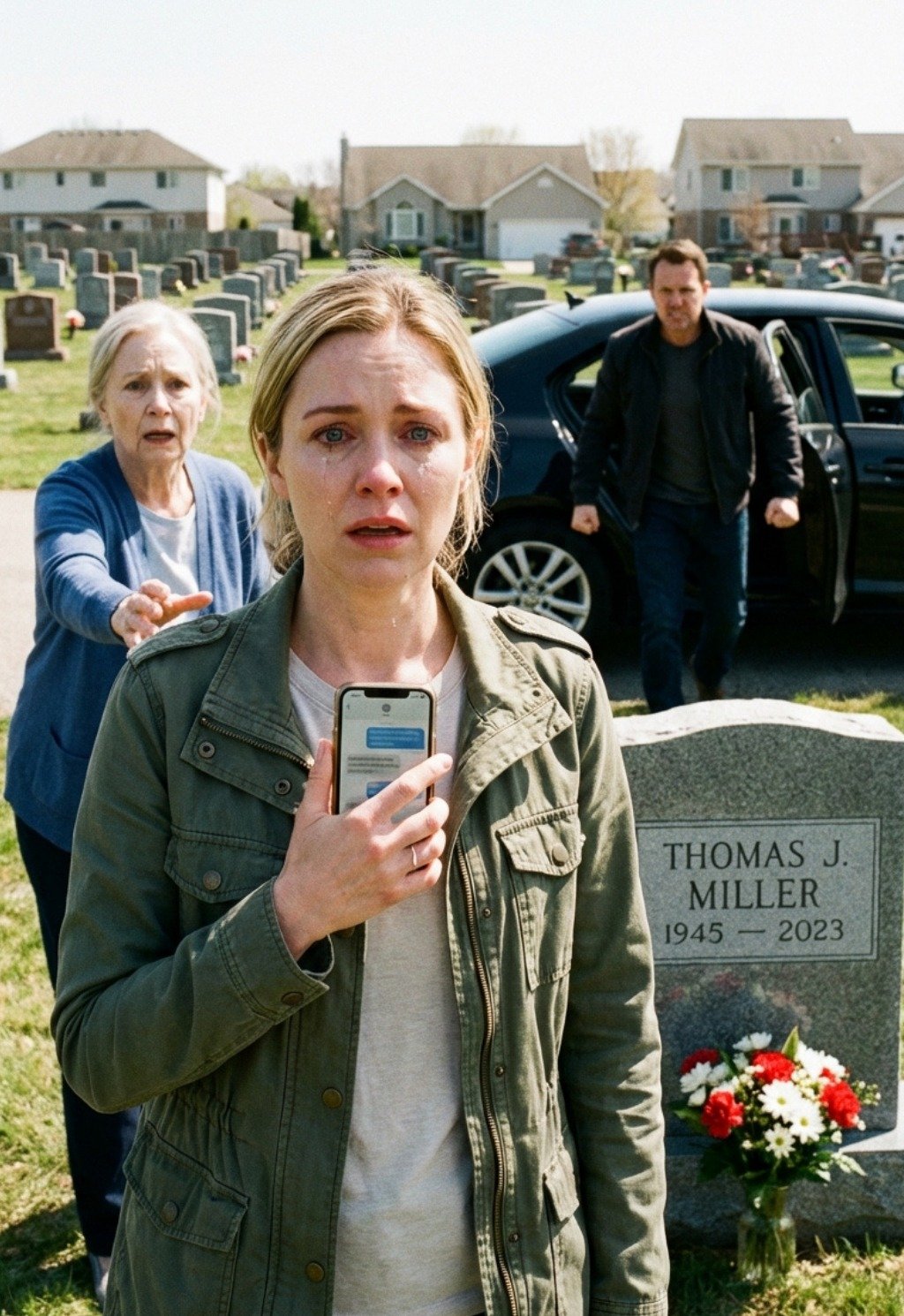
My father’s phone was standing upright against his gravestone, its screen glowing softly in the dark.
My breath caught as I approached. The soil around the grave was disturbed, marked with footprints that were not mine and not old enough to belong to the burial crew. Someone had been there recently, deliberately.
Before I could fully process what that meant, I heard a faint metallic sound behind me, like a tool shifting or a foot striking something solid. My entire body froze.
I was not alone.
I turned slowly and saw a figure near the edge of the trees, average in height, wearing a hooded jacket. Their hands were hidden in their pockets, their face swallowed by shadow, but I could feel their attention fixed on me.
“Who are you?” I called out, forcing my voice to stay steady.
The figure did not answer. Instead, they stepped back cautiously.
“I am calling the police,” I said.
That made them stop.
After a long pause, a voice emerged from the darkness, trembling and unmistakably familiar.
“Meredith, please wait.”
Recognition hit me like a blow. It was Lucy Parker, the caregiver who had looked after my father during his final months at the assisted living facility. She had been kind to him, patient in ways my husband never bothered to be.
She stepped forward into the light, her eyes red and swollen.
“You scared me half to death,” I said, anger rising fast. “Why would you do this?”
“I did not know how else to reach you,” she replied quietly. “I found his phone yesterday. He asked me to keep it safe.”
“You could have called me normally,” I said sharply.
“I was afraid you would not answer,” she admitted. “And what I needed to tell you could not wait.”
A chill crept through me. “Tell me what?”
Lucy swallowed hard. “Your father told me someone was coming to see him. A man. Someone who frightened him. He said the man argued with him when staff were not around and warned him to stay quiet.”
My knees felt weak. “Why did no one say anything?”
“I reported it,” she said. “The director told me it was confusion and ordered me to drop it. I could not.”
She reached into her coat and pulled out a sealed envelope. My father’s handwriting covered the front.
“He wanted you to have this.”
Before I could open it, headlights cut through the darkness at the cemetery gate. A car rolled in slowly and stopped nearby.
Lucy’s face drained of color. “We need to leave.”

The driver’s door opened. Brian stepped out. He did not look surprised to see me there. He looked furious.
“What are you doing here?” he demanded.
“What are you doing here?” I asked back.
His eyes flicked to Lucy. “You should not be listening to her.”
“Why not?” I asked.
“She is unstable,” he snapped.
“That is not true,” Lucy said. “They tried to silence me.”
Brian’s jaw tightened. The pieces clicked together in my mind with sickening clarity.
His secret trips. His private visits to my father. His complete lack of grief.
“What did you say to my father?” I asked quietly.
“He did not know what he was talking about,” Brian replied.
That answer terrified me more than any confession could have.
“He told me to help you leave me,” Brian said suddenly. “He wanted to turn you against me.”
“He was protecting me,” I whispered.
Brian stepped closer. “You are coming home with me.”
“No,” I said.
I held the envelope up, and for the first time, real fear crossed his face. Lucy and I got into the car and locked the doors. I opened the envelope with shaking hands.
Inside was a single page. “My daughter, if you read this, then I was right to be afraid. Please trust yourself. The man who comes to see me does not mean you well. Protect yourself.”
There was no name, but there did not need to be. I folded the letter carefully and stared straight ahead as Brian stood helplessly in the cemetery light. My father did not return from the dead to speak to me.
He left the truth behind, and now it was my responsibility to carry it forward, no matter how painful the path ahead might be.

In the days after that night, everything changed with a quiet inevitability. I did not confront my husband again in private, because I had learned that silence was his strongest weapon. Instead, I took the letter my father left, gathered Lucy’s statement, and went directly to people whose job was to listen and record facts, not excuses.
The investigation moved slowly, but it moved forward. My husband’s visits to the assisted living facility were confirmed, his conversations with staff were no longer denied, and his sudden trips were exposed as lies layered on top of older lies. When the truth reached daylight, it did not explode, but it burned steadily, leaving nowhere for him to hide.
I moved out before the case was finished. Packing my belongings felt less like loss and more like shedding a skin that no longer belonged to me. My mother watched silently from the doorway, and when I finished, she hugged me and said my father would have been proud, not because I was brave, but because I finally chose myself.
Months later, the legal consequences followed their course, and the marriage ended without drama or reconciliation. I did not attend the final hearing out of anger or spite, but because I no longer needed to look at a man who thrived on control to feel closure.
One morning, I returned alone to my father’s grave. The grass had grown back, the soil was smooth, and the stone no longer felt cold to the touch. I thanked him softly, not for the warning, but for trusting me enough to leave it behind.
As I walked away, I understood that the dead do not come back to frighten us. Sometimes, they leave just enough truth to help the living survive.