My name is Marissa Lowell, and three decades ago my life split into two parts inside a crowded maternity ward in Brighton County Hospital, a public facility in upstate New York that was always understaffed and painfully loud. I had been in labor for nearly twenty hours, drifting in and out of consciousness as doctors spoke above me and machines hummed without pause. When the pain finally receded and my eyes adjusted to the harsh fluorescent lights, I saw something that felt unreal.
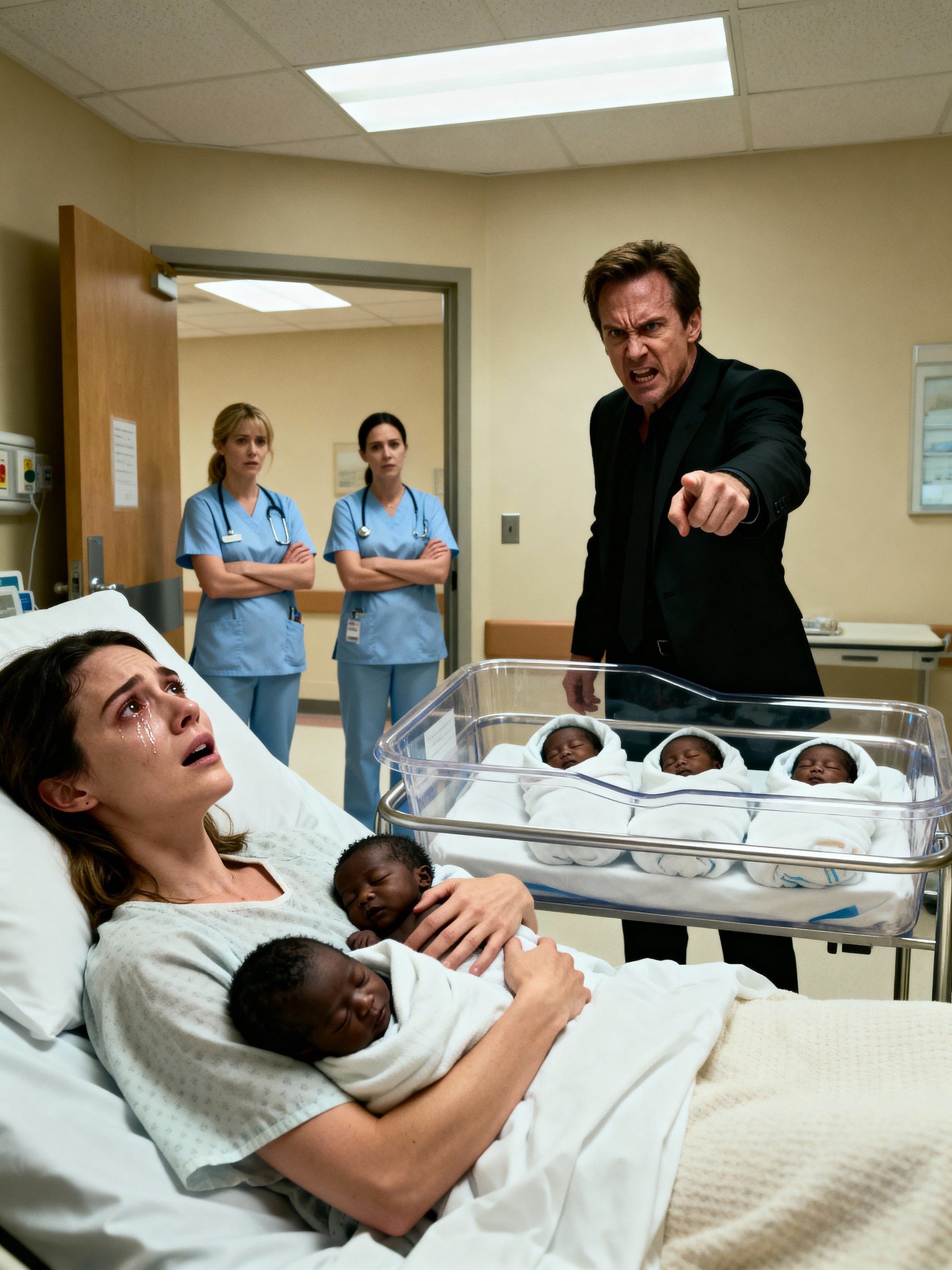
Five bassinets stood in a neat row beside my bed, each holding a tiny newborn wrapped in white cloth, each breathing softly, each alive because my body had endured more than I believed possible.
Fear and love collided inside my chest, leaving me unable to speak.
Before I could even lift my hand, the door opened and Thomas Lowell, my husband at the time, walked in. He was still wearing the jacket he had refused to remove since the pregnancy began, as if distance could protect him from responsibility. His eyes moved from one bassinet to the next, slowly at first, then faster, until his jaw tightened and his expression hardened into something I had never seen before.
He did not ask how I was feeling, and he did not ask whether the babies were healthy.
Instead, his voice rose, sharp and trembling with fury.
“This is not possible,” he said loudly enough that the nurses froze in place. “Those children are not mine, and you know it.”
The room fell silent.
Medical staff tried to intervene, explaining that no tests had been completed and that unusual outcomes sometimes occurred due to genetic factors that were not immediately visible. None of it mattered to Thomas, who pointed at me as though I were a stranger rather than the woman he had shared a life with.
“I will not be humiliated like this,” he said, his words echoing off the tiled walls. “Do not expect me to stay.”
Then he turned and walked out.
He did not wait for answers, and he did not look back.
I was left lying there with five newborns and a silence so heavy it felt like another body pressing down on my chest. Nurses avoided my eyes, whispers traveled through the hallway, and I felt something inside me shut down in order to survive the moment.
I named the children myself, choosing names that carried strength and warmth, names I believed could help them grow into people who would never doubt their worth. I signed every document, pushed a borrowed stroller out of the hospital doors, and stepped into a future I had not chosen but would not abandon.
Raising five children alone was not inspiring or noble. It was relentless.
I worked cleaning offices during the day and repairing clothes at night, measuring time in exhaustion rather than hours. There were months when money barely stretched far enough for groceries, and weeks when sleep came in fragments that never fully restored me. Still, the house was filled with laughter, shared chores, and the kind of closeness that grows when people rely on one another completely.
As the children grew, questions surfaced naturally.

They noticed the difference in their appearances compared to mine, and they asked about the man whose absence shaped our lives.
I told them the truth as I understood it. I told them their father had left without listening, and that I did not yet have answers that satisfied even myself. I refused to let bitterness poison the way they saw the world, even when my own heart carried unanswered grief.
When they reached adulthood, curiosity turned into determination. We agreed to pursue genetic testing together, not to prove anything to anyone else, but to finally understand ourselves.
The results confirmed what I had always known, that they were my biological children without question. However, the deeper analysis revealed something rare and undeniable. I carried a documented inherited genetic variation capable of producing children with features not immediately predictable by appearance alone. It was uncommon, but it was real.
Science had spoken clearly.
I attempted to contact Thomas, believing that truth deserved to be acknowledged, but he never responded.
Years passed, and life continued forward.
Then one winter afternoon, a message arrived through an intermediary. Thomas was ill, his condition severe, and compatible donors were scarce. Someone had located us, and he wanted to speak.
I agreed to meet, not for him, but for the children who had grown into adults with their own voices and boundaries.
We met in a quiet conference room. Thomas looked older, thinner, and uncertain, as though confidence had drained from him over time. My children sat across from him calmly, placing medical documents on the table one by one.
He read them slowly, his hands shaking.
“So they were mine,” he said, barely above a whisper.
No one answered immediately.
Finally, one of my children spoke, explaining that understanding the truth did not mean accepting responsibility for his choices. They told him they had built full lives without his presence, and that absence had shaped them, but it had not destroyed them.
They made it clear that compassion did not require sacrifice, and that illness did not erase the past. Thomas wept openly, apologizing for fear, for social pressure, for his own ignorance. His words filled the room, but they did not change its emotional weight.

When he turned to me, searching my face for something he could name, I spoke honestly.
“I did not hold hatred for you,” I said calmly. “But I did not preserve a place for you either.”
He left quietly. What remained was not anger or triumph, but closure. My children stood together afterward, grounded in truth and secure in their identities. They had grown without a father, but not without love, resilience, or clarity.
What I learned over thirty years was simple and unyielding. Dignity is not granted by others. It is built through endurance, truth, and the refusal to abandon oneself.
This was never a story of revenge. It was a story of consequence, and of lives shaped by a moment where fear spoke louder than reason.
Some decisions echo for a lifetime. And some truths, no matter how long they wait, always find their voice.