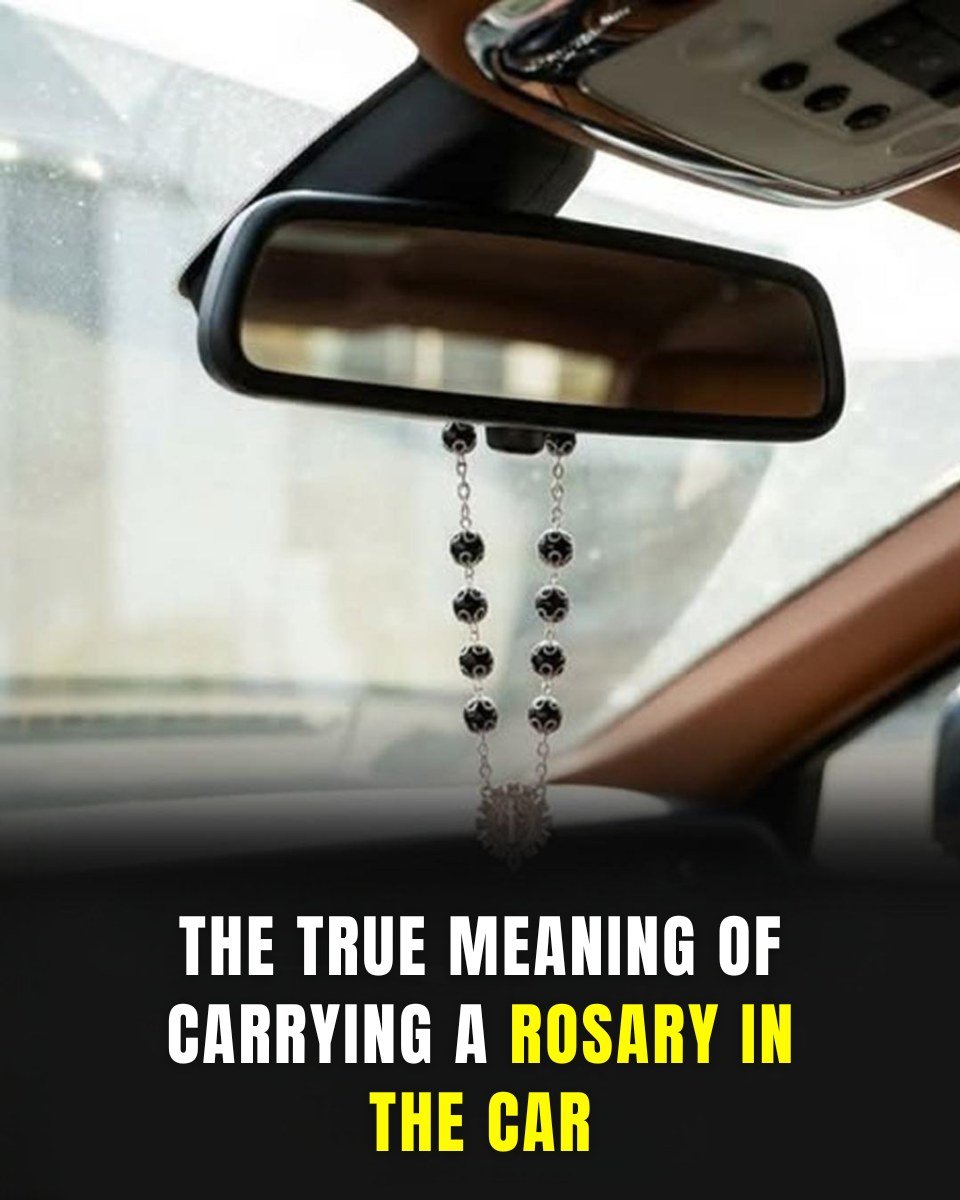
“The true meaning of keeping a Rosary in your car” often sparks different opinions. For some, it’s a family tradition; for others, it’s simply a decorative detail hanging from the rearview mirror.
Yet within the Catholic faith, this everyday gesture carries a much deeper spiritual and symbolic meaning—one that goes far beyond aesthetics or inherited custom.
The Rosary is not a magical object or something meant to function as automatic protection. The Church has been clear about this over time: it is not a lucky charm or a tool of superstition.
Its value does not lie in any supposed ability to prevent accidents on its own, but in what it represents to the person who carries it. It is a visible sign of faith, a quiet presence that reminds believers in Whom they place their life and their journey.
A Conscious Expression of Faith
Placing a Rosary in your car is, above all, a conscious act. It expresses that faith is not limited to church walls or formal moments of prayer, but accompanies daily life—commutes, work, long trips, worries, and the decisions made behind the wheel. It’s a symbol that speaks without words, saying that God is part of everyday life.
For many Catholics, seeing the Rosary while driving serves as a constant reminder—not only of God’s presence, but also of their own behavior. Each glance at it can become a quiet invitation to reflect: How am I driving? How am I responding to traffic? Am I acting with patience or anger, respect or haste? In that sense, the Rosary speaks to the conscience and suggests a different way of traveling the road.

Devotion and Trust
This simple object is also closely connected to Marian devotion. For many believers, keeping a Rosary in the car is a way of entrusting their journey to the Virgin Mary, asking for her intercession, care, and companionship. Not as a form of automatic protection, but as an act of filial trust—similar to the confidence a child places in a mother. It is a gesture of surrender, not a material guarantee.
A Small Moving Altar
The Rosary in the car can also be understood as a small, moving altar—not in a literal sense, but symbolically. It represents the idea that faith travels with the person, that it does not fade when leaving church but becomes integrated into real life, with all its challenges, tensions, and responsibilities. In a world marked by rush, stress, and impatience, this symbol gently invites people to slow down and regain inner calm.
Faith and Responsibility
It’s important to clarify that carrying a Rosary does not replace personal prayer, excuse anyone from following traffic laws, or remove responsibility while driving. Catholic faith does not promote a spirituality detached from reality; on the contrary, it calls for a faith expressed through concrete actions, such as respecting one’s own life and the lives of others. In this sense, the Rosary does not act on its own, but it can influence the heart of the person behind the wheel.
Many believers say this simple gesture helps them drive differently—with greater serenity, awareness, and care. Not because the object has power in itself, but because it reminds them of core Christian values: prudence, gentleness, respect for others, and trust in God, even on the simplest journeys.

Living What It Represents
From this perspective, keeping a Rosary in the car becomes a quiet form of personal witness. It doesn’t impose, demand, or call attention to itself. It simply remains there, accompanying the driver. It is a sign that faith is lived in small, everyday moments—the ones that often go unnoticed.
Ultimately, the true meaning of keeping a Rosary in your car is not about hanging it there, but about living what it represents. It is a constant invitation to drive with greater peace, greater respect, and deeper faith. Because when faith travels with you, it doesn’t just transform the journey—it transforms the person making it.