Chapter 1: The Root System
There are seasons in life when we lull ourselves into believing the storms have passed.

We convince ourselves that we have finally reached the soft, golden years, earned through sweat, heartbreak, and a thousand tiny, unseen decisions.

I thought I was entering that hallowed season when I remarried at sixty. Instead, I walked straight into a war I didn’t know was being fought. The only reason I am still standing on my land, sipping wine I coaxed from the earth, breathing air that belongs to me, is because I guarded one truth like a sacred talisman.
The vineyard estate wasn’t “ours.” It was mine.

My name is Eleanor Hart, though for most of my life, people just called me Elle—a name that somehow managed to sound softer than the iron I carried in my spine. I bought my first scraggly stretch of land in Aldercrest Valley in 1990.

It was an era when men in suits still politely patted women on the head, reminding us that real estate and viticulture were “serious business,” not hobbies for single mothers with stubborn chins and terrifyingly fragile bank balances.

Banks didn’t just doubt me; they dismissed me with a wave of their manicured hands. Friends whispered behind cupped palms at grocery stores. “She’ll lose the land by winter.” “She’ll sell it for pennies.” “She doesn’t know a Cabernet from a Concord.”

But the vines grew. Slowly. Stubbornly. And so did I.
I built Hartstone Estate inch by painful inch, bottle by bottle, sacrifice by sacrifice. I learned to negotiate with distributors who thought my competence was a parlor trick. I learned to fix irrigation lines in the pitch black of a freezing Tuesday, how to read the pH of the soil by taste, how to pray silently to the capricious gods of weather patterns.

One day, I looked up from the dirt and realized I wasn’t just surviving anymore. I had built a kingdom.
By my sixtieth birthday, I owned nearly two hundred acres of producing vineyard land. A stone winery glowed warm amber at sunset, and a tasting room filled every weekend with laughter and the clinking of glasses. My brand was respected. Critics knew my name. But success brings a quiet, creeping loneliness that settles in around the evening shadows, cold and pervasive.

That loneliness is how Charles Bennett slipped through the gates.
He was tall, calm, with silver hair that caught the light and a laugh that sounded like safety. A widower. He had gentle hands that wrapped around a wine glass like it meant something to him. We met at a charity gala, and by the end of the night, he was looking at me as if I were the only person in the room. Within months, he had become part of my routine, the soft presence filling rooms that used to echo with my solitude.
He told me he loved the land. He loved how hard I’d worked. He loved my independence. He said the word “love” often, and I wanted to believe every syllable.
But Charles didn’t come alone. He came with baggage wrapped in silk. His three adult children looked at the world like it owed them interest payments on a debt they never incurred.
Lucas, the eldest, was polished and calculating, his eyes always assessing value. Sabrina was perfectly groomed, her poise a weapon, her gaze constantly roving over my furniture, my art, my life. And Andrew, the youngest, was quieter, softer spoken, but watchful—a silent sentinel waiting for a command.
Their smiles were warm enough. Their hugs were polite. But their questions were surgical.
They circled my life carefully at first, gently inquiring about acreage, distribution channels, profit margins, corporate structure. Then, the comments began to slip out, feeling rehearsed, like lines in a play I hadn’t auditioned for.
“You’re like family now, Eleanor,” Sabrina would coo, touching my arm lightly.
“You really should modernize your business model,” Lucas would say, swirling my vintage red. “Maximize the yield.”
“You and Dad should streamline things,” Andrew would murmur helpfully. “Combine assets for tax purposes.”
And Charles? He never stopped smiling. He just watched, a benevolent king observing his new subjects.
But before the wedding, I had done something. A whisper of instinct, a ghost from my past battles, had nudged me. I met with my attorney, Mara Klein—fierce, brilliant, a woman whose calm voice could steady earthquakes. She insisted on a prenup. I agreed. But then, I went a step further.
Three years earlier, long before Charles ever walked into my life, I had quietly placed the estate into an irrevocable trust under my sole control. It wasn’t advertised. It wasn’t something I discussed at dinner parties. And when Charles and his family asked ownership questions, I wrapped my truth in a mist of vague answers.
“Family land arrangement.”
“Complicated trusts.”
“Legal stuff I don’t always follow.”
Not technically lies. Just… layered truth. I kept the keys to my kingdom hidden in my pocket.
The first year of marriage was honeyed and calm. Year two began to taste metallic.
Charles stopped asking permission and started assuming authority. His children stopped hinting and began pressing. Documents began appearing on the kitchen counter. “Routine paperwork,” Charles would say. “Estate alignment,” Lucas would add. “Just signatures,” Sabrina would smile.
The first time I refused to sign, Charles didn’t speak to me for two days. The silence was heavy, punitive.
The second time, his smile didn’t reach his eyes. It stopped at his mouth, a frozen grimace.
The third time, I came home early from the vineyard to find all three of his children in my private winery office. They were rifling through my file cabinets, pulling out ledgers and contracts with a familiarity that felt like trespassing wrapped in entitlement.
“We’re just helping you organize,” Lucas said smoothly, not even flinching.
I heard the wolves in the politeness. That night, I called Mara.
“This isn’t curiosity, Elle,” she said, her voice tight. “This is positioning.”
I thought that was my worst fear—that they were greedy. I was wrong. It was so much worse.
Months later, things escalated quietly, which is always how the most dangerous things begin. Charles took me to a “routine wellness appointment.” Just a checkup, he said sweetly. Just ensuring we age responsibly, darling.
Except the appointment wasn’t routine. It was evaluative.
The doctor asked pointed questions about memory, capability, comprehension. I answered perfectly, my mind sharp as a tack. But I felt something shift in the room—a sense of being measured against criteria I hadn’t agreed to.
Later, I discovered Charles had already spoken to the doctor privately about establishing a baseline for “medical incompetence.” If I had scored slightly differently—or if I had been tired, distracted, or confused by the intentionally overwhelming questioning—that evaluation could have triggered legal petitions.
Petitions that would have opened the door for guardianship. Guardianship that would have handed them control of my assets.
They weren’t just trying to steal my land. They were preparing to declare me incapable of owning it. They were going to erase me to get to my soil.
That realization split something inside me clean open. All at once, I understood. This wasn’t about blending families. This was a planned extraction.
I sat in my study, the moonlight casting long, cold shadows across the floor, and I made a choice. I didn’t rage. I didn’t scream. I didn’t confront them.
I planned.
Chapter 2: The Vintage Trap
I moved quietly. Precisely. I worked with Mara. I hired a cyber forensics team. I brought in Gabe Lawson, a private investigator friend who had been uncovering corporate ugliness longer than Charles’s children had been alive.
We secured every file. We traced every attempt at forgery. We mirrored emails. We installed silent, pinhole security cameras in my office and the main house.
And yes—they came back.
Watching the footage afterward was a visceral violation. I sat in Mara’s office, staring at the screen as Lucas instructed Sabrina on how to mimic the loop of my ‘L’ in my signature. I heard Charles calmly discuss a staged narrative about my “declining clarity” with his children. I heard Andrew practicing a script of concern to deliver to our neighbors.
“She’s just getting so forgetful lately,” Andrew practiced, his voice dripping with faux sympathy. “We’re worried about her managing the estate alone.”
It broke something ancient and fierce inside me. Not because they were monsters—I had met monsters before. But because they were so casual about it. Like I was a solved problem. Like I was already gone, a ghost in my own home.
But they forgot one thing. I wasn’t just a sixty-year-old woman. I was a farmer. I knew how to weather a storm. I knew how to prune dead weight to save the vine.
I planned a dinner.
It was to be an intimate affair, just family. I told Charles I wanted to discuss the “future of the estate.” His eyes lit up. He thought I was finally yielding. He thought the pressure had worked.
They arrived polished, smiling, confident. They believed they were winning. They believed the groundwork had been laid so deeply that I would never claw my way out.
They were half right. Groundwork had been laid. Just not by them.
The dining room was set with my finest china, the candlelight flickering against the crystal glasses. I poured the wine—a 2015 Reserve Cabernet, deep and complex. A wine that took patience.
“To family,” Charles toasted, his voice rich with satisfaction.
“To the future,” Lucas added, his eyes gleaming.
Halfway through the second course, there was a knock at the door.
Charles frowned. “Who could that be at this hour?”
“I invited a few more guests,” I said calmly, placing my napkin on the table. “I thought it was time we expanded the circle.”
The doors opened. Mara walked in, carrying a thick leather briefcase. Behind her was Gabe, looking like a storm cloud in a suit. And behind them, two women I had never met before that week, but whose stories I now knew by heart.
Lydia, Charles’s first wife’s sister. And Nora, his second wife’s daughter.
Both women were calm. Both looked tired. Both held histories that mirrored mine too closely.
The air in the room changed instantly. It went from warm to frigid. Charles slowly lowered his fork.
“Eleanor,” he said, his voice tight. “What is this?”
“This,” I said, standing up, “is a family reunion.”
I gestured for the new guests to sit. “Please. Join us. We were just discussing the future.”
Lydia spoke first. Her voice was raspy, worn down by years of regret. “Hello, Charles. It’s been a long time. Since the bankruptcy hearings, I believe.”
Charles went pale.
Nora looked at Sabrina. “You have your father’s eyes,” she said softly. “I remember when he looked at my mother that way. Right before he had her declared unfit to manage her trust.”
Sabrina dropped her wine glass. It didn’t shatter; it bounced on the carpet, staining the beige wool a deep, blood red.
“What is going on?” Lucas demanded, standing up. “Who are these people?”
“Sit down, Lucas,” Gabe said. His voice wasn’t loud, but it carried the weight of a sledgehammer. He placed a stack of files on the table.
Stories began to spill. Gently at first, then sharply, like knives hitting the wood.
Property signed away under duress. Legal isolation tactics. Medical narratives manipulated to strip autonomy. Women erased quietly, efficiently, while estates were restructured and assets siphoned off.
Patterns. Cold. Consistent. Chilling.
“My sister died in a state facility,” Lydia said, her eyes locked on Charles. “Because you convinced the court she couldn’t handle her own care. You took the house. You took the savings. You left her with nothing.”
“And my mother,” Nora added, her voice trembling, “signed over her portfolio to ‘protect’ it for me. I never saw a dime. You vanished the day the transfer cleared.”
Charles tried to rise, his face a mask of indignation. “This is preposterous! Eleanor, these are lies! How dare you ambus—”
Detective Alvarez, who had been listening silently from the hallway, stepped into the light. He placed a heavy hand on Charles’s shoulder.
“Sit,” Alvarez said.
Charles sat.
“We have the forensic accounting,” Mara said, opening her briefcase. “We have the mirrored emails from your server, Lucas. We have the video of you practicing Eleanor’s signature, Sabrina. And Andrew,” she looked at the youngest, who was shaking, “we have your text messages to the doctor.”
Andrew whispered, “I didn’t know it would go this far.”
“You knew,” I said, my voice cutting through the room. “You all knew. You just didn’t care.”
Charles looked at me then. The mask was gone. The loving husband, the gentle partner—he had evaporated. In his place was a man who looked at me with pure, unadulterated hatred.
“You think you’re clever,” he hissed. “You think you can stop this? We are your family. The courts will see—”
“The courts will see everything,” I interrupted. “But they won’t see a helpless old woman. They’ll see the owner of the Hartstone Trust.”
I pulled a document from my own pocket.
“The vineyard estate,” I said, holding it up, “was never ‘ours,’ Charles. It has been in an irrevocable trust for three years. I am the sole trustee. I am the sole beneficiary. You could have declared me incompetent ten times over. You could have forged a thousand signatures. You would never have touched a single vine.”
The silence that followed was heavy, absolute. It was the sound of a trap snapping shut.
“You married a ghost,” I whispered. “You tried to steal from a fortress.”
Chapter 3: The Harvest
The aftermath was an explosion.
Investigations launched the next morning. Fraud evidence mounted like a tidal wave. Forgery charges were locked in. Financial exploitation cases from two decades ago were reopened thanks to the new evidence connecting the patterns.
Family reputations shattered. Not because I destroyed them—but because the truth finally stood in the daylight long enough that the shadows couldn’t cover it anymore.
Charles was charged with conspiracy, attempted fraud, elder financial abuse, and obstruction of justice. His children faced conspiracy and forgery charges. The courtrooms echoed with their polished voices trying suddenly, desperately, to sound innocent.
But the evidence was relentless. The videos. The emails. The testimonies of Lydia and Nora.
The trust held. The prenup held. My estate never moved an inch.
But here is the twist they never predicted. Their plan didn’t fail because I outplayed them in the moment. It failed because decades before they ever arrived, another woman—a poorer, younger, frightened version of me—had taught herself never to hand away the keys to anything she built.
That young woman, the one who dug irrigation ditches in the rain, she saved me.
I sat in the back of the courtroom the day the verdict was read. Charles refused to look at me. Lucas was weeping. Sabrina looked hollow.
I didn’t feel triumph. I didn’t feel joy. I felt a deep, resonant peace.
I walked out of the courthouse alone. The air was crisp, smelling of autumn leaves and woodsmoke.
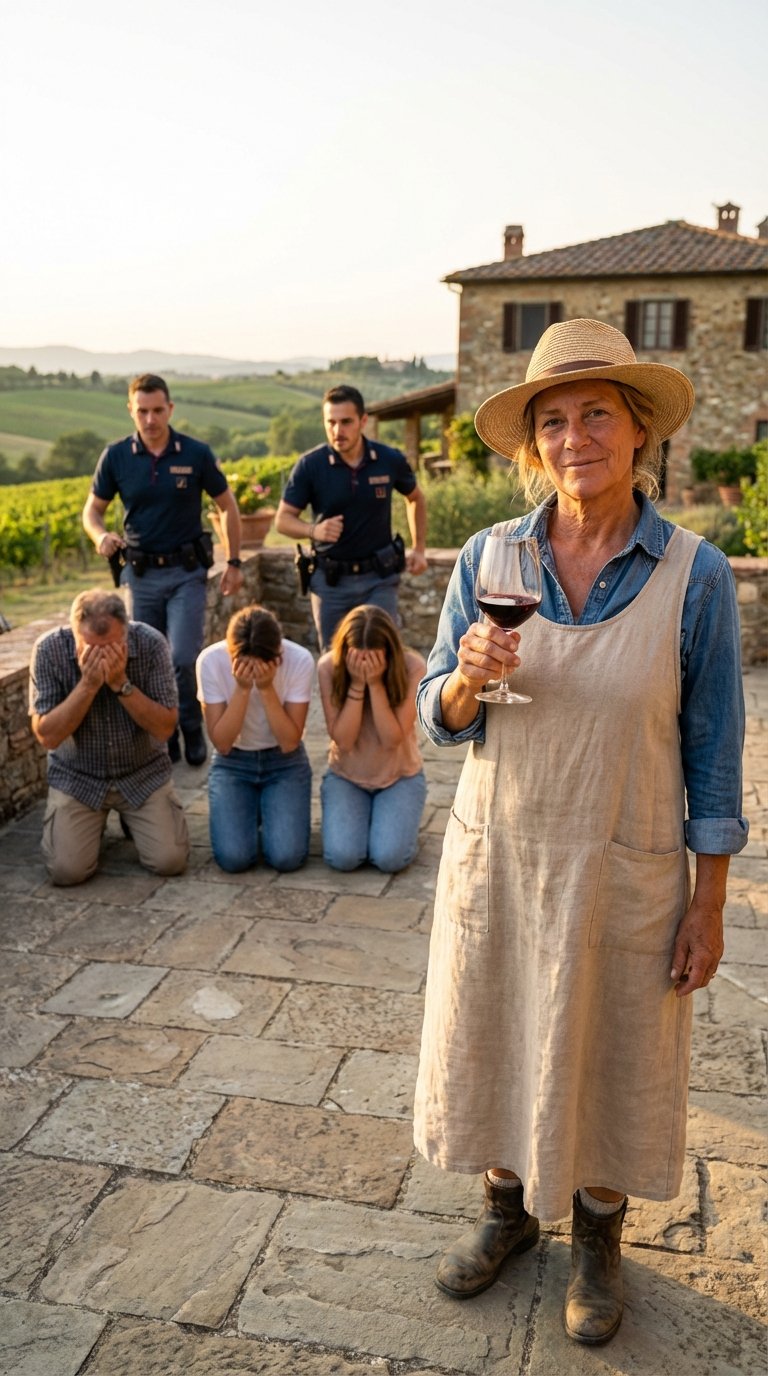
I drove back to the valley. I parked my truck at the top of the ridge, overlooking my land. The sun was setting, threading gold through the rows of green vines.
I’m sixty-nine now.
I still walk my vineyard rows barefoot sometimes, letting the soil stain my heels. I still taste every barrel, still argue lovingly with my vineyard manager about harvest timing, still laugh loudly when tourists ask if I “married into this.”
I tell them gently, “No. I built this.”
And I mean every syllable.
There is a lesson I carry in my bones, one I offer to you now.
If you have built something—a business, a home, a life—there will be people who see it as an inheritance waiting to be claimed, rather than a miracle forged from your spine. Sometimes they will come dressed as lovers. Sometimes as helpers. Sometimes as family.
Guarding what is yours is not bitterness. It is literacy about the world.
Love deeply. Trust thoughtfully. But protect fiercely. And never apologize for safeguarding the empire your younger self nearly broke herself creating.
Because one quiet truth, held close to your chest, may be the difference between losing everything and standing proudly in the place you refused to surrender.
I remarried at sixty. They tried to erase me.
But I am still here. Not as their victim. As their reckoning.
And I am free.