PART 1 — THEY THOUGHT SHE WAS NOBODY
The road was quiet, the kind of quiet that only existed just outside small towns where nothing ever seemed to happen—at least not officially.
Anna Parker rode her motorcycle steadily, the low rumble of the engine blending with the late-afternoon wind. She wore no uniform, no insignia, no jewelry that hinted at status. Just jeans, a plain jacket, and boots that had seen more miles than most patrol cars in the county.

She liked it that way.
Today, she wasn’t a deputy governor. She wasn’t an official. She was just a woman heading to a friend’s wedding, carrying a small gift strapped to the back of her bike and a rare sense of peace she didn’t often allow herself.
She was less than five miles from town when the flashing lights appeared.

Red and blue reflected across the asphalt ahead, cutting through the calm like a warning flare. A temporary police checkpoint blocked the road—cones funneling traffic, two cruisers angled aggressively, officers standing around like they owned the stretch of land beneath their boots.
One of them stepped forward and raised a hand.
Anna slowed, pulled over smoothly, and shut off the engine.

The officer approached slowly, chewing gum, sunglasses perched high on his nose. His name tag read JOHNSON.
“License,” he said sharply. “Where you headed?”
Anna removed her gloves calmly.
“A wedding.”

Johnson looked her up and down—slow, deliberate, invasive. Then he laughed.
“A wedding?” he repeated. “On a bike? No helmet? Little fast too, don’t you think?”
“I wasn’t speeding,” Anna replied evenly. “And my helmet is in the saddlebag.”
Johnson snorted. “Sure it is.”

He circled her motorcycle, tapping his baton against his palm.
“Funny thing about people like you,” he said. “Always in a hurry. Always got an excuse.”
Anna felt the shift instantly. This wasn’t procedure. This wasn’t law enforcement.
This was a man fishing.

“Sir,” she said firmly, “if there’s no violation, I’d like to continue.”
Johnson stopped smiling.
“Oh really?” he said. “You gonna tell us how to do our job now?”
He turned to another officer nearby and smirked.

“She thinks she knows the law.”
A couple of officers chuckled.
Anna’s jaw tightened. She had spent years dealing with people who mistook authority for dominance, but something about Johnson’s tone was darker—more personal.
“I didn’t break any law,” she repeated. “You have no reason to detain me.”
That was when Johnson slapped her.

Hard.
The sound echoed across the road, sharp and humiliating.
“When the police talk,” he snarled, “you shut up and listen.”
For a brief second, the world tilted. Anna tasted blood. Heat flared across her cheek. Rage surged—fast, violent, instinctive.
She could end this immediately.
One call.
One sentence.
But instead… she didn’t.
She steadied herself and looked him straight in the eye.
“Touch me again,” she said quietly, “and you will regret it.”
Johnson’s expression twisted—not with fear, but delight.
“Oh, hear that?” he laughed. “She’s threatening an officer.”
One of the cops grabbed Anna’s arm.
“Come on,” Johnson said. “Get in the car.”
She yanked her arm free.
“Don’t touch me.”
That was the moment things crossed from abuse into something worse.
Johnson’s face hardened. Another officer grabbed her hair and dragged her forward while Johnson raised his baton and brought it down hard against her motorcycle.
Plastic shattered. Metal dented.
“That’s enough, saint girl!” he barked. “Now you’re our toy.”
People driving past slowed. Some stared. Others looked away.
No one stopped.
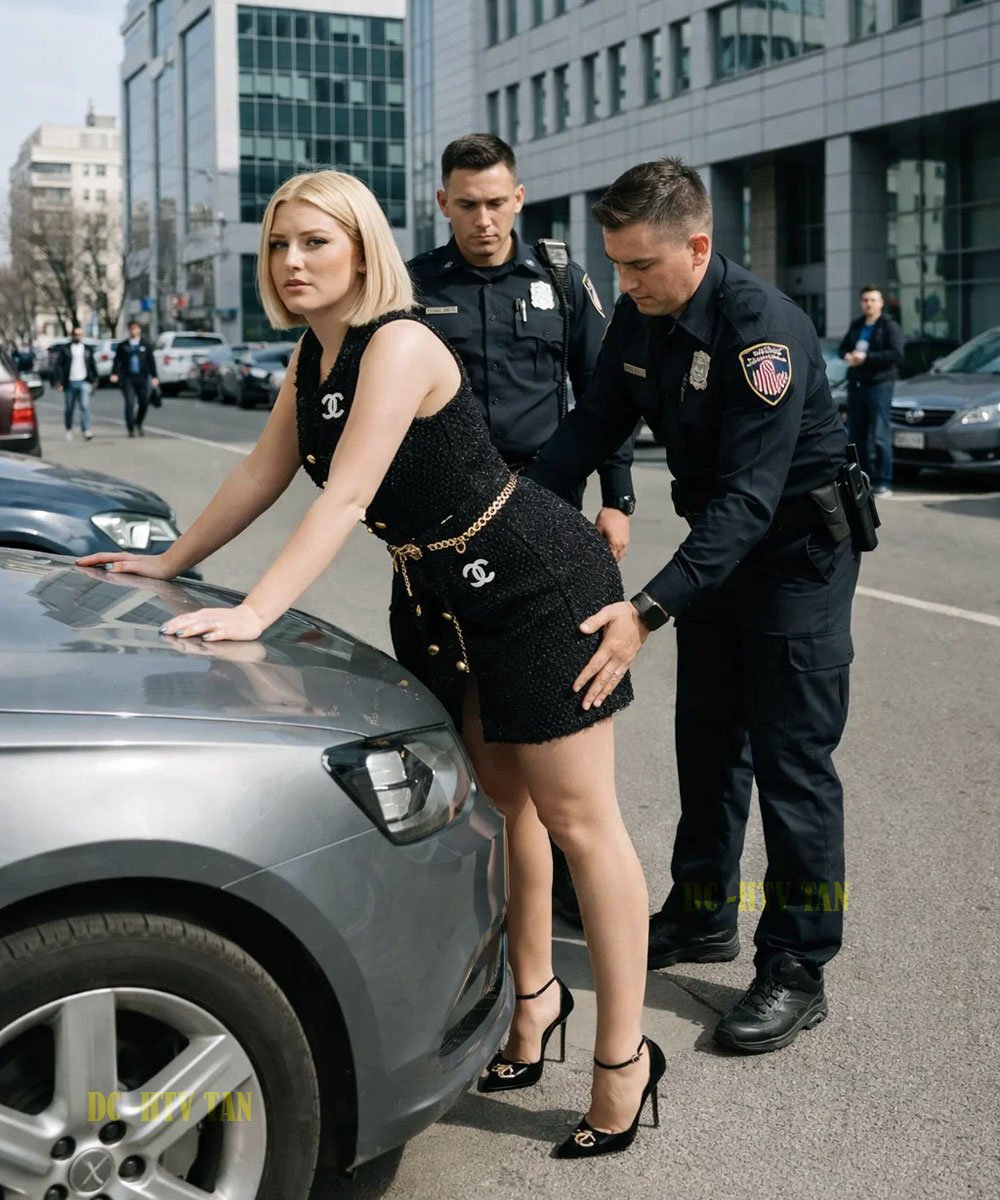
Minutes later, Anna Parker—Deputy Governor of the county—was shoved into the back of a patrol car, wrists aching, cheek burning, motorcycle ruined behind her on the roadside.
She said nothing.
Not yet.
The police station doors slammed open as Johnson dragged her inside.
“Move it!” he shouted. “We got special merchandise today.”
Laughter rippled through the room.
A younger officer leaned over and whispered, “What charges we putting on her, boss?”
Johnson waved a hand carelessly.
“Speeding. No helmet. Maybe theft. Make something up.”
Anna stood straight, eyes cold, watching them fabricate lies with practiced ease.
“You can’t do this,” she said calmly.
Johnson leaned close to her face and grinned.
“Watch us.”
They shoved her into a holding cell—rusted bars, stained concrete, a bench that smelled like old sweat and neglect. The door clanged shut.
For the first time since the checkpoint, Anna exhaled slowly.
Not fear.
Control.
Outside the cell, Johnson laughed with his men, already writing reports that would bury her under charges that never happened.
What he didn’t know was that Anna had already triggered the emergency alert hidden in her watch the moment he struck her.
What he didn’t know was that the Governor was already on the phone.
And what he absolutely did not know—
Was that every second he smiled was bringing him closer to the most humiliating downfall of his life.
PART 2 — A CELL FULL OF LIES
The holding cell door slammed shut with a metallic echo that lingered longer than it should have.
Anna Parker didn’t move.
She stood in the center of the small concrete space, hands relaxed at her sides, breathing slow and measured. The fluorescent light above her flickered, casting uneven shadows across rusted bars and walls carved with years of anger, desperation, and forgotten names.
Outside the cell, Officer Johnson laughed.
“Jesus, you should’ve seen her face,” he said loudly. “Thought she was special or something.”
Another officer snorted. “They always do.”
Anna watched through the bars as they went to work—not on justice, but on paperwork.
Johnson dropped into a chair, boots up on the desk, typing with one hand while sipping coffee with the other. His screen reflected lines of text that rewrote reality in real time.
Time of stop: adjusted.
Speed: exaggerated.
Behavior: “hostile,” “noncompliant,” “aggressive.”
He didn’t even try to hide it.
A younger officer hesitated nearby. “Uh… sir, she didn’t really—”
Johnson cut him off with a look. “You new?”
The officer swallowed. “No, sir.”
“Then you saw what I saw,” Johnson said calmly. “She resisted. She threatened. We acted accordingly.”
The younger officer nodded and walked away.
Anna felt something colder than anger settle in her chest.
This wasn’t one bad cop.
This was a system trained to protect itself.
Johnson stood and walked toward the cell, stopping just inches from the bars. He leaned in close, lowering his voice.
“You should’ve paid the ticket,” he said. “Would’ve been easier.”
Anna met his eyes without blinking.
“You’re not even pretending anymore,” she replied.
He smiled. “Why would I?”
He turned to the booking officer. “Add disorderly conduct. And resisting.”
The officer typed without question.
Anna finally spoke again.
“You’re making a mistake.”
Johnson laughed, louder this time. “You keep saying that.”
He pointed at her face. “You know how many women sit right where you are? All of them think someone important is going to show up.”
He leaned closer.
“No one’s coming.”
Anna said nothing.
But inside, she counted.
Every minute.
Every breath.
Because she knew exactly how long it would take before someone noticed the emergency alert hadn’t been canceled.
And outside that building, phones were already ringing.
THE FIRST CRACK
Twenty minutes later, the station’s front doors opened again.
A man in a plain suit stepped inside, scanning the room with quiet authority. He didn’t wear a badge. He didn’t announce himself.
But the captain on duty straightened instantly.
“Sir,” the captain said, voice tight. “Can I help you?”
The man held up an ID.
State Internal Affairs.
Conversations died mid-sentence.
Johnson looked up from his desk, irritation flashing across his face. “What’s this about?”
The man didn’t answer him.
“I’m here regarding a detention that occurred at approximately 4:12 p.m. on County Route 9,” he said calmly. “Female motorcyclist. Alleged speeding.”
The captain’s eyes flicked to Johnson.
Johnson stood slowly. “That would be my stop.”
“Good,” the agent replied. “I’d like to see the body cam footage.”
Johnson froze.
“Body cam?” he repeated. “Mine malfunctioned.”
The agent nodded slowly. “That’s unfortunate.”
He turned to the captain. “We’ll also need surveillance footage from the holding area. Immediately.”
Johnson’s jaw tightened. “This is ridiculous. She’s just some—”
The agent finally looked directly at him.
“Careful,” he said quietly. “You don’t yet know who she is.”
Anna watched from the cell as the dynamic shifted—subtle, but unmistakable. Voices lowered. Chairs scraped. Someone closed a door.
Johnson glanced toward the cell for the first time with something other than amusement.
“What did you do?” he muttered.
Anna didn’t answer.
She didn’t need to.
THE CALL NO ONE EXPECTED
The captain’s phone rang.
He answered it, listened for three seconds, and went pale.
“Yes, sir,” he said. “Of course. Immediately.”
He hung up slowly.
Everyone waited.
The captain cleared his throat. “Officer Johnson,” he said carefully, “I need you to step away from the desk.”
Johnson scoffed. “Why?”
The captain hesitated.
“Because,” he said, “the Governor is on his way.”
The room went silent.
Johnson laughed once. Sharp. Nervous. “That’s not funny.”
“No one’s joking,” the captain replied.
Anna finally shifted her weight.
Johnson turned toward the cell, eyes narrowing.
“What the hell did you do?” he demanded.
Anna met his gaze calmly.
“I told you,” she said. “You were going to regret it.”
Outside, distant engines could be heard.
Not sirens.
Convoys.
And Officer Johnson felt something he hadn’t felt in years.
Fear.
PART 3 — WHEN THE ROOM CHANGED SIDES
The sound came first.
Engines.
Not sirens. Not rushing. Controlled. Heavy. Deliberate.
Officer Johnson felt it before he fully understood it—the subtle shift in the room, the way officers stopped pretending to work, the way no one laughed anymore. Even the fluorescent lights seemed harsher now, buzzing louder in the silence.
The front doors opened.
Two state troopers entered first, uniforms immaculate, eyes sharp. They didn’t scan the room like visitors. They assessed it like owners.
Behind them walked three men and a woman in dark suits.
No badges displayed.
No introductions given.
The captain stepped forward immediately, posture rigid. “Gentlemen—ma’am—”
The woman raised a hand.
“Where is she?” she asked calmly.
Her voice wasn’t loud. It didn’t need to be.
The captain swallowed and pointed toward the holding cells.
Anna Parker straightened.
Johnson’s breath caught in his throat.
The woman in the suit approached the cell, stopping directly in front of Anna. For a moment, they simply looked at each other.
Then the woman spoke.
“Madam Deputy Governor,” she said clearly, “are you injured?”
The words hit the room like a physical blow.
Every head turned.
Someone dropped a clipboard.
Officer Johnson’s face drained of color.
Anna nodded once. “Yes.”
The woman turned slowly.
“I want every officer who had contact with her today to step forward,” she said. “Now.”
No one moved.
The captain barked, “You heard her!”
Johnson didn’t step forward.
He couldn’t.
The woman looked at him.
“You,” she said, pointing. “Name.”
Johnson opened his mouth.
Nothing came out.
The woman didn’t raise her voice. “Officer Johnson. Badge number 4173. You initiated the stop.”
Johnson’s legs felt weak. “I—yes. But—”
“Did you strike her?” the woman asked.
Johnson glanced around, desperate. “She was noncompliant.”
Anna spoke.
“He slapped me. Unprovoked.”
The woman nodded slightly. “Thank you.”
She turned to the troopers. “Remove his weapon.”
Johnson stumbled back. “You can’t just—”
The trooper was already moving.
Metal scraped. The sound was final.
The woman continued calmly, “Now escort Officer Johnson to Interview Room B. He is not to speak to anyone.”
Johnson tried to protest.
No one listened.
As he was led away, his eyes locked on Anna’s.
For the first time since the checkpoint, she saw it.
Panic.
THE UNRAVELING
Within minutes, the station became a crime scene.
Body cams were seized. Desks searched. Computers locked down. Officers separated and escorted into different rooms.
The younger officer who had hesitated earlier sat shaking, head in his hands.
“I didn’t know,” he whispered. “I swear—I didn’t know who she was.”
Anna watched quietly as the system that had protected Johnson began devouring itself.
The woman in the suit returned to Anna’s cell.
“Medical team is on the way,” she said. “Do you want us to notify your family?”
Anna shook her head. “Notify the Governor.”
The woman nodded. “He’s already en route.”
A flicker of something—respect, maybe—crossed her face.
“You waited,” she said. “You could have stopped this sooner.”
Anna met her gaze. “I needed to know how deep it went.”
The woman exhaled slowly. “You got your answer.”
JOHNSON BREAKS
Through the one-way glass of Interview Room B, Anna watched Officer Johnson unravel.
At first, he tried bluster.
Then denial.
Then anger.
Then fear.
When confronted with synchronized timestamps, altered reports, and video footage that survived deletion, his voice cracked.
“They do it all the time,” he shouted. “This isn’t new!”
The interrogator leaned forward. “Then you won’t mind explaining how.”
Johnson realized too late what he’d said.
Anna turned away.
THE ARRIVAL
The station doors opened again.
This time, no one needed to announce him.
The Governor walked in.
The room stood without being told.
He didn’t look at the officers.
He walked straight to Anna.
“Are you all right?” he asked quietly.
She nodded. “Now I am.”
He turned.
“I want everyone who touched her suspended immediately,” he said. “Pending arrest.”
The captain nodded, pale. “Yes, sir.”
The Governor’s eyes hardened.
“And I want this department frozen. Effective now.”
Anna felt the weight of the moment settle.
Johnson had thought he was untouchable.
He was wrong.
And the worst part?
He still didn’t know what was coming next.
PART 4 — THE UNTOUCHABLE FALLS
Officer Johnson spent the first hour in Interview Room B insisting there had been a misunderstanding.
He sat with his arms crossed, jaw tight, leg bouncing beneath the metal table. He demanded a lawyer. He demanded respect. He demanded to know why “state suits” were storming his station like it was enemy territory.
No one answered him.
Outside the room, the police station no longer felt like his kingdom. It felt like a sealed box, slowly filling with water.
Anna Parker sat in a private office with an ice pack pressed to her cheek, a medical examiner documenting every bruise, every abrasion, every torn strand of hair. She answered questions calmly, precisely, without exaggeration or emotion. Dates. Times. Words spoken. Who touched her. How. Where.
Facts were her weapon now.
The Governor stood near the window, phone pressed to his ear, voice low and controlled. Each call he made sent ripples outward—county commissioners, the state attorney general, internal oversight boards. This was no longer about one corrupt officer. This was about whether the system would protect itself or finally correct itself.
And it was being watched.
By midnight, the story was already leaking.
Not her name.
Not yet.
But whispers moved faster than official statements ever could.
State oversight at Brookhaven PD.
Multiple officers detained.
Serious misconduct under investigation.
Inside the station, officers sat separated in rooms, some angry, some pale, some quietly realizing their silence over the years had finally come due.
THE MOMENT JOHNSON REALIZED
The door to Interview Room B opened again.
This time, Officer Johnson straightened.
He recognized the man who walked in—not by name, but by presence. A federal prosecutor. Calm. Unhurried. The kind of person who never entered a room without already knowing how it would end.
Johnson smirked weakly. “Finally. Took you long enough.”
The prosecutor set a thick folder on the table and opened it.
“Let’s skip ahead,” he said. “You assaulted a woman during a traffic stop. You falsified reports. You destroyed private property. You illegally detained her.”
Johnson scoffed. “That’s your version.”
The prosecutor slid a tablet across the table.
“Body cam footage,” he said. “From a civilian vehicle stopped behind you. Audio is clear.”
Johnson’s smirk vanished.
The prosecutor didn’t stop.
“Station surveillance footage. Booking logs altered after the fact. Text messages between you and other officers coordinating false statements.”
Johnson’s breathing quickened.
“And finally,” the prosecutor said, voice still flat, “assault of a public official.”
Johnson laughed once, high and brittle. “You can’t prove that.”
The prosecutor leaned forward slightly.
“She’s the Deputy Governor.”
Silence.
Pure. Absolute. Crushing.
Johnson’s mouth opened.
Closed.
His face went gray.
“No,” he whispered. “No, that’s not—she didn’t—”
“You slapped her,” the prosecutor said. “In public. On camera.”
Johnson’s shoulders slumped for the first time.
“This… this isn’t fair,” he muttered.
The prosecutor raised an eyebrow. “Fair?”
He stood.
“This is overdue.”
THE PUBLIC COLLAPSE
By morning, Brookhaven woke up to chaos.
Squad cars sat idle behind yellow tape. Officers were escorted out in silence. The station doors were locked under state authority.
A press conference was called.
The Governor stood at the podium, Anna Parker beside him. She wore a simple coat. No makeup to hide the bruise on her cheek.
Cameras flashed.
The Governor spoke first.
“Yesterday, a member of my administration was assaulted, detained, and framed by officers sworn to protect the public.”
A murmur rippled through the crowd.
He continued.
“This is not about one individual. This is about a culture that believed power meant immunity.”
He gestured slightly toward Anna.
“She chose not to reveal who she was until she understood how far abuse would go when unchecked. What she found was unacceptable.”
Reporters shouted questions.
“Was the officer aware of her position?”
“Is this political retaliation?”
“How deep does this go?”
Anna stepped forward.
Her voice was steady.
“I didn’t speak up immediately because this doesn’t only happen to people with titles,” she said. “It happens to ordinary citizens every day. And most of them don’t get to stand here afterward.”
The room went quiet.
“I wanted to see what would happen if I were treated like nobody,” she continued. “And I did.”
No applause followed.
Something heavier filled the air instead.
Truth.
THE SENTENCING
Officer Johnson was denied bail.
Charges stacked quickly—assault, kidnapping, falsification of records, destruction of evidence, civil rights violations.
Former colleagues testified against him.
Some cried.
Some stayed cold.
No one defended him.
When the judge finally spoke at sentencing months later, Johnson stood in shackles, a shell of the man who once laughed at a woman behind bars.
“You believed your badge made you untouchable,” the judge said. “Instead, it documented your crimes.”
The sentence echoed through the courtroom.
Decades.
Johnson screamed.
No one listened.
AFTERMATH
Brookhaven PD was dissolved and rebuilt under state supervision. Policies changed. Oversight was no longer optional. Body cams became mandatory and externally archived.
Anna Parker returned to her work quietly.
She never mentioned the wedding she missed.
She never spoke publicly again about the slap.
But sometimes, when she rode her motorcycle through small towns and quiet roads, she noticed something different.
Officers stood straighter.
Hands stayed visible.
Voices stayed respectful.
Because power doesn’t vanish when exposed.
It changes shape.
And Officer Johnson learned—too late—that some women don’t need to announce who they are to end a career.
They just need to let the truth run its course.
THE END