Mrs. Harrison had heard the sentence before the way every parent fears it most—calm, rehearsed, and completely disconnected from what it was doing to her child.
“Grace’s behavior was unacceptable.”
Her daughter sat beside her, only fourteen years old, small in a chair that suddenly felt too big for her shoulders. Her eyes were red, not from defiance, but from holding back everything she couldn’t safely say out loud.
The teacher continued speaking, careful and formal, trying to frame the situation as discipline rather than pain. But what no one in that office seemed to understand was that this wasn’t just about behavior.
It was about loss.
Grace’s father had been a Marine. A real one. The kind of man who didn’t come home because he chose something bigger than himself. She had been three years old when the door closed on that part of her life forever.
And yet, in a school hallway full of teenagers who didn’t know her story, someone had decided to turn that loss into a joke.
A careless sentence. A laugh. A moment that should have meant nothing.
But it meant everything.
Because for Grace, it wasn’t just a comment.
It was her father being erased again.
And something inside her broke.

She stood up so quickly her chair hit the floor behind her.
Her voice trembled, but it didn’t hesitate.
“My dad was a HERO. Don’t you ever talk about him like that again.”
That was it.
No violence. No threat. Just grief, loyalty, and a child refusing to let her father be reduced to nothing.
But the system didn’t see it that way.
She was sent to detention.
That night, the house was quiet in a way that felt heavy. The kind of silence that settles after a storm, when everyone is too tired to speak.
Grace sat on the floor in her father’s old sweatshirt. It was too big for her now, but she wore it like armor. Like if she held onto it long enough, she could still feel him nearby.
“I’m sorry I got in trouble,” she whispered. “I just couldn’t let her say that about him.”
Her mother didn’t answer right away. Because some pain doesn’t need correction. It needs witnessing.
And in that moment, she understood something important:
Grace hadn’t misbehaved.
She had defended something sacred.
The next morning started like any other school day.
Until it didn’t.
An emergency assembly was called. Teachers were confused. Students were restless. Nothing in the announcement explained what was coming.
Then Grace sent a message from the auditorium.
A few seconds later, her mother’s phone rang.
Her voice was shaking.
“Mom… you need to come.”
And then, before anything else could be explained, another sentence followed—different, strange, almost unreal.
“Four men in uniform just walked into the school.”
By the time she arrived, the entire building felt different.
The auditorium doors opened, and silence hit her immediately.
Not the normal quiet of a school assembly.
Something deeper.
Something waiting.
Eight hundred students sat frozen in their seats. Teachers stood still along the edges of the room like they weren’t sure whether to move or breathe.
And then she saw them.
Four Marines in perfect Dress Blues walking down the center aisle.
Crisp uniforms. Controlled steps. Presence that didn’t need introduction.
And at the front—
Staff Sergeant Miller.
Her late husband’s closest friend.
The man she had called the night before without expecting anything more than comfort.
But he hadn’t come to talk.
He had come to answer.
He stepped to the microphone without hesitation.
No permission needed.
No uncertainty in his voice.
“We were informed that a student in this school was punished for defending the honor of a fallen United States Marine.”
The words landed differently than anything else that had been said in that building all year.
The teacher who had issued the detention suddenly couldn’t look up.
The principal stood frozen.
And every student in that room felt it—
this wasn’t a lecture anymore.
It was something else.
Something heavier.
Something true.

“Where is Grace Harrison?” Miller asked.
And for a moment, no one moved.
Then Grace stood.
Slowly.
In her father’s sweatshirt.
And the entire room watched her walk down the aisle as four Marines stepped into formation behind her.
Not to intimidate.
But to stand with her.
When they reached the front, Staff Sergeant Miller turned back to the room.
And what he said next changed everything.
“Captain Mark Harrison didn’t abandon anyone. He died pulling wounded men from a burning transport under fire.”
A pause.
“I know. Because I was one of them.”
The silence that followed wasn’t awkward.
It was absolute.
The kind of silence that doesn’t come from discipline.
It comes from realization.
Miller turned to Grace, his voice softening for the first time.
He knelt.
And from his pocket, he pulled out a small velvet box.
Inside was a Challenge Coin.
He placed it into her hand.
“Your father was the bravest man I ever knew,” he said quietly. “And you stood your ground just like he would have.”
Then, one by one, all four Marines raised their hands in a sharp, synchronized salute.
To a fourteen-year-old girl.
Not because she demanded respect.
But because she had earned it through something far deeper than words.
And then something unexpected happened.
A student stood up.
Then another.
Then the entire auditorium.
Applause filled the room—first uncertain, then overwhelming, then impossible to ignore.
Even the teachers stood.
Even the principal.
Because in that moment, everyone understood something they hadn’t understood before:
This wasn’t about punishment.
It was about memory.
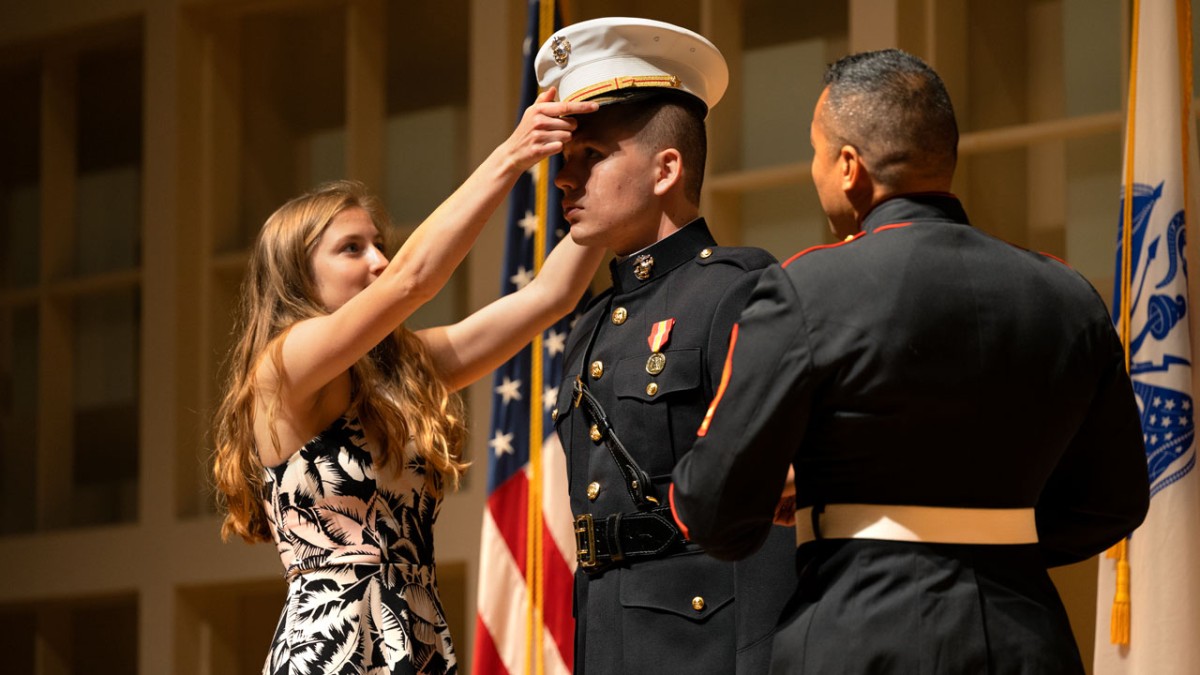
Later, in the hallway, apologies came quickly—too late, but sincere.
The detention was removed.
The incident was reviewed.
But none of that mattered anymore.
Because Grace wasn’t standing there as a student who got in trouble.
She was standing there as something else entirely.
A daughter carrying a legacy bigger than the room around her.
She squeezed the coin in her hand and looked at the men who had known her father not as a memory—but as a man who had saved their lives.
And in that moment, no explanation was needed.
Because some truths don’t need permission to exist.
They only need to be remembered.