But sometimes, something slips through the structure. Not a mistake in writing, not a technical failure—but a human reaction that refuses to stay inside the boundaries of the script.
And that is exactly what happened in this moment between Carol Burnett and Tim Conway on The Carol Burnett Show.
A moment that began as a simple scene… and ended as something no one in the room could ever fully control again.

A SCENE BUILT ON CONTROL AND EXPECTATION
Before anything went wrong, everything was exactly where it was supposed to be.
The set was prepared. The timing was locked. The performers knew their positions, their cues, their rhythm. This was the kind of comedy built on discipline—where every pause, every glance, every movement mattered.
Tim Conway was known for this kind of environment. He could hold a straight face longer than almost anyone in the room. He understood timing not as chaos, but as structure.
Nothing about the setup suggested collapse.
And yet, collapse was already waiting—quietly, invisibly—just outside the frame.
Because comedy, especially live or semi-live sketch comedy, is never just about lines. It is about pressure. And pressure does not always show itself immediately.
It waits for the smallest crack.
THE MOMENT CAROL BURNETT ENTERED THE FRAME
Then she stepped in.
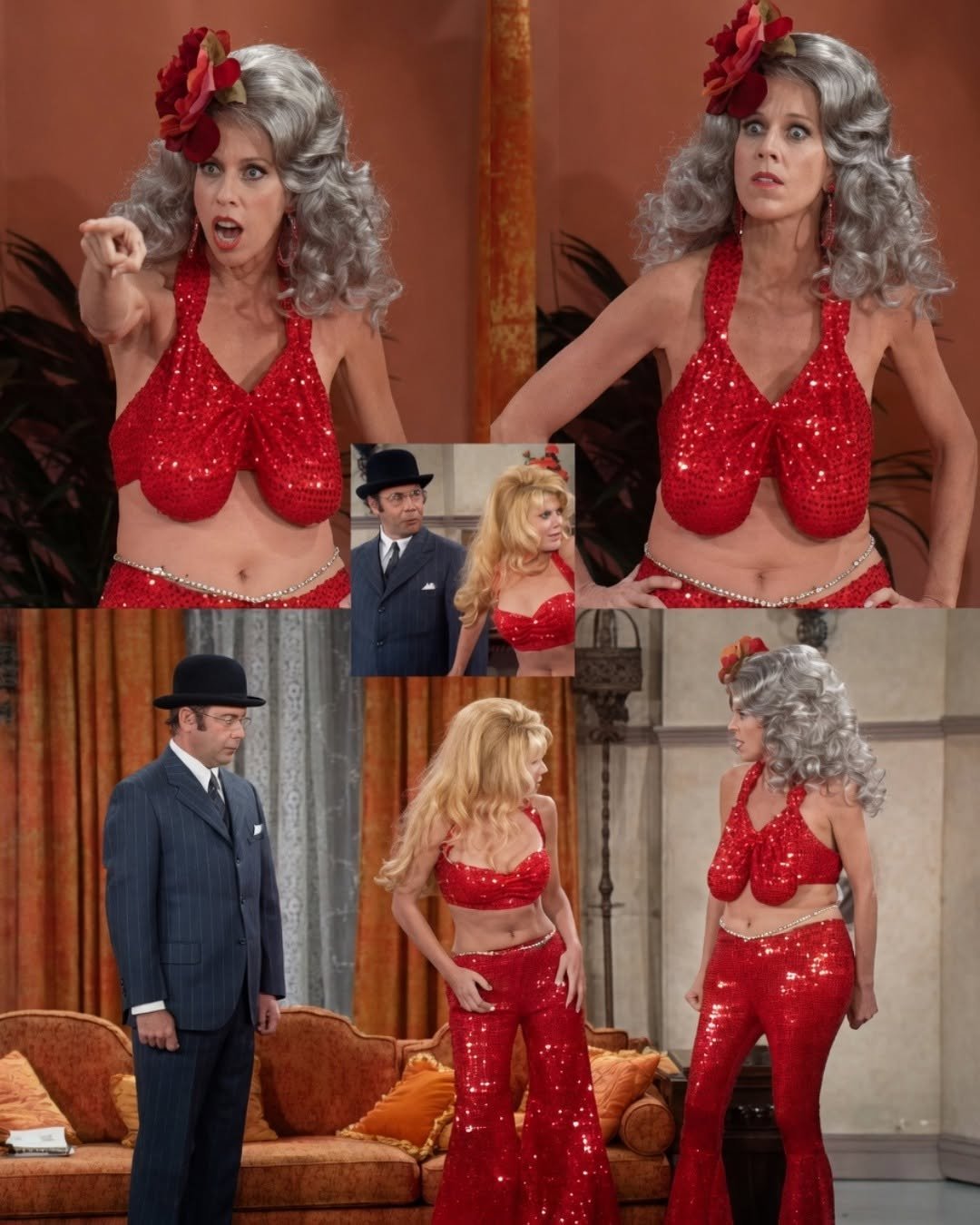
Carol Burnett did not need dialogue to change the atmosphere. Her presence alone was enough to shift attention in the room. But on this day, it wasn’t just presence—it was visual impact.
The outfit she wore was bright, exaggerated, and completely impossible to ignore. It didn’t blend into the scene. It dominated it. It pulled focus without asking permission.
And in comedy, focus is everything.
The moment she appeared, the entire rhythm of the sketch subtly changed. Not officially. Not in the script. But in the air.
Even the audience could feel it before anything was said.
Because suddenly, the scene was no longer balanced.
It was leaning.
And everyone could sense it.

THE FIRST SIGN THAT CONTROL WAS SLIPPING
Tim Conway tried to stay inside the structure.
You can see it in the way he holds himself. The deliberate stillness. The careful avoidance of eye contact. The attempt to treat everything as normal, even when it clearly isn’t.
This is where the brilliance of professional comedy becomes visible—not in the punchline, but in the effort to resist it.
Because once something unexpected enters a controlled scene, the first battle is never laughter.
It is restraint.
And restraint always loses slowly.
It begins with a pause that is slightly too long. A breath that is slightly too sharp. A hesitation that no one would notice unless they were looking for it.
But it is there.
And it is growing.
THE LOOK THAT BROKE EVERYTHING OPEN
Then came the moment that changed the entire direction of the sketch.
A look.
Not a dramatic gesture. Not a physical joke. Just a glance—small, precise, almost accidental.
But it landed at exactly the wrong time… or the right time, depending on how you see comedy.
Because in that instant, something inside Tim Conway cracked.
It wasn’t loud. It wasn’t immediate explosion.
It was worse.
It was recognition.
The kind of recognition that tells a performer: this is no longer under control.
And once that realization arrives, the body reacts before the mind can intervene.

WHEN THE SCRIPT STOPPED MATTERING
The first sign was a smile that should not have been there.
Then a pause that tried to erase it.
Then the failure to erase it.
What followed was not acting anymore.
It was survival.
Tim Conway attempting to hold a straight face became part of the comedy itself. Every effort to stay serious made the situation more unstable. Every second of resistance created more tension. And tension always needs release.
Carol Burnett didn’t even need to push further.
The outfit had already done its job.
The moment had already tilted.
Now it was only a matter of time.
THE TRANSFORMATION FROM PERFORMANCE TO REALITY
And then it happened.
Laughter.
Not scripted. Not planned. Not controlled.
The kind of laughter that doesn’t belong to characters anymore—but to people who have lost the ability to remain inside them.
The sketch collapsed completely, not into failure, but into something far more powerful: shared human reaction.
The Carol Burnett Show became legendary precisely because of moments like this—where structure gave way to something unpredictable and completely real.
Because when comedy stops being performed and starts being experienced, it becomes something else entirely.
It becomes memory.
WHY THE MOMENT STILL LIVES ON
Decades later, this moment is still watched, clipped, shared, and studied—not because it went according to plan, but because it didn’t.
People don’t return to it for perfection.
They return to it for truth.
Because what you see is not just a sketch breaking down. You see two of the greatest comedic performers of their time losing control in the most human way possible.
You see discipline collide with instinct.
You see professionalism collide with joy.
And you see the exact moment when performance stops being enough.
THE QUESTION THAT NEVER EXPIRES
So every time the clip is replayed, the same question quietly returns:
Was it really just an accident?
Or was it something deeper—an understanding between performers so experienced that even “losing it” becomes part of the art?
Because one thing is certain.
Once that outfit entered the scene…
nothing after it was ever going to stay the same.