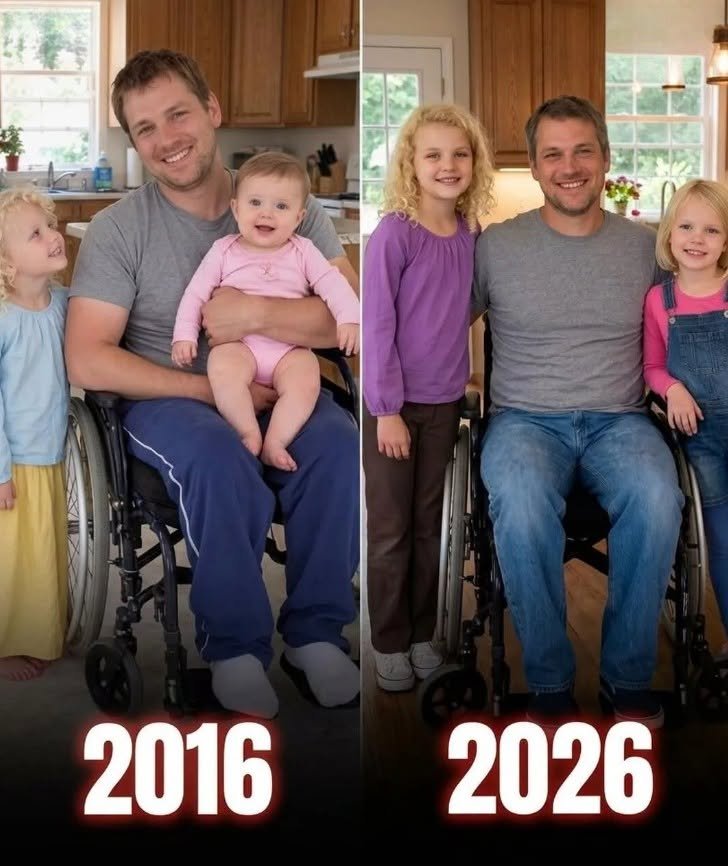
Katherine stood on my porch in a faded gray coat, asking for help as though ten silent years could be explained in a single conversation. My daughters, thirteen-year-old Greta and ten-year-old Amelia, remained beside me in the doorway, studying the woman they knew mostly from old photographs. Katherine’s eyes dropped toward my wheelchair, and for a moment she looked exactly as she had on the night she walked away. She explained that her second husband had disappeared, leaving unpaid loans, credit-card balances, and business debts in her name. Her house had been taken, her savings were gone, and she needed money for rent, groceries, and a security deposit. I told her I would help—but first, she needed to face the two people whose childhood she had abandoned.
Ten years earlier, I had returned from rehabilitation only eleven days before Katherine packed her suitcase. Greta was three, Amelia was six months old and running a fever, and I was still learning how to move safely from my bed into the wheelchair. Katherine placed the baby in my arms and told me she had never agreed to become my nurse. She left us with $18,000 in medical bills, a $1,250 monthly mortgage, and less than $400 in our checking account. I eventually found remote bookkeeping work, negotiated the insurance expenses, and raised both girls while attending therapy and keeping our small home. Katherine never sent birthday cards, child support, or even a message asking whether the girls were healthy. Now she sat at our dinner table, trying to recover a decade of missed birthdays through careful questions and uncomfortable small talk.
After dinner, I removed a battered children’s book called The Adventures of Little Fox from the shelf. Katherine recognized it immediately because she had purchased it before Greta was born, planning to read it to both children. She did not know that I had filled every margin with memories—their first steps, lost teeth, school concerts, nightmares, illnesses, and questions about why their mother had left. One note described Greta calling for Katherine during a fever; another recorded Amelia learning to tie her shoes after forty determined minutes. Katherine’s hands began to tremble as she read the years she had missed, squeezed between illustrations and faded pages. Then I placed the book in her lap and told her what she had to do before I would open the envelope containing the help she had requested.
Katherine read the entire bedtime story aloud while the girls watched her face instead of the pictures. When she finished, Amelia quietly said that she finally knew what her mother’s bedtime voice sounded like, and Katherine could no longer hold back her tears. The girls asked whether she had remembered their birthdays, kept their photographs, or ever truly planned to return, and for once she answered honestly instead of blaming my accident or her failed marriage. Later, I gave her enough money for three months in a modest apartment, along with groceries and a deposit, but no access to my investment accounts or estate. My attorney had already protected the girls through updated court documents, a revised will, and an education trust separate from my mortgage and insurance obligations. I explained that compassion did not erase accountability, nor did financial help purchase forgiveness. Katherine finally understood that the largest debt she owed could not be measured in dollars.
At the door, Amelia removed the old storybook from the shelf and placed it in Katherine’s hands. I assumed she wanted her mother to have something by which to remember them, but Greta gently corrected me. “She can finish reading it,” she said, leaving open the possibility of future pages without promising an easy reunion. Katherine walked toward her car clutching the taped book against her chest, while the girls returned to the living room and chose a new story for us to begin. We did not pretend the past had been repaired, and no one offered forgiveness before they were ready. But that evening, Katherine finally listened to the childhood she had missed—and my daughters learned that kindness can be offered without surrendering the boundaries that kept us safe.