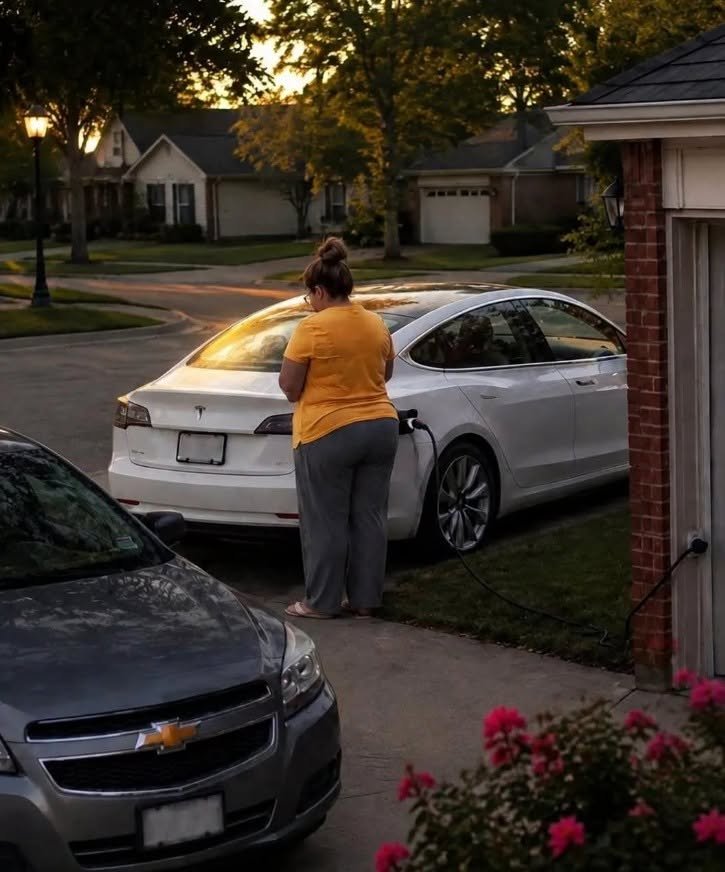
The electric bill shook slightly in my hand as I stared at the total: $227, nearly twice what I normally paid. At sixty-four, living alone in the same suburban house for thirty-two years, my routine was predictable enough that such a jump made no sense. I checked the meter, called my daughter Diane, and even wondered whether an aging appliance was responsible. Then I looked across the fence at Monica, my thirty-something neighbor, and her shiny white Tesla parked unusually close to my garage. Monica had already developed a habit of treating other people’s belongings casually—my lawn mower had once disappeared for a week, and a garden gnome my late husband bought me had somehow ended up beside her front steps. I had always told myself to keep the peace, but that electric bill told me something had changed.
Several nights later, unable to sleep, I heard a faint humming outside my bedroom window. When I looked down, Monica’s Tesla was parked beside my property line, with a thick charging cable running directly into the outdoor outlet on my garage. I stepped outside and asked what she was doing, expecting embarrassment or at least an apology. Instead, Monica shrugged and said I lived alone and probably didn’t need much electricity anyway. When I mentioned my doubled bill, she offered me ten dollars and acted as though I were making too much of it. I calmly told her to disconnect the car and watched her leave, but when I returned to my kitchen, I knew staying silent was no longer an option—and this time, I had a plan she wouldn’t expect.
The next morning, I retrieved my old garden gnome from Monica’s flower bed and placed it beside my garage outlet as a very visible reminder that the property belonged to me. More importantly, I contacted an electrician about securing the exterior outlet and began documenting every unusual charge and incident. Diane suggested I keep copies in case I needed an attorney, an insurance claim, or evidence for court, advice that suddenly seemed far less dramatic than it once would have. I reviewed my utility statements alongside my mortgage paperwork, household expenses, retirement investment records, and estate documents so I could clearly separate normal costs from the unexplained increase. When Monica returned that night with her charging cable, several neighbors were outside, including Frank, who revealed she had also borrowed his ladder without permission. Monica tried to dismiss everything as a misunderstanding, but the pattern was becoming difficult to explain away.
Two weeks later, Monica’s landlord, Mr. Alvarez, stopped by my house after hearing what had happened. He explained that he had inspected the property and discovered unpaid utility balances, unreported damage, and unauthorized repairs; with her lease ending soon, he had already decided not to renew it. A month later, I watched quietly from my porch as Monica loaded the last boxes into a moving truck. My electricity bill had returned to normal, the outdoor outlet was secured, and my little gnome stood beside the mailbox where my husband had originally placed him years ago. I never felt triumphant watching Monica leave, only relieved that I had finally understood something my husband used to remind me of: kindness does not require accepting every boundary someone chooses to cross.