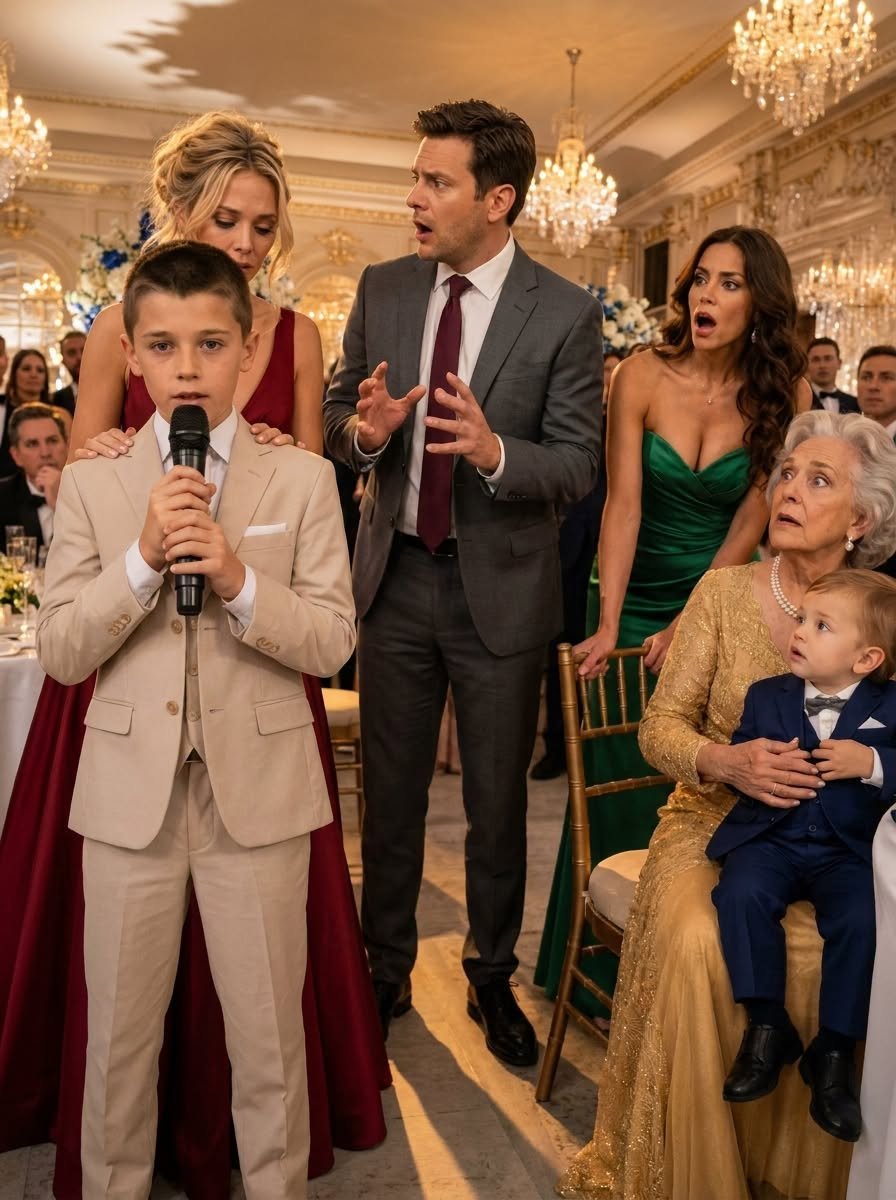
Joe Vance chose his mother’s seventy-fifth birthday party to announce the end of our marriage. More than a hundred guests filled the country-club ballroom when he walked in beside a younger woman named Tracy and a three-year-old boy, then introduced the child as his son. His mother, Eleanor, opened her arms to Leo with a warmth she had rarely shown our ten-year-old son, Tommy, whose childhood had been shaped by serious respiratory problems. Joe turned to me and said I no longer belonged there, that I should sign the divorce papers, leave the house, and make no trouble over the company shares I owned independently. I was about to answer when Tommy stepped onto the stage, took the microphone, and said, “I want to thank you for taking my dad off our hands.” Then he pulled a black USB drive from his blazer and announced that he had copied everything from the secret phone Joe thought no one had found.
Three days earlier, I had discovered that burner phone hidden in Joe’s study. It contained messages documenting the affair, payments to Tracy, photos of Leo, and evidence suggesting Joe had been preparing to pressure me into surrendering the minority stake in Vance Global that my late father-in-law had left me for years of work in public relations, partnerships, and crisis management. What I did not know was that Tommy had found even more. On the USB were emails showing Joe discussing ways to make me appear unstable, along with an audio recording of Joe and Eleanor planning the public confrontation. Eleanor’s voice was unmistakable: if I would not sign away the shares voluntarily, Joe should use Tommy and the spectacle of a public breakdown to undermine my standing with the company board and strengthen his position in a custody dispute. Their plan depended on me becoming emotional in front of witnesses. Instead, my son exposed the plan before I ever raised my voice.
The following morning, my attorneys reviewed the files and confirmed that the divorce would involve far more than adultery. It was a high-net-worth marital dispute involving independently held corporate equity, questionable transfers, potential misuse of company funds, custody considerations, and documented evidence that Joe had attempted to manufacture leverage against me. I moved with Tommy to my parents’ house, routed all communication through counsel, and placed him with a child psychologist because I refused to let the legal battle turn him into another piece of evidence. That decision mattered more than any asset. Tommy had already absorbed years of Eleanor treating his health problems as weakness and Leo as the “proper” grandson the Vance name deserved. During therapy, he drew a house with two separate doors and placed himself alone between them. I realized then that while the adults were fighting over property and control, he was fighting not to feel forced to choose between his parents.
The divorce took nearly a year of audits, depositions, custody evaluations, and negotiations. I retained my independently owned Vance Global shares and separate assets, and I received primary physical custody of Tommy while Joe was given structured visitation combined with family counseling. At the first monitored visit, Joe arrived carrying expensive gaming equipment, but Tommy ignored it and asked the only question that mattered: why had his father brought Leo to the party as though one child were more valuable than another? Joe struggled to answer. Tracy later left him and took Leo back to her hometown, saying she wanted no part of Eleanor turning another child into an “heir.” Even after the decree became final, I did not celebrate Joe’s losses. I told him that if he missed Tommy, he should do the long, unglamorous work of becoming a father his son could trust again. The court settlement gave me legal breathing room; the harder work was teaching Tommy that he was allowed to love his father, resent him, forgive him someday, or never forgive him at all without betraying me.
Years later, Tommy grew healthier, learned piano, and eventually studied child psychology because he wanted to help families stop repeating the patterns that had damaged ours. Eleanor apologized in writing and slowly earned limited contact under boundaries Tommy set himself. Joe improved too, not dramatically, but in smaller ways—showing up alone, listening instead of performing, apologizing without adding an excuse. I remained on the Vance Global board and helped establish a foundation supporting pediatric respiratory-health research, turning part of the life that once diminished my son into work that honored him. At Tommy’s college graduation, he asked Joe and me to stand together for one photograph. We were not pretending to be a whole family again. We were simply three people acknowledging the truth of what had happened without allowing it to define every future moment. Looking back, the thing I regret most is that my ten-year-old ever felt he had to grab a microphone and save me. The life I built afterward was designed around one promise: he would never have to do it again.