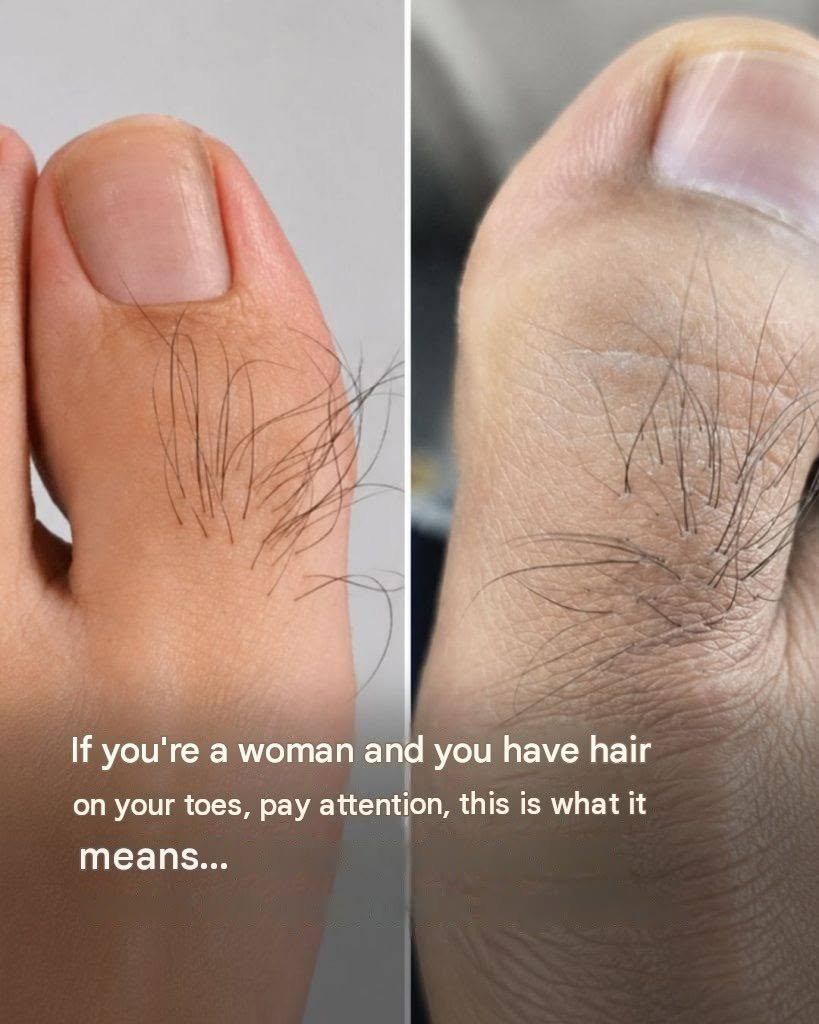
It might seem like a completely insignificant detail. Some women have quite a bit of hair on their toes; others have just a few fine hairs, and some have practically none. We usually think it’s simply a matter of genetics or aesthetics. And often, that’s exactly what it is. However, a noticeable change in hair growth on the feet and legs can also be among the signs that professionals look for when evaluating blood circulation.
Join causes
The key lies in one word: change. Having little body hair
doesn’t automatically
mean there’s a circulatory problem. The amount of body hair varies greatly from person to person due to individual factors. What warrants more attention is when hair that previously grew normally begins to disappear or grows much more slowly, especially if this occurs along with cold feet, changes in skin color, slow-healing wounds, slow-growing nails, or leg pain when walking. These characteristics can appear in peripheral arterial disease, known as PAD.
Hair Care
Why do we have hair on our toes?
The human body contains hair
follicles in numerous areas
of the skin, and the toes are no exception.
In some people, hair is dark and clearly visible. In others, it is so fine and light that it can barely be seen.
That’s why there is no “correct” amount of hair that all women should have.
A person who has never had visible hair on their toes should not look at their feet and immediately conclude that they have poor circulation.
What is truly important is to observe the set of
signs and, above all, the changes that appear over
time.
What is the relationship between body hair and circulation?
In order to grow normally, the tissues of the legs and feet need to receive blood with oxygen and nutrients.
When the arteries that carry blood to the lower limbs narrow considerably, the flow can decrease.
One of the diseases related to this situation is peripheral arterial disease.
The American Heart Association explains that PAD occurs when peripheral arteries narrow or become blocked,
reducing blood flow to certain parts of the body; the most common form affects the
legs and feet.
When the circulatory problem becomes significant, changes in the skin and its structures may begin to be observed.
These include the decrease or loss of leg hair.
The U.S. National Heart, Lung, and Blood Institute notes that among the possible symptoms of peripheral artery disease, leg hair may stop growing and toenails may also grow more slowly.
MedlinePlus is even more specific in including hair loss
on legs, feet, and toes among the findings that may occur when peripheral artery disease is more advanced.
That explains
why observing feet can provide clues.
But a clue is not a diagnosis.
Not having hair on your fingers does NOT automatically mean you have a blocked artery
This clarification is fundamental.
It would be incorrect to state:
“If you don’t have hair on your toes, you have poor circulation.”
A person can have very little body hair naturally.
You can
also remove it by shaving, waxing, laser hair removal, or other procedures.
Hair density and visibility also vary between individuals.
Therefore, the isolated absence of hair does not allow
for the diagnosis of peripheral arterial disease.
Doctors evaluate medical history, risk factors, symptoms, leg pulses, and specific tests before establishing a diagnosis.
What may be most relevant is noticing that the hair gradually disappears in an area where it previously grew normally, and that other changes also appear.
Sign number 1: one leg or
foot is colder than the other
Touch both feet.
You don’t need to be alarmed if you feel slightly different after sleeping in a certain position or being exposed to air conditioning.
But a persistent difference may warrant attention.
Both the NHLBI and the American Heart Association include a lower temperature in one foot or leg compared to the other among the possible manifestations of reduced blood flow.
When you also notice hair loss, changes in your nails, or discomfort when walking, the
whole becomes more important than any of those signs separately.
Sign number 2: Leg pain when you walk
This is one of the classic characteristics of peripheral arterial disease.
It may feel like:
Cramps.
Heaviness.
Burning.
Pain.
Tiredness in
the legs.
Discomfort in calves, thighs, buttocks or ankles.
The characteristic feature is that it appears when walking, climbing stairs, or exercising and improves after resting. This phenomenon is known as intermittent claudication.
Why does this happen?
When you are
at rest, your muscles need relatively little blood.
When you start walking, they need much more.
If an artery is sufficiently narrowed, it may not increase the flow as needed, and then discomfort appears.
Not everyone with peripheral artery disease experiences the typical pain when walking. Some have different symptoms,