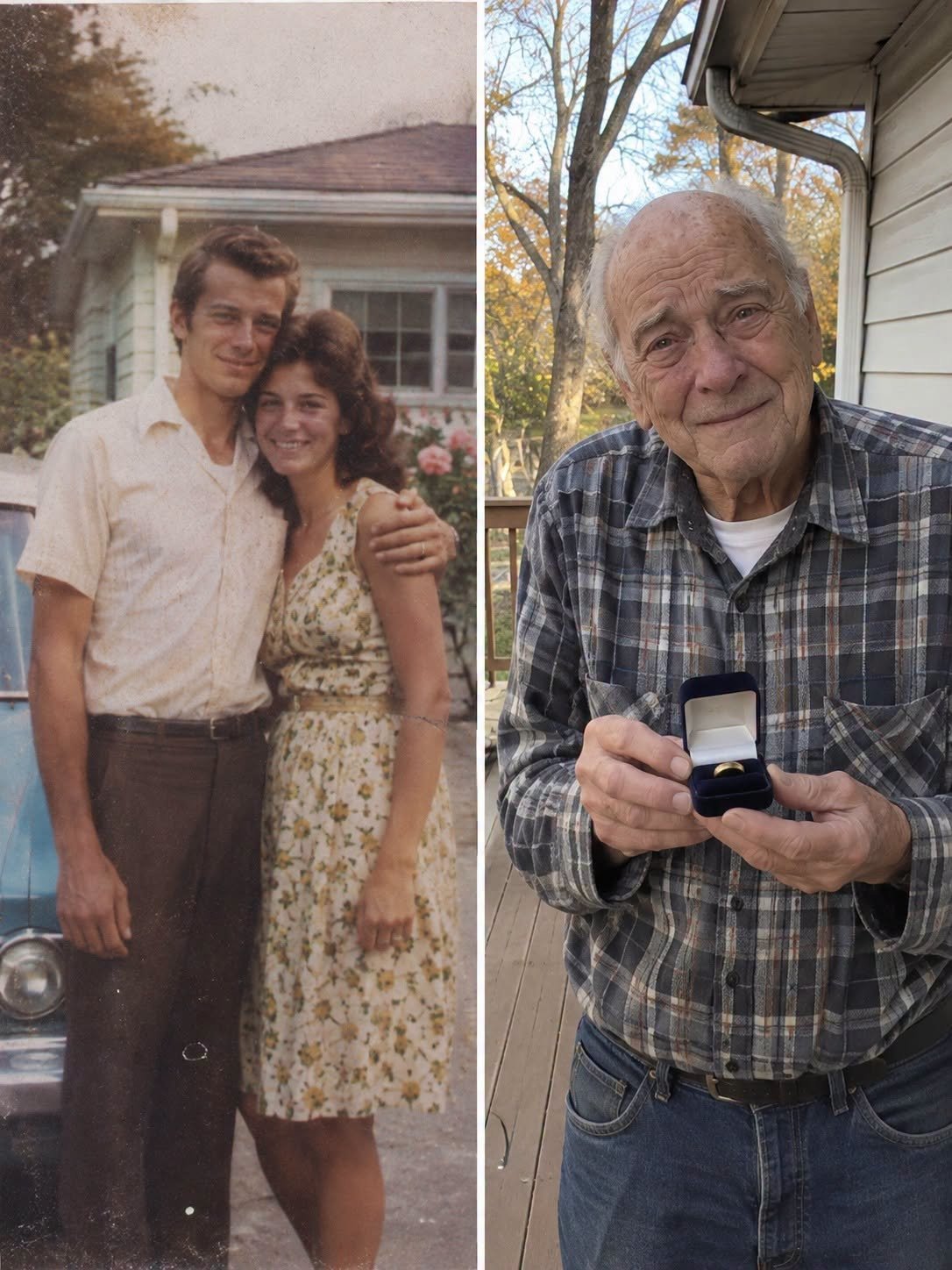
The stranger placed a small blue box on the table between Isobel’s red carnations and her untouched coffee.
It was an ordinary cardboard box, slightly worn from years of storage. Yet the man who had brought it seemed to understand that its contents were important.
“I made someone a promise,” he said quietly. “He wanted this to reach you.”
Isobel looked up at him and immediately noticed something familiar. His blue eyes, crooked smile, and small dimple reminded her of Benjamin, the young man she had loved more than six decades earlier.
“Who are you?” she asked.
Before he could answer, her niece Wren entered the coffee shop. One look at the box told Isobel that Wren knew more than she had explained.
The stranger introduced himself as Edward. Then he shared something Isobel had never expected to hear.
“Benjamin was my father.”
For most of her life, Isobel had believed Benjamin had never returned from military service. They had met as teenagers, shared dreams of building a home together, and exchanged a simple silver promise ring before he left.
He had promised to return.
But after months without reliable news, his family received information that he was missing and later presumed deceased. Isobel was left with memories, a photograph, and a promise she never forgot.
Now Edward was explaining that Benjamin had survived.
According to the family records, Benjamin had suffered a serious injury during the war and experienced lasting memory difficulties. His identity was eventually corrected, but important family connections had already been lost. Over time, he rebuilt his life in Ohio, married a woman named Dorothy, and raised a family.
Edward explained that he had discovered the old blue box while organizing his father’s belongings. Inside were a silver ring, a faded photograph, and a handwritten message addressed to Isobel.
The photograph showed two young people standing beneath a willow tree. On its back were seven simple words:
“Isobel, I will come home to you.”
For Isobel, the discovery brought back memories of a summer when everything seemed possible. She remembered Benjamin’s sense of humor, their conversations beneath the willow tree, and the little plans they had made for their future.
She also learned that Benjamin had occasionally spoken about a girl in a yellow dress. Although he could not always remember her name, certain memories and feelings had remained with him.
Edward explained that his father had recently asked him to find Belle, the special nickname Benjamin had given Isobel.
That was why Edward had begun searching.
After hearing the story, Isobel asked whether she could visit Benjamin. Edward agreed, and the three of them prepared for the journey.
At the care home, Isobel stood outside his room for a moment, gathering her thoughts. Benjamin was now an elderly man who needed assistance with everyday activities. His memory was no longer reliable, and Edward gently explained that he might not recognize her.
When she entered, Benjamin was sitting beside the window, watching birds at a feeder.
His hair had turned white, but his blue eyes were still familiar.
“Somebody came to see you,” Edward said.
Benjamin smiled politely.
“Are you one of the nurses?” he asked.
“My name is Isobel,” she replied.
He repeated her name but showed no clear recognition.
Isobel sat beside him and opened the blue box. She showed him the silver ring and the old photograph. For a moment, he examined them with interest, but the memories did not immediately return.
Rather than asking him to remember everything, Isobel decided to approach their visits differently.
She began visiting regularly, bringing books and spending quiet afternoons beside him. Sometimes she read stories aloud. Other times they simply watched the birds outside the window.
Edward gradually became an important part of her life too. They shared coffee after visits and exchanged stories about Benjamin’s younger years and the family he had built.
One afternoon, Edward arranged a special outing with help from the care home staff. They returned to the willow tree where Isobel and Benjamin had once spent so many evenings together.
The tree was covered in golden leaves.
Isobel approached Benjamin with a red carnation and gently placed it in his hand.
“We used to sit here together,” she told him. “You wore a smile that I never forgot.”
Benjamin looked at the flower. Then he studied her face.
After a quiet moment, he touched the dimple on his chin and spoke a familiar name.
“Belle?”
Isobel covered her mouth in surprise.
He remembered the yellow dress. He remembered the willow tree. For a few precious minutes, fragments of their shared past returned.
They talked about their school days, the little silver ring, and even the unusual name Benjamin had once wanted to give their imaginary dog.
The moment was brief, but it became one of Isobel’s most treasured memories.
As time passed, the family created new traditions. Edward brought cherry pie, Wren joined their visits, and Isobel continued reading to Benjamin whenever she could.
They no longer measured their relationship by how much he remembered. They found happiness in familiar voices, gentle conversations, and the simple comfort of spending time together.
Benjamin eventually passed away peacefully, surrounded by the people who cared about him.
At his funeral, Edward made sure Isobel had a place beside the family. He spoke about his father’s life, recognizing the important role Dorothy had played in building their family while also acknowledging the special place Isobel held in his father’s early memories.
A few weeks later, Edward returned to the willow tree with the blue box.
Inside were the original silver ring, the faded photograph, and another picture taken during their visit beneath the golden branches.
Isobel placed the ring on a silver chain and wore it around her neck.
Then she took out her carnations.
For the first time in many years, she shared them with Edward and Wren. Together, they placed the flowers beneath the tree.
The experience had given Isobel something she had never expected: a connection with a family she had not known existed and an opportunity to understand a story that had remained unfinished for decades.
Edward continued calling her on Sundays. His daughter Nora eventually joined the family gatherings, and Isobel became an important part of their lives.
One afternoon, Nora asked Isobel whether she regretted the years that had passed.
Isobel thought carefully before answering.
“I didn’t spend my whole life waiting,” she said. “I lived my life, helped people, made friends, and built memories. I simply never forgot someone who had once meant so much to me.”
Today, Isobel continues volunteering at the children’s hospital, where she has spent many years sharing stories with young readers.
She still visits the willow tree and brings red carnations.
But she no longer stands beneath its branches alone.
What began with a small blue box and an unexpected visitor became a remarkable family connection. It reminded everyone involved that life can bring unexpected reunions, meaningful friendships, and new beginnings at any age.
Sometimes, a promise made long ago becomes the beginning of a story that reaches far beyond the two people who first made it.