My father was sitting in the passenger seat of my log truck when I returned across the sawmill yard. He had stayed there the entire time, watching the grading deck through the windshield. He said his knees were bothering him, although I suspected he simply wanted to observe what happened without drawing attention to himself.
He held a check in both hands. When I climbed into the driver’s seat, he quietly showed it to me.
Six hundred dollars.
The check was from Lindholm Lumber Company, and it was made out to my father, Arvid Lindholm. On the memo line, my cousin had written one word: “Pallet.”
My cousin Lyle operated the family sawmill in Hemlock Run, Pennsylvania. His father, my uncle Walt, had established the business in 1961 with an old circular saw and a used steam engine. For decades, he had worked with local farmers and woodland owners, building a reputation for careful grading and fair business practices. When he passed away, Lyle took over the operation.
That morning, our twenty-two black cherry logs had been unloaded onto the grading deck. They measured between twelve and fourteen feet long, with diameters ranging from sixteen to twenty-two inches at the smaller ends. My father had spent much of October cutting them from the hillside behind his barn.
Lyle came out of his office with a grading crayon and began inspecting the logs. He examined the first one and marked it with a large yellow P. Then he moved to the next.
Pallet.
He continued down the entire row.
Every log received the same grade.
Pallet-grade lumber is generally used for basic construction and shipping materials. It typically brings a much lower price than high-quality hardwood used in furniture and cabinetry. Looking at those beautiful cherry logs, I struggled to understand how every single one could receive such a low classification.
I knew better than to argue without evidence. In the timber business, a disagreement about grading is best settled by having another experienced sawyer inspect the wood.
So I decided not to argue.
Back in August, Lyle had visited my father’s farm to look at the cherry trees. He had walked the hillside with Dad, examining the trees and taking notes. Afterward, he offered four thousand dollars for the standing timber. His crew would handle the cutting and transportation.
Dad thanked him but declined.
He wanted to cut the trees himself.
“You know you’re eighty years old,” Lyle had reminded him.
“I know how old I am,” Dad replied with a smile.
Throughout October, Dad worked carefully on the hillside. My son Mason helped whenever he could, especially on weekends and after his shifts at the distribution center. They used the old tractor and chains to move the logs toward the barn.
My mother watched from the kitchen window. She knew how much effort the project required, but she also understood why Dad wanted to do it himself.
Those cherry trees had been part of his life for as long as he could remember.
His father, Nils, had arrived from Sweden in 1922 and purchased the family farm in 1938. The hillside had once been covered with young growth, and the cherry trees gradually became some of the tallest trees on the property.
Dad was born in 1945. He often remembered walking up the hill with his father and hearing stories about the trees.
His father had once told him that planting a tree was a way of thinking about the future.
Over the decades, those trees grew into a beautiful part of the landscape. Dad watched them bloom in spring, turn golden in autumn, and stand quietly beneath the winter snow.
He had always said he would never cut them.
Then my mother needed extensive dental work.
At seventy-eight, she had been postponing treatment for several years. Her dentist explained that she needed four implants, a bridge, and two crowns. The estimated cost was $11,400, while her insurance covered only part of the expense.
Dad wanted to help pay for her treatment. He also hoped to set aside something for the grandchildren.
That was why he finally decided to harvest the trees.
I knew Lyle’s mill had been experiencing financial difficulties. Business had slowed, and he had invested heavily in new equipment. But I still believed family members should treat one another fairly, especially when money was involved.
I left Dad in the truck and returned to the grading deck.
Lyle was writing figures on his clipboard.
“Pete,” he said.
“Lyle.”
He showed me the calculations. Twenty-two logs, approximately 4,300 board feet according to the Doyle scale. At fourteen cents per foot, the total came to around six hundred dollars.
“We’re not selling at that price,” I told him.
He shrugged.
“That’s the market right now. You can leave them here or take them home. The offer stands.”
I looked at him for a moment. We had grown up together, attended the same school, and shared many family memories. He had even spent an entire night with me at the hospital when my father had experienced a health emergency years earlier.
It was difficult to understand how we had reached this point.
My son Mason had been standing beside the trailer. He was nineteen, tall and quiet, much like his grandfather. He had worked around my logging equipment since he was young and understood how to operate the hydraulic loader with care.
Without making a scene, he climbed into the loader seat.
He started the hydraulic pump and began moving the logs.
One by one, all twenty-two cherry logs returned to our trailer. Mason handled each one carefully, placing it securely on the trailer bunks.
It took about forty minutes.
Nobody argued. Nobody raised their voice.
When the last log was loaded, I secured the trailer with chains and binders. Mason climbed down, and we prepared to leave.
Dad was still holding the check.
He folded it carefully and placed it inside his coat pocket.
He never deposited it.
We drove home in silence. When we arrived at the farm, Mom was waiting on the porch. She noticed that the logs were still on the trailer and understood that something had happened.
She simply went inside and prepared coffee.
The four of us sat around the kitchen table. Dad placed the folded check in front of him.
Mom read the memo line.
“Pallet,” she said quietly.
Dad explained that the mill was struggling financially and that Lyle might be under pressure.
Mom listened, then reminded him that the trees had been part of their family history for generations.
That afternoon, I made a phone call.
I had worked in the logging business for twenty-six years and had delivered timber to mills throughout the region. One place I remembered was a small sawmill outside Smicksburg, Pennsylvania.
It belonged to a man named Levi Yoder.
Levi operated a traditional sawmill on his farm. I had delivered several loads of oak to him over the years, and I remembered that he took considerable care when examining timber.
I called the shared telephone booth near his property and asked someone to let him know I wanted to speak with him.
A little later, Levi came to the phone.
I explained our situation. I described the twenty-two black cherry logs, their dimensions, and where they had grown.
He listened without interrupting.
Finally, he asked a few questions about the trees and the hillside.
Then he said, “Bring them Saturday morning. And bring your father.”
We left before sunrise.
Mom packed sandwiches, coffee, and a homemade rhubarb pie. Dad insisted on riding in my log truck because he wanted to travel with his timber.
The drive took us through the beautiful hills of western Pennsylvania. The autumn leaves had mostly fallen, revealing the dark green hemlocks and the bare branches of the hardwood trees.
Dad hummed a familiar Swedish hymn during part of the journey.
After a while, he began telling me more about his father.
He explained that the largest cherry tree on the hillside had been planted intentionally. His father had brought a seed from Sweden and planted it around the time Dad was born.
“In our family, planting a tree meant thinking about the next generation,” he explained.
I glanced at the trailer.
The largest log had once stood beside the old stone wall at the top of the hill.
It was the same tree.
When we reached Levi’s property, we found him waiting beside his sawmill. The operation was simple and traditional, with a large circular saw powered by a diesel engine.
Levi greeted us and began examining the logs.
He walked slowly along the trailer, looking at the ends, bark, shape, and overall condition of each piece. He spent extra time studying the largest cherry log.
He even rubbed his thumb across the yellow grading mark.
Dad climbed down from the truck with Mason’s help and stood nearby, watching.
After inspecting everything, Levi nodded toward Mason.
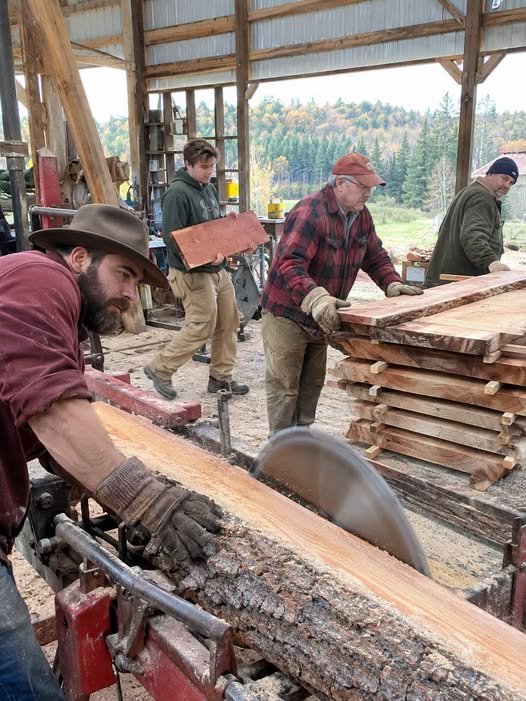
Mason unloaded the logs onto the mill deck.
Then Levi selected the largest one and positioned it on the saw carriage.
The diesel engine started, and the circular blade began turning. The first outer slabs came away, revealing the fresh cherry beneath.
Soon, the first board emerged.
It was beautiful.
The wood had a rich reddish-pink color and a remarkably straight grain. The fourteen-foot board was wide, smooth, and nearly free of visible imperfections.
Levi’s son carried it to a nearby stack.
Dad slowly approached and placed his hand on the surface.
He stood there quietly, looking at the board that had come from the tree his father planted.
I watched him for a moment and understood how much that piece of wood meant to him.
Mason continued helping with the boards as Levi worked through the remaining logs. Some contained knots and natural imperfections, as expected with mature trees, but much of the timber was excellent quality.
By early afternoon, the mill had produced a substantial stack of freshly sawn cherry lumber.
Levi began measuring and sorting the boards. He separated the clearer pieces from the common-grade material and carefully recorded the measurements in his notebook.
When he finished, he approached Dad.
“You have approximately 4,600 board feet,” he explained. “About 3,100 feet are firsts and seconds. The rest is number one common.”
He explained that the clearer cherry could be sold to a cabinet shop that regularly purchased hardwood lumber.
After calculating the figures, he offered $2.80 per board foot for the clear material and $1.40 for the common boards.
The total came to $10,780.
Dad listened carefully.
It was considerably more than the original offer from the first mill.
Levi explained that the price reflected the actual lumber quality after the logs had been opened and measured. He also clarified that different buyers and processing arrangements could produce different prices.
Then he made another suggestion.
He pointed toward seven particularly wide boards that had come from the largest cherry log.
“I think you should keep these,” he told Dad.
Dad looked at him.
“That was my father’s tree,” he explained.
Levi nodded.
“Then perhaps you should make something from it.”
He offered to dry those seven boards in his kiln without charging Dad for the service. He would purchase the remaining lumber for $9,400.
Dad stood quietly for a moment.
Then he thanked Levi.
Before leaving, Dad mentioned the unusual grading experience at the first mill. He explained that the same logs had received a very low classification despite the earlier offer for the standing trees.
Levi considered the situation carefully.
“That is why examining the actual lumber matters,” he said. “A tree’s quality becomes much easier to understand when you can see the boards.”
He did not encourage an argument. He simply reminded Dad that careful inspection and transparent measurements were important in the timber business.
Levi paid Dad $9,400 for the lumber he purchased.
We placed the seven special boards aside for drying.
On the drive home, Dad finally began talking about what the money would mean.
“Your mother can get the dental work she needs,” he said.
“Yes, Dad.”
“And I promised the grandchildren something for Christmas.”
He also mentioned that he wanted to help Mason with his education.
I looked at my son in the pickup behind us. I had not realized that he was seriously considering studying forestry at Penn State DuBois.
Dad explained that Mason had told him about his plans while they were working on the hillside.
He wanted to learn more about woodland management, timber quality, and responsible forestry.
Dad smiled.
“He should learn how to grade a log properly,” he said.
When we reached the farm, Mom was waiting on the porch.
Dad walked over and placed the brown envelope in her hands.
She looked inside and then at him.
“What happened?” she asked.
“I found someone who was willing to examine the wood properly,” Dad replied.
Mom smiled and hugged him.
A few weeks later, she began receiving the dental treatment she had postponed for so long.
The seven cherry boards were dried at Levi’s mill and eventually brought back to Dad’s workshop.
He had a plan for them.
Throughout the winter, he spent many mornings working with hand planes, chisels, and his old table saw. Mason joined him whenever possible, learning how to measure, shape, and join the wood.
I often stopped by to watch.
Dad never rushed the project. He worked carefully, checking each measurement and smoothing every surface.
By April, he had finished.
It was a beautiful piano bench for Mom’s old Baldwin piano. The lid lifted to provide storage for her hymnbooks, and the cherry wood displayed a rich red and golden grain.
Dad had made it entirely from the seven boards that came from his father’s tree.
Inside the lid, he placed a small inscription remembering his father and the tree planted so many years earlier.
Mom was delighted when she saw it.
She sat down at the piano, opened her hymnbook, and played the familiar Swedish hymn.
Dad stood behind her with one hand resting gently on her shoulder.
It was one of those family moments that does not require many words.
Meanwhile, something else was happening.
Lyle eventually visited the farm.
He arrived on a snowy afternoon and asked to speak with Dad. He looked tired and admitted that the mill had been under serious financial pressure.
He explained that the bank had given him until March to address the outstanding business debt.
He also admitted that he had been grading timber too low in an effort to keep the business operating.
He had made similar mistakes with other local farmers.
When Dad asked about the cherry logs, Lyle admitted that he had known they were valuable. He remembered inspecting the trees in August and making the original offer.
He apologized for the way he had handled the later transaction.
Dad listened without interrupting.
Then he reached into his coat pocket and took out the original six-hundred-dollar check.
“I never deposited this,” he said.
Lyle looked at it.
Dad reminded him that his father had built the sawmill on a reputation for honest business. The mill had served the community for decades, and its reputation had been built one customer at a time.
He encouraged Lyle to contact the other farmers whose timber had been incorrectly graded and work out fair arrangements with them.
Lyle agreed.
Over the following months, he visited eleven farmers in the surrounding counties. He explained what had happened, apologized, and began arranging repayments.
He sold some personal property and made payments whenever he could.
Unfortunately, the business could not recover financially. The bank eventually took possession of the mill’s equipment, including the band saw and kiln.
The old building stood quiet for a while.
But Lyle did not give up on the trade.
In April, he visited Levi’s sawmill outside Smicksburg. He explained his situation and asked whether there might be an opportunity to work there.
He did not ask to manage the business or handle the grading.
He offered to begin with basic work, carrying boards, moving logs, and learning the trade again.
Levi considered his request.
Then he handed him a pair of work gloves.
“You can start Monday,” he said. “We will work on getting things right.”
Lyle began working several days a week at the sawmill.
He learned to inspect logs carefully, measure lumber accurately, and understand the importance of honest grading.
It was a fresh beginning.
Back at the farm, Dad had another idea.
On the first warm Saturday in May, he asked Mason and me to meet him near the barn.
He was holding a cardboard box containing twenty-two small black cherry seedlings.
“One for every log,” he explained.
We walked up the hillside together.
The old trees were gone, leaving open spaces and weathered stumps. New grass had begun growing across the ground.
Mason carried the box while I brought the planting tools.
We spent the morning planting the seedlings.
Dad carefully positioned each one and pressed the soil around its roots. I added protective wire cages to help keep wildlife from damaging the young trees.
The final seedling was planted beside the old stump at the top of the hill.
Dad handed it to Mason.
“My father planted the first tree for my future,” he explained. “Now we’re planting this one for yours.”
Mason carefully placed the seedling into the ground.
Dad put a hand on his grandson’s shoulder.
“These trees may take many decades to reach their full size,” he said. “You may be the one who sees them become what the old trees once were.”
We sat together beside the stone wall, looking across the hillside.
Three generations of our family had gathered there, each with a different connection to the same piece of land.
Down at the farmhouse, we could hear Mom playing the piano. The new cherry bench stood beneath her, made from the tree that Dad’s father had planted so many years earlier.
Dad began humming the familiar Swedish hymn.
Mason and I joined him.
A little later, a pickup appeared on the gravel lane.
It was Lyle.
He had brought something wrapped carefully in a blanket. When he reached the bottom of the hill, he removed the blanket and revealed a beautiful cherry board from his recent work at Levi’s mill.
It was a clear, carefully graded board.
He looked up at us.
Dad recognized him and raised his hand.
“Come on up, Lyle,” he called. “We saved you a seat.”
And as Lyle walked toward us, I thought about the twenty-two new trees growing on that hillside.
The original trees had provided much more than lumber. They had helped our family care for one another, encouraged a young man to consider a future in forestry, and reminded everyone involved that good work depends on honesty and patience.
The new seedlings would need years of care before they became mature trees.
But that was the point.
Some things are planted not for what they can provide today, but for what they might mean to the people who come after us.