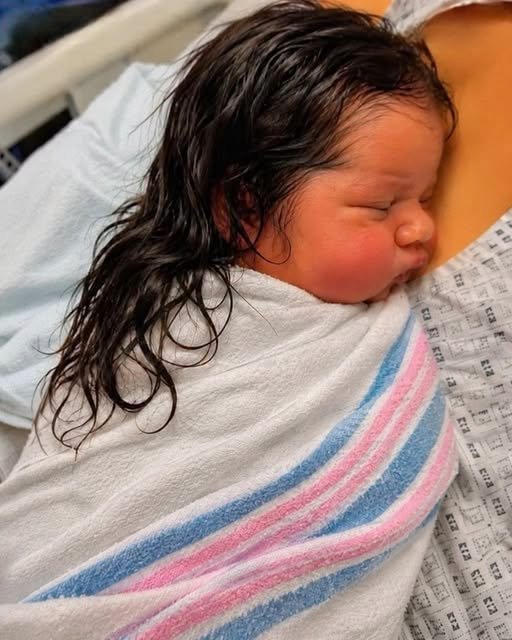
The nurses gently gathered my newborn daughter’s unusually long hair into a tiny ponytail. Everyone in the room smiled at the adorable sight. But when my mother-in-law arrived, she immediately insisted that we cut it. I refused. Two days later, when we brought our daughter home, I noticed something unusual above our bedroom dresser. Two hooks remained on the wall where our mirror used to hang. My husband already knew why.
The nurse gently lifted a section of Charlotte’s hair. Even while damp, it reached almost to her shoulders. She smiled and called another nurse over to see it. Mason immediately reached for his phone to capture the moment. One nurse suggested gathering the strands into a tiny ponytail for a photograph. I agreed, and she carefully secured the hair with a soft little tie. Charlotte looked adorable, and Mason couldn’t stop smiling.
After taking a few pictures, the nurse removed the tie and handed Charlotte back to me. I held her close, adjusting her blanket while Mason helped me get comfortable. Everything felt peaceful until his mother, Margaret, arrived carrying two cups of coffee.
She approached the bed and looked closely at Charlotte.
“That hair needs to be cut,” she announced.
I smiled, assuming she was joking. However, her expression remained serious.
“In our family, we always cut a baby’s hair early,” she explained. “There is a reason for it.”
I asked what she meant, but she avoided giving me a clear answer. Instead, she turned toward Mason and asked him to support her request.
“Your husband knows what happened before,” she added.
I had been married to Mason for six years. I knew plenty about his childhood, but he had never mentioned anything that explained his mother’s unusual concern.
“Mom, please stop,” he said quietly.
Margaret insisted that Charlotte’s hair should be cut before we left the hospital. I gently adjusted the blanket around my daughter and made my decision clear.
“We are keeping her hair. We can decide about a haircut when she’s older.”
Margaret eventually left, but the conversation stayed with me. Mason offered to warm my coffee, changed the subject, and helped me settle into bed. I expected him to explain his mother’s behavior, but he remained unusually quiet.
Two days later, we brought Charlotte home.
Mason had prepared everything beautifully. The bedroom was clean, the sheets were fresh, and my slippers were waiting beside the bed. I was grateful for all his help during those first few days.
Then I noticed the empty space above our dresser.
Our mirror was missing.
I looked around the room before checking the bathroom. The other mirrors were gone, too.
“Mason, where did all the mirrors go?”
He stopped in the doorway and looked uncomfortable.
“Mom asked me to put them away.”
I stared at him.
“Why would she ask you to do that?”
He explained that his mother believed mirrors should be covered or removed when a newborn had unusually long hair. He admitted that he didn’t share her belief but had agreed because he wanted to avoid another disagreement.
I looked at the empty wall.
“You made this decision without discussing it with me?”
He apologized and explained that he thought he was keeping things peaceful. However, I told him that making decisions about our home without asking me was not the right way to handle the situation.
He sat beside me while Charlotte rested in her bassinet.
I asked him about the sister his mother had mentioned at the hospital.
Mason became quiet.
“Her name was Anna,” he finally said. “She was five when she passed away.”
I had never heard him talk about her before. He explained that Anna had been a cheerful little girl with beautiful, long hair. His mother had always kept photographs and memories from those years, but the subject was difficult for the family.
That evening, while Mason was preparing something for dinner, I heard him speaking with Margaret on the phone.
“Mom, we have already discussed this,” he said. “Charlotte is fine.”
His voice became quieter.
I noticed that he was looking at an old photograph on his phone.
When he returned upstairs, I asked him what he had been discussing.
He showed me a picture of Margaret sitting with a little girl on her lap. The child’s long hair was carefully gathered away from her face.
“That’s Anna,” he explained.
He then showed me another photograph from an old family album. Margaret was holding a teddy bear, and beside the picture was a small section of Anna’s hair preserved in a protective sleeve.
I looked at him.
“Why did your mother become so concerned about Charlotte’s hair?”
Mason took a deep breath.
He explained that Anna had been getting ready with her mother one morning. Margaret had been brushing her hair in front of a bedroom mirror when Anna noticed a butterfly outside and became excited.
The little girl wanted to follow it into the garden.
Unfortunately, the family had not secured the outside gate properly. Anna wandered beyond the garden area before anyone realized she had gone outside. A nearby driver noticed her and immediately tried to stop, but the situation became a heartbreaking family tragedy.
Anna was taken to the hospital, where she later passed away.
Mason had been seven years old at the time.
His mother kept Anna’s photographs, favorite belongings, and a small lock of her hair. Over the years, she developed unusual beliefs connected to that difficult morning.
“She began associating long hair and mirrors with the memories of Anna,” Mason explained. “I think seeing Charlotte brought all those memories back.”
I understood that his mother was carrying years of sadness. However, I also knew that Charlotte deserved to grow up without being connected to a painful family memory.
Before making any assumptions about the small pink mark Mason had noticed on Charlotte’s head, we contacted the hospital. Her pediatrician reviewed the newborn examination notes and confirmed that it was a harmless birthmark.
That reassurance helped us put the concern aside.
I then returned to the issue of the missing mirrors.
“You should have talked to me before removing them,” I told Mason.
He nodded.
“I know. I thought I was helping, but I should have discussed it with you first.”
I appreciated his honesty. We agreed that decisions concerning Charlotte would always be made together.
I also asked him to speak with his mother and explain that we would not be cutting Charlotte’s hair because of an old family belief.
Mason called Margaret.
He told her that Charlotte was doing well and that we intended to let her hair grow naturally. He also explained that we respected Anna’s memory but wanted to make our own decisions as parents.
Margaret was quiet for a moment.
Then she asked whether she could visit and bring Anna’s old memory book.
I agreed.
That evening, Margaret arrived carrying a faded green album. She placed it carefully beside me and opened it to a page containing several photographs of Anna.
There were pictures of her playing in the garden, sitting beside Mason, and smiling at family gatherings.
Margaret turned the pages slowly.
“She loved having her hair brushed,” she said. “She would sit in front of the mirror and smile whenever I finished.”
I listened as she shared memories of Anna’s personality, favorite activities, and funny childhood moments.
Mason joined the conversation and remembered how he used to read random words from cereal boxes to make his younger sister laugh.
“It was pancake mix,” he said with a smile.
Margaret looked at him and laughed softly.
For the first time that evening, the conversation was about Anna’s life rather than the sadness surrounding her final morning.
As we continued looking through the album, I noticed a small protective sleeve with Charlotte’s name written on its label.
I asked Margaret about it.
She looked down at the page.
“I prepared it after seeing her beautiful hair at the hospital,” she admitted. “I thought it would be a way to connect the two girls.”
I gently explained that Charlotte needed her own memories, experiences, and identity. Anna would always have a special place in the family, but Charlotte was not meant to replace her.
Margaret listened without interrupting.
After a moment, she removed the label she had prepared and closed the album.
“I suppose I was trying to hold on to something I missed,” she said.
I reached across the table and touched her hand.
“Tell us about Anna whenever you want. We would love to know more about her.”
Mason brought Charlotte over, and Margaret looked at her granddaughter with a softer expression.
We stood together near the dresser. The mirror had been put back in its original place, and the little hair tie was still resting beside the lotion.
I gathered a few strands of Charlotte’s hair between my fingers, arranging them gently into a tiny ponytail.
It leaned slightly to one side.
Margaret smiled.
“She really does have beautiful hair.”
I looked at Charlotte’s reflection and smiled back.
Her hair fell naturally around her little face as she moved in Mason’s arms.
For the first time since the hospital, everyone seemed comfortable.
Anna would always be remembered as part of the family, and Charlotte would have the freedom to create her own story.
Some memories deserve to be preserved, but the future deserves room to grow.