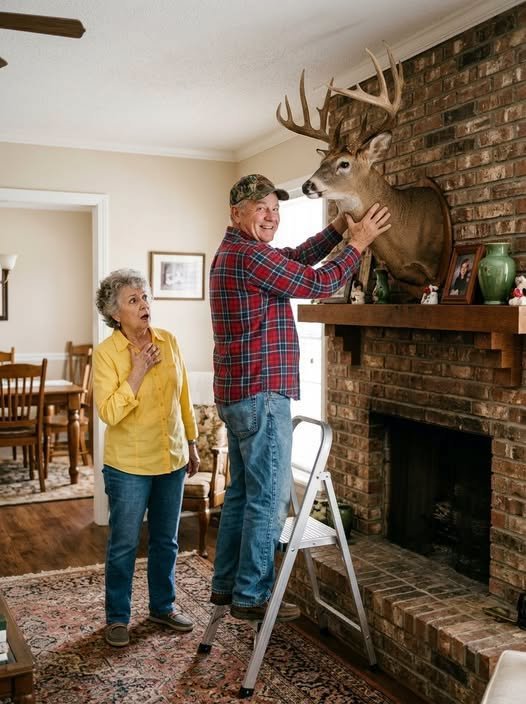
I came home from the grocery store that Tuesday afternoon and heard a drill running in my living room. My new husband, Lamont, was standing on a step stool, holding something large against the wall above my fireplace.
“Surprise, darlin’!” he announced.
It was his late father’s deer head, complete with eight points and a slightly loose glass eye. He had taken down the handmade wedding-ring quilt that had hung above my fireplace for years and folded it on the couch.
“Lamont, what are you doing?” I asked.
He smiled proudly and positioned the decoration against the chimney.
“Mama and Sis are moving in Sunday,” he said. “Mama gets the big bedroom, and Sis can have your sewing room.”
I put my grocery bags down and stared at him.
“We never discussed anyone moving into this house.”
“There’s nothing to discuss,” he replied.
“Lamont, I’m telling you that I don’t agree.”
He stepped down from the stool and folded his arms.
“Darlin’, the day you married me, this became my house too. A man decides who lives under his roof.”
I looked at the deer head hanging above my fireplace. Somehow, that decoration seemed to represent everything that had changed in just three weeks.
I was sixty-seven years old. I had lost my first husband, Wardell, six years earlier after sharing many years together. I had worked for thirty-one years in the laundry department at the county hospital, saving carefully and making sure I could enjoy a comfortable retirement.
The little white house in Madison, Georgia, was something I had worked hard to own. I had paid off the mortgage myself, and the property was in my name alone.
Three weeks earlier, I had married Lamont, a widower who lived nearby. He had brought me fresh tomatoes, shared funny stories, and made the quiet evenings feel less lonely.
“I’ll take care of you, Dorinda,” he had promised when he proposed.
After selling his trailer, he moved into my home. At first, I thought we were beginning a peaceful new chapter together. I never imagined he would start making major decisions about my home without even asking me.
I wanted to argue, but instead, I took a deep breath.
“Well, then,” I said with a small smile, “I’ll make sure your family receives a welcome they won’t forget.”
He kissed my cheek.
“That’s my girl.”
A few minutes later, my neighbor, Nedra Pope, called.
“Dorinda, am I seeing things, or is there a deer head hanging in your living room?”
“You are seeing exactly what you think you are.”
“Lord, have mercy,” she replied.
I stepped outside and explained what had happened. Nedra listened patiently, occasionally shaking her head.
By supper, Lamont had already prepared a list of household arrangements. His mother preferred soft eggs and early morning coffee. His sister needed certain towels because she was particular about the fabrics she used.
Then he made another suggestion.
“Maybe you should put Wardell’s photographs in the attic,” he said while eating the pot roast I had prepared.
“Why would I do that?”
“Mama will want to make herself comfortable. It’s a new family now.”
I looked at him without answering. Those photographs were important memories, and I had no intention of hiding them to make someone else feel more at home.
The following morning, Lamont asked me to prepare a large Sunday dinner.
“Fried chicken and that coconut cake you make,” he said. “Mama loves coconut cake.”
“I’ll have something special ready,” I answered.
That evening, I lay awake thinking about our marriage. I had missed having someone to share ordinary moments with after Wardell passed away. Perhaps I had been so eager to welcome companionship that I had overlooked some important differences between affection and respect.
For the first time, I wondered whether I had rushed into this marriage.
On Saturday morning, Lamont went to the hardware store. I found his mother’s telephone number in the address book beside the coffee maker.
Her name was Clementine Sizemore. She was eighty-nine years old, and although I had met her only once at the wedding, she had seemed like a thoughtful woman.
“Miss Clementine, this is Dorinda. I wanted to call and let you know we’ll be ready for your visit tomorrow.”
There was a long pause.
“Ready? Honey, Lamont told me you were asking us to come. He said you wanted the company.”
I became quiet.
“He also said you were having trouble keeping up with that big house he bought you.”
I nearly dropped the telephone.
“He bought me this house?”
“That’s what he told me, dear.”
I sat down at the kitchen table and took a moment to collect my thoughts.
“Miss Clementine, I think there are a few things you should know about this house and the arrangements your son has been making.”
For the next twenty minutes, I explained everything. I told her about the deer head, the quilt, the bedrooms, and the conversation about who supposedly had the authority to decide who lived there.
She listened without interrupting.
Finally, she asked one question.
“Is his father’s deer head hanging above your fireplace?”
“Yes, ma’am.”
“Well,” she replied calmly, “you leave it exactly where it is. I’ll see you tomorrow.”
Sunday morning arrived, and I didn’t prepare the fried chicken or the coconut cake.
Instead, Nedra came over to help me arrange the front porch. We had coffee together and talked about ordinary things while I waited for the afternoon.
Lamont was upstairs getting ready, humming as he buttoned his shirt.
Just after lunch, I heard a vehicle coming up the driveway.
His father’s old blue pickup pulled into the yard. His sister was driving, and Miss Clementine was sitting in the passenger seat.
There were no suitcases or moving boxes in the back.
Lamont hurried outside with a big smile.
“Mama! Y’all made it!”
Nedra stood near the porch railing, holding her coffee.
Miss Clementine stepped down carefully, using her cane for support. She looked at the porch, then at the house, before turning toward her son.
“Lamont Thurston,” she said clearly, “you are going to gather your belongings and come home with me. Your old room is ready.”
Lamont’s smile disappeared.
Behind him, several boxes were arranged neatly along the porch wall. His recliner stood beside them, and his father’s deer head had a bright red bow tied around its neck.
I had placed the bow there myself.
“What is all this?” Lamont asked.
“I told you,” his mother replied. “Your belongings are going home with you.”
He looked at me, then at the boxes.
“Mama, you can’t just decide where I’m going.”
“I can offer you a place to stay,” she answered. “Now, let’s get your things into the truck.”
His sister remained near the driver’s seat, watching the conversation.
Lamont turned toward his mother.
“I thought you wanted to live here.”
Miss Clementine raised her eyebrows.
“You told me Dorinda had invited us. You said she was looking forward to having us in the house.”
“She was,” he answered quickly.
“No, she wasn’t,” I said gently. “We never had that conversation.”
He looked uncomfortable.
His mother continued.
“You also told me that you bought this house for her and that she needed help managing it.”
I stood beside the boxes.
“Miss Clementine, I paid off this house myself. It is my home, and I never agreed to have anyone move in.”
Lamont looked toward the front door.
“I sold my trailer. Where am I supposed to go?”
His mother answered without hesitation.
“You have a room at my house. That’s where you’re going today.”
I could see that he was becoming frustrated, but I had no intention of changing my decision.
“I never promised anyone my sewing room,” I told him. “And I never agreed to give up my bedroom or change the way I live.”
Miss Clementine nodded.
“That is exactly what I wanted to understand.”
Lamont looked at the deer head.
“You even put a bow on my daddy’s decoration?”
“I thought it deserved a proper farewell,” I replied.
His sister laughed quietly from beside the pickup.
I had to smile.
The situation was certainly unexpected, but I was beginning to feel something I hadn’t felt in days: relief.
Lamont turned toward his sister.
“You think this is funny?”
She shook her head.
“I’m just surprised by how everything turned out.”
His mother tapped her cane lightly against the porch.
“You made arrangements with other people using someone else’s home. You cannot expect Dorinda to accept that.”
Lamont tried to explain that he believed marriage meant sharing everything. I understood that marriage involved compromise, but I also believed important decisions required an honest conversation between two people.
Sharing a life did not mean one person could make every decision.
I stepped forward.
“Lamont, I wanted this marriage to work. I welcomed you into my home because I thought we were building a future together. But I cannot continue a relationship where my opinions and decisions are treated as unimportant.”
He looked at me for a long moment.
“I thought you wanted a family,” he said.
“I wanted a husband and a partner. I wanted someone who would respect me as much as I respected him.”
There was nothing more I needed to explain.
His mother looked at him.
“You heard what she said. Let’s get your things.”
Lamont eventually picked up the first box and carried it toward the pickup. His sister stepped forward to help load the remaining belongings.
They handled everything carefully, including the recliner. I appreciated that because I had no intention of damaging his possessions.
The deer head was the last item.
Lamont lifted it carefully, making sure the antlers didn’t catch on the doorway. The red bow swung beneath its chin.
Miss Clementine watched him place it in the truck.
“That will look fine in your old room,” she commented.
For the first time that afternoon, his sister laughed openly.
I smiled too.
Before leaving, Miss Clementine approached me.
“Dorinda, I am sorry you were put in this position. I was told a very different story.”
“Thank you for listening to me,” I replied.
She gave my hand a gentle squeeze.
“You deserve to feel comfortable and respected in your own home.”
Those words meant more than she probably realized.
The blue pickup eventually pulled out of the driveway. Lamont sat beside his mother, while his sister drove. His belongings were secured in the back.
I watched until the vehicle disappeared down the road.
Nedra stood beside me.
“Well,” she said, taking another sip of coffee, “that certainly wasn’t the Sunday dinner we expected.”
I laughed.
“No, it certainly wasn’t.”
Then she glanced toward the living room.
“Would you like some help bringing your quilt back inside?”
“Yes, please.”
We carried the wedding-ring quilt through the front door and carefully placed it above the fireplace. I smoothed the corners and adjusted it until it hung just the way I remembered.
The room looked familiar again.
I sat down in my favorite chair and looked around. The photographs of Wardell were still there, the furniture was where I wanted it, and the house was peaceful.
I knew I would need time to think about my marriage and what I wanted to do next. I was disappointed that things had turned out this way, but I was also relieved that I had finally spoken honestly.
At sixty-seven, I understood something important: starting a new chapter in life should never mean giving up the right to make decisions about your own future.
A loving relationship should make room for two people’s voices, not just one.
That afternoon, I made myself a fresh cup of coffee and enjoyed the quiet.
For the first time in days, I wasn’t worrying about who would occupy my bedrooms, where my belongings would go, or whether my wishes would matter.
I was simply home.
And that was exactly where I wanted to be.