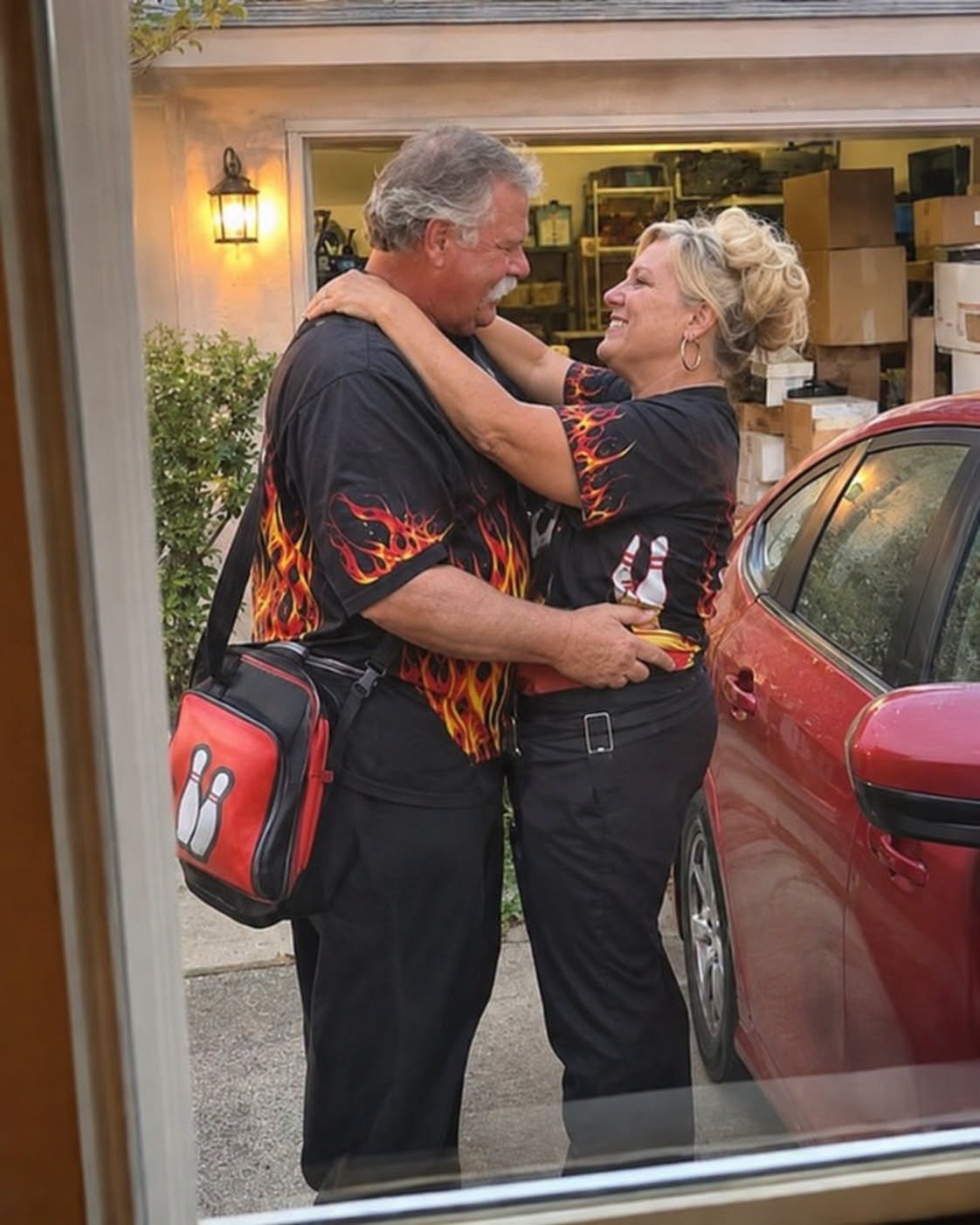
Lana stepped out of her little red car wearing a bright blue bowling shirt, white sneakers, and a cheerful smile. She looked as though she believed she was about to begin an exciting new chapter of her life. Her blond hair was carefully styled, and she waved enthusiastically at my husband as she approached the garage.
“There you are, sweetheart!” she called.
Harold stood in the garage doorway, one hand resting on the doorframe. His smile quickly faded when he noticed the eleven cardboard boxes stacked behind him.
“What is all this?” Lana asked, looking from the boxes to Harold.
“Just a few things,” he replied.
I stepped into view behind him. “Those are Harold’s belongings. He told me he was leaving after supper, so I thought I would help him organize everything.”
Lana stopped smiling.
Harold turned toward me. “Raelene, please don’t start.”
“I’m not starting anything. I’m simply making sure you have everything you need.”
Lana looked confused. “You said you were staying at your place first.”
“I am,” Harold answered quickly.
I calmly explained that the house belonged to me. It had originally belonged to my father, and I had inherited it years before. Harold had lived there with me throughout our marriage, but the ownership arrangements were something we would need to discuss properly.
Lana looked at him. “You told me this was your house.”
Harold shifted uncomfortably. “It’s practically mine. I’ve lived here for forty-four years.”
“Living somewhere and legally owning it are two different things,” I replied.
I wasn’t interested in arguing. After forty-four years of marriage, I had learned that some conversations were better handled calmly, with the right documents and professional advice.
Harold turned toward the boxes and began searching through them.
“Where are my good clothes?”
“Boxes four and five.”
“My television?”
“Box eight.”
“And my important papers?”
I pointed toward a smaller box sitting on the workbench.
He noticed the writing on top.
LANA.
His expression changed immediately.
“Why does that have her name on it?” he asked.
“Because some of the things inside concern her.”
Lana stepped closer. “What things?”
Harold looked uncomfortable. “It’s nothing important.”
But Lana was no longer satisfied with that explanation.
I placed the box on the workbench and opened it carefully. Inside were several photographs, a jewelry receipt, and a large envelope.
Lana immediately recognized a gold earring resting near the top.
“That’s mine,” she said quietly.
“I found it in Harold’s truck several weeks ago,” I explained.
Harold shook his head. “This is becoming unnecessary.”
I picked up the photographs. They showed Harold and Lana together at a restaurant, outside a jewelry store, and beside the truck he had been driving.
Lana looked at the pictures with growing concern.
“You took these?” she asked.
“No. They were photographs that had been shared publicly online.”
I then showed her the jewelry receipt.
A diamond necklace had been purchased for $2,850. The payment information was connected to a credit card belonging to our household account.
“Harold gave me that necklace,” Lana said.
“I understand. But I never knew about the purchase.”
Harold tried to explain that we had shared finances throughout our marriage.
That was true. We had shared many responsibilities, but I had never agreed to have household money used for expensive personal gifts without discussing them first.
Lana looked at him.
“You told me you bought that with your own money.”
Harold rubbed his forehead. “I was going to explain everything.”
I opened the envelope and removed several printed emails. They were conversations between Harold and a real estate agent concerning the house.
The agent had explained that Harold was not listed as the sole owner and that any decisions involving the property would need to be handled according to the legal documents.
One message from Harold suggested that I would probably agree to whatever arrangements he proposed.
Lana read the page carefully.
“You said you owned this house,” she repeated.
Harold tried to change the subject, but she wasn’t finished asking questions.
There were also messages concerning the truck. Harold had been asking about changing its registration, even though the title was in my name.
“You told me that truck was yours,” Lana said.
“I’ve been driving it for years,” he answered.
“That doesn’t necessarily mean it’s legally yours,” I explained.
Lana slowly placed the papers back on the workbench.
Then she asked the question that changed the entire evening.
“Harold, you told me you had already started the divorce process. Is that true?”
He looked away.
I had never received any divorce papers or official notification.
Lana took out her phone and showed him several messages in which he had suggested that the separation was already being arranged.
Harold became unusually quiet.
For the first time, Lana seemed to understand that the future he had described might not have been as certain as she believed.
The Woman Who Thought She Was Starting a New Life
Lana remained in the garage, looking through the documents while Harold moved between the boxes.
“You said you were getting divorced,” she told him.
“I was planning to,” he answered.
“That’s not what you told me. You said everything was already arranged.”
Harold sighed. “Things became complicated.”
I stood quietly beside the workbench.
For weeks, I had wondered whether I had misunderstood something about my marriage. Now I was beginning to understand that Harold had been telling different versions of the same story to different people.
Lana turned toward me.
“He told me you had been living separate lives for years.”
I shook my head.
“We were still sharing our bedroom until recently. I had no idea he was making plans with someone else.”
Lana lowered her eyes.
“He said you didn’t care about him anymore.”
I took a moment before answering.
“I spent forty-four years building a life with that man. I worked long shifts at a local food-processing plant, helped raise our children, managed our household, and supported our family through difficult times. I never imagined our marriage would end this way.”
Harold interrupted.
“I worked hard too.”
“I know you did,” I replied. “I never denied your contribution. But we both worked for the life we built. Neither of us should pretend otherwise.”
At that moment, my neighbor Mattie appeared at the end of the driveway.
She had always been a thoughtful friend, and I had asked her to bring some paperwork I needed.
“Everything all right?” she asked.
“Just sorting through a few things,” I answered.
She handed me a brown envelope containing copies of bank statements and other financial records.
I had recently discovered several withdrawals from our shared savings account that I hadn’t understood. The transactions included restaurant visits, hotel expenses, and purchases I had never discussed with Harold.
I wanted everything reviewed carefully before making any decisions.
Harold looked through the statements.
“You’ve been checking the accounts?”
“They are accounts I am connected to. I have every reason to understand our financial situation.”
Lana looked at the documents.
“You told me that money came from your personal savings.”
Harold didn’t provide a clear explanation.
I looked at him and remembered all the years we had spent together.
I remembered working long days, preparing meals, helping our children with schoolwork, and making sure the bills were paid. I remembered the difficult years when money was tight and the times we had celebrated small achievements together.
I wasn’t claiming that I had done everything alone.
I was simply asking him to acknowledge the life we had both helped create.
Lana opened her purse and removed a small velvet jewelry box.
Inside was a diamond ring.
“You gave me this last month,” she said. “You told me it came from the money you received after selling your old fishing boat.”
Harold looked uncomfortable.
I hadn’t known about the ring or the sale.
Lana slowly closed the box.
“I don’t think I can accept this anymore.”
Harold tried to reassure her, but she shook her head.
“You told me everything was settled. You told me we would have a home together and enough money to enjoy retirement. Now I’m discovering that you haven’t been honest about several important things.”
She turned toward me.
“I’m sorry. I should have asked more questions.”
I nodded.
“I appreciate that. But I hope you understand that I didn’t know about your relationship until recently.”
Lana looked down.
“I understand.”
She picked up her purse and walked toward her car.
Harold followed her, asking her to wait so they could talk privately.
But Lana had made her decision.
“I need some time to think,” she told him. “Please don’t contact me for a while.”
She got into her car and drove away.
Harold remained in the driveway, watching until the car disappeared around the corner.
Mattie stood beside me.
“Well, that certainly wasn’t how he expected the evening to go.”
“No,” I replied. “It wasn’t.”
Harold eventually turned toward me.
“Are you happy now?”
I looked at the man I had shared nearly half my life with.
I remembered the young man who once brought me flowers after a difficult day. I remembered him holding our first child at the hospital and the evenings when we sat together discussing our plans for the future.
Those memories still mattered.
But they couldn’t change what had happened.
“I’m not happy, Harold. I’m disappointed and heartbroken. But I cannot pretend everything is fine.”
He looked toward the boxes.
“Where am I supposed to go?”
“You told me you were leaving. I assumed you had made arrangements.”
He sat quietly for a moment.
“Can we discuss this tomorrow?”
“Yes,” I answered. “But I think we should speak through our attorneys about the practical arrangements.”
He looked surprised.
“Attorneys?”
“I want everything handled properly. That’s all.”
He eventually began loading his belongings into the truck.
I watched from the porch as he carried the final box outside.
Before leaving, he turned toward me.
“You really don’t want me back?”
I held the screen door open.
“I wanted you to stay when you still wanted to be my husband.”
He didn’t respond.
A few minutes later, he drove away.
I stood in the driveway until his vehicle disappeared.
Then I went inside, washed the supper dishes, and placed the leftover meatloaf in the refrigerator.
Everything looked exactly the same.
The curtains were still hanging in the windows. The kitchen clock continued ticking. Our family photographs remained on the walls.
But something had changed.
For the first time in forty-four years, I was living in the house without Harold.
And I knew my life would never be quite the same.
Learning to Begin Again
The first week after Harold left was more difficult than I expected.
People sometimes imagine that the hardest moment in a long marriage is the day someone walks out the door.
But the following mornings can be just as difficult.
I would wake up and instinctively prepare two cups of coffee. Sometimes I would hear a vehicle outside and briefly wonder whether Harold had returned.
Old routines are difficult to change after decades together.
On the third morning, I prepared enough breakfast for two people before remembering that I was alone.
On the fifth morning, I found myself folding towels and remembering how Harold used to prefer them arranged.
I smiled at the memory, although it made me a little sad.
Forty-four years cannot simply disappear because a relationship has ended.
But I also began to understand something important.
Being a good wife had never meant forgetting my own needs. Being patient had never meant accepting every decision without question.
Love and respect should work both ways.
The following Monday, I met with a divorce attorney named Mrs. Whitaker.
She was a calm woman who listened carefully as I explained what had happened.
I brought the house deed, the truck title, the financial statements, and the emails I had discovered.
After reviewing everything, she explained that property and financial arrangements could depend on state laws, ownership records, inheritance documents, and the circumstances surrounding the marriage.
She advised me not to make assumptions before the documents had been reviewed properly.
I appreciated her honesty.
For the first time, I felt that I didn’t have to argue with Harold about every detail. I could let the appropriate professionals help us reach a fair arrangement.
Two weeks later, Harold called.
I was outside planting marigolds beside the porch when my phone rang.
“Raelene,” he said.
“Hello, Harold.”
“Can we talk?”
“About what?”
“About us. I miss you.”
I looked at the flowers.
“Do you miss me, or do you miss having someone who makes breakfast and takes care of the house?”
There was a long pause.
“That’s not fair,” he replied.
“Perhaps not. But I think it’s a reasonable question.”
He explained that Lana was no longer speaking with him and that he had temporarily arranged to stay with a relative.
He said he was tired of sleeping somewhere unfamiliar and wanted to return home.
I listened without interrupting.
“Harold, when you told me you were leaving, did you consider how I would feel? Did you think about what would happen to our family and the life we had built?”
He remained silent.
“I made a mistake,” he eventually said.
I closed my eyes.
For years, my first instinct had been to comfort him whenever he was upset. But this time, I knew that I couldn’t solve everything for him.
“I’m sorry things are difficult,” I said. “But we both need time to understand what happens next.”
He asked whether we could start again.
I told him that I wasn’t ready to make that decision.
Then we ended the conversation.
A week later, Lana visited my house.
She arrived in the same red car, but this time she looked much quieter.
She stood on the porch holding a white envelope.
“I hope I’m not disturbing you,” she said.
“What can I do for you?”
She handed me the envelope.
Inside was a cashier’s check for $2,850.
“This is for the necklace,” she explained. “I didn’t know how it had been purchased. After learning about the circumstances, I didn’t feel comfortable keeping it.”
I looked at the check.
“You don’t need to do this.”
“I know. But I want to make things right.”
I thanked her.
She then explained that Harold had told her many things about our marriage that weren’t accurate.
He had described me as someone who no longer cared about him and suggested that we had been living separate lives for years.
“I believed him because I wanted to believe him,” she admitted.
I understood that she had also been making decisions based on what she had been told.
“I hope you find some peace,” I said.
She nodded.
“I’m sorry, Raelene.”
This time, I believed that she meant it.
After she left, I placed the envelope with the other documents and returned to my afternoon.
The divorce process took several months.
Harold initially disagreed with some of the property arrangements, but our attorneys reviewed the documents and worked toward a settlement.
The inherited house was evaluated according to the applicable legal rules, while the truck and financial accounts were handled using their ownership and payment records.
There were disagreements, but eventually we reached an agreement.
I didn’t recover every dollar that had been spent, but I was able to rebuild much of my savings.
Our divorce was finalized in the spring.
When the final papers arrived, I sat at the kitchen table with a cup of coffee and read them twice.
Forty-four years of marriage had ended with several pages of paperwork.
I didn’t celebrate.
I simply placed the documents in a folder, put the folder inside my father’s old desk, and went outside.
The marigolds were blooming.
A Different Kind of Happiness
A few weeks later, my daughter called.
She had heard about the divorce and wanted to know whether I was doing all right.
“I’m fine,” I told her.
“Are you sure, Mom?”
“I’m learning.”
She explained that Harold had told her I had packed all his belongings and made the situation difficult.
I took a deep breath.
“Your father and I remember some things differently. I packed his belongings because he told me he was leaving. I don’t want to argue with him through you.”
My daughter was quiet.
“I don’t know what to believe.”
“Then take your time. You don’t have to choose sides. Just look at the facts and make your own decisions.”
She promised to visit the following weekend.
When she arrived, she hugged me for a long time.
We sat on the porch, drank iced tea, and talked about our families.
Before leaving, she looked toward the garage.
“You really packed everything?”
“One box at a time.”
She smiled.
“That sounds like you, Mom. You always were organized.”
I laughed.
“I suppose I was.”
Then she took my hand.
“I’m proud of you.”
Those words meant more than she could imagine.
As summer approached, Mattie and I started taking little day trips.
We visited the farmers’ market, enjoyed lunch at a small diner outside town, and once drove nearly two hours just to visit a beautiful public garden.
I also joined a Thursday afternoon book club at the library.
I bought a comfortable pair of walking shoes and painted my kitchen a soft yellow.
Harold had never liked yellow. He always thought it made the room look too bright.
But I loved it.
For the first time in years, I didn’t have to ask anyone whether they liked the color of my walls or the arrangement of my furniture.
I could simply enjoy the things that made me happy.
One Saturday morning, I found a small package on the porch.
There was no return address.
Inside was an old photograph of Harold and me taken forty years earlier.
We were standing beside the house on our wedding anniversary. His arm was around my waist, and I was laughing at something outside the frame.
On the back, he had written:
“I wish I had remembered how happy we were.”
I sat with that photograph for a long time.
I remembered the celebration, the music, the children playing in the yard, and the evening we spent dancing together in the kitchen after everyone had gone home.
I didn’t hate those memories.
I didn’t want to erase them.
But I understood that wonderful memories couldn’t automatically repair a difficult present.
I placed the photograph in a drawer with the other family pictures.
It belonged to my past, and I was learning to appreciate the past without allowing it to decide my future.
In August, Harold called again.
This time, he sounded calmer.
He told me he had started attending counseling and was trying to understand some of the decisions he had made.
“That’s a positive step,” I replied.
He apologized for the way he had handled our separation.
“I know I hurt you,” he said.
“Yes, you did.”
He asked whether we might have coffee together someday.
I thought about it before answering.
“Perhaps someday. But I’m not ready right now.”
“I understand,” he said.
We ended the call politely.
And that was enough.
I never remarried.
I had friends, children, grandchildren, a little garden, and a home filled with sunlight.
I discovered that being alone wasn’t necessarily the same as being lonely.
Some evenings were quiet, and certain holidays were difficult. But I no longer measured my happiness by whether someone else was sitting across from me at the dinner table.
Nearly a year after Harold left, I was cleaning the garage when I found a small piece of cardboard beneath the workbench.
It was part of one of the labels I had written on his boxes.
I picked it up and remembered that evening.
I remembered the photographs, the documents, the conversations, and the moment Lana realized that the future she had imagined was very different from what Harold had described.
But the most important memory wasn’t watching either of them leave.
It was realizing that I could face a difficult change without losing myself.
That afternoon, Mattie came over with a fresh pie.
We sat on the porch, watching a storm move across the fields.
“Do you ever think about that night?” she asked.
“Sometimes.”
“What do you remember most?”
I considered her question.
“I remember the garage, the boxes, and the look on everyone’s faces. But the most important thing was realizing that I didn’t have to beg someone to stay in a home where I already had a life of my own.”
Mattie nodded.
“You’ve always been stronger than you think.”
I looked toward the old oak tree beside the driveway.
My father had planted it when I was a little girl.
He used to tell me that a strong tree didn’t need to chase the wind. It simply needed deep roots.
I had spent forty-four years building a life with Harold. When that marriage ended, I felt as though everything familiar had changed.
But my roots were still there.
My father’s house was still standing. My garden was still growing. My family was still part of my life.
And I was still Raelene.
A few months later, I received one final letter from Harold.
He wrote that he had moved into a small apartment, organized his belongings, and started attending a different bowling league.
He apologized for the way he had handled everything.
He also wrote that he had finally understood how much I had contributed to our shared life.
I read the letter once, folded it neatly, and placed it in the drawer beside the old photograph.
I didn’t write back.
There was nothing left that needed explaining.
On the anniversary of the evening Harold told me he was leaving, I made meatloaf again.
Not because I missed the argument or wanted to remember the difficult days.
I made it because I liked meatloaf.
For years, I had prepared meals with everyone else’s preferences in mind. That evening, I decided to enjoy my own favorite dinner.
I set the table with my good cloth napkins and placed a small vase of yellow flowers in the center.
Then I sat down and ate slowly.
Afterward, I washed my plate, turned on the porch light, and stepped outside.
Across the street, Mattie’s house was glowing warmly. She waved when she noticed me, and I waved back.
The neighborhood was peaceful.
A dog barked somewhere down the road, and the evening air smelled of freshly cut grass.
I thought about the woman I had been forty-four years earlier, standing in a wedding dress and believing that marriage meant promising never to leave.
Then I thought about the woman I had become.
I had learned that promises matter, but so does honesty. I had learned that a long history deserves respect, but it should never require someone to ignore their own well-being.
Harold believed he was leaving a wife who would never manage without him.
Lana believed she was beginning a future with a man who had everything arranged.
Both of them had misunderstood the situation.
The truth had been waiting in that garage, among the boxes, photographs, and documents.
But the greatest discovery wasn’t about the house, the truck, or the money.
It was about me.
I was a woman who had worked hard, raised a family, built a home, experienced disappointment, and found the courage to begin again.
The house was part of my inheritance. The memories were part of my history.
But the future was mine to shape.
And for the first time in a very long while, I was looking forward to it.