I was twenty-seven that spring, working long hours as a waiter at a restaurant called the Harbor Grill in Elizabeth, New Jersey. Life wasn’t easy, but I was doing everything I could to provide for my family.
My wife, Emily, was seven months pregnant with our second child, a little girl. We already had a four-year-old son named Kevin, who was growing faster than we could afford to keep up with. His favorite blue sneakers, decorated with little dinosaurs that lit up whenever he stomped, had become too small. He never complained, though. He simply wore them because he knew we were doing our best.
We lived in a modest two-bedroom apartment on Spring Street. Rent was $1,400 a month, and Emily had temporarily reduced her working hours because of medical advice during her pregnancy. Most of our household expenses depended on my restaurant job.
I worked six days a week, often from eleven in the morning until ten at night. My feet were constantly tired, and I rarely had enough time to spend with my family. Still, I never complained. We had a baby coming, and I wanted to make sure our children had everything they needed.
Losing my job was the last thing I could afford.
Then, one Tuesday afternoon in April, something happened that changed our lives.
The lunch crowd at the Harbor Grill was unusually busy. Every table was occupied, and several customers were waiting near the entrance. I was carrying two meals toward a table when someone suddenly shouted from near the front window.
“There’s a fire!”
Everyone turned toward the street.
Across Elizabeth Avenue stood an old apartment building. Smoke was coming from several windows on the third floor, and people had gathered outside, looking up with worried expressions.
A woman on the sidewalk was calling for help. Someone had already contacted emergency services, but the fire department had not yet arrived.
I noticed a man wearing a construction vest speaking urgently with another person.
A few seconds later, our busboy, Luis, turned toward me.
“Tony, there’s a mother and a little boy still inside,” he said.
My heart sank.
I looked toward the apartment building. People were frightened, and nobody seemed certain whether everyone had made it outside.
I immediately placed the meals on a nearby counter and headed toward the entrance.
My manager, Greg Harmon, noticed me leaving.
“Russo! Where are you going?” he shouted.
“There’s a family in that building. We need to help them.”
Greg stepped toward me.
“Stay here! The firefighters are coming. You have customers waiting, and you cannot just walk away from your section.”
I understood that he was worried about the restaurant, but I couldn’t stop thinking about the mother and child.
“I need to see if someone can tell the firefighters where they are,” I replied.
Greg shook his head.
“If you leave your shift, don’t expect to have a job when you return.”
I looked at him for a moment.
Then I walked outside.
The street was crowded with concerned neighbors. Several people were speaking with emergency dispatchers, while others were helping residents move farther away from the building.
A man in a construction vest approached me.
“There is an older gentleman who managed to get out,” he explained. “He says a woman named Nadia and her little boy may still be upstairs. She has an injured leg and probably needs assistance.”
I immediately told the nearest firefighter who had just arrived what I had heard.
The crew began organizing its response.
While waiting, I helped direct people away from the entrance and explained the situation to the emergency personnel. I was desperate to do something useful, but I knew the building was not safe to enter.
A few minutes later, paramedics brought an elderly man out of the building. He was coughing and appeared exhausted.
I recognized him as the resident the construction worker had mentioned.
He was sitting on the sidewalk when he noticed me.
“Please,” he said between breaths. “There are two people on the third floor. Apartment 3C. Nadia and her little boy.”
I repeated the information to the firefighters.
One of them nodded and immediately passed the details to the team preparing to enter.
The minutes felt endless.
I watched the firefighters move into the building with their protective equipment. Their calm coordination was impressive. They knew exactly where to go and what needed to be done.
Meanwhile, I stayed outside with the other residents.
A short time later, two firefighters emerged with a young woman and a small boy.
The woman was holding her child close. Her left leg was supported by a medical brace, and her face was covered with soot.
The little boy was frightened, but he was safe.
Paramedics immediately began checking them.
I felt an enormous sense of relief.
The woman looked around until her eyes met mine.
“Thank you,” she said quietly.
I approached her.
“You’re safe now. The paramedics are going to take care of you.”
She held her little boy closer.
“I thought we weren’t going to get out,” she whispered.
I didn’t know what to say. I simply offered her a reassuring smile.
Within minutes, the firefighters and medical team had taken control of the situation. I was advised to remain outside because of the smoke in the area.
After everything had settled, I looked at my watch.
It was already two-fifteen.
I had been away from the restaurant for more than an hour.
My shirt was dirty, my hands were covered in dust, and my knee hurt because I had slipped while helping people move away from the crowded sidewalk.
Still, I was grateful that the family had been found.
I crossed Elizabeth Avenue and returned to the Harbor Grill.
The lunch rush was almost over. Several tables had been cleared, and the restaurant was much quieter.
Greg was standing behind the bar.
My black apron was folded neatly on the counter.
He looked at me, then pointed toward it.
“You’re finished here, Tony.”
I stared at him.
“Greg, I explained what happened. There was a mother and a little boy in that building. The firefighters needed information about where they were.”
He folded his arms.
“You left your section. Customers walked out, and we lost money. I cannot have employees deciding when they feel like working.”
“My family depends on this job,” I said. “You know that. My wife is pregnant, and we have another child.”
Greg looked at the apron.
“You should have considered that before leaving.”
I stood silently for several seconds.
Then I picked up my apron and walked out.
I had lost my job.
On the bus ride home, I kept thinking about the rent, the baby, and the bills waiting on the kitchen table. I wondered how I was going to explain everything to Emily.
When I finally arrived, she was sitting on the couch reading a book about baby names.
She looked up and immediately noticed my dirty clothes.
“Tony, what happened?”
I sat beside her and explained everything.
I told her about the fire, the elderly man, the mother and her little boy, the firefighters, and Greg.
When I finished, I expected her to be upset.
We had only a few hundred dollars available, and our next rent payment was approaching.
Instead, Emily wrapped her arms around me.
“We’ll find a way,” she whispered.
I looked at her.
“Are you not angry?”
She shook her head.
“Tony, imagine if Kevin had been in that apartment. Wouldn’t you hope someone would help him?”
“Of course.”
“Then you did what you believed was right. We’ll figure out the rest together.”
Her words made me feel a little better.
That evening, we talked about our finances. We discussed possible temporary jobs, reduced expenses, and people who might know about restaurant openings.
Kevin woke from his nap and walked into the kitchen.
“Daddy, why are your clothes dirty?”
“There was an emergency at an apartment building,” I explained. “Some people needed help.”
“Are they okay?”
“Yes, they’re safe.”
He nodded and climbed into my lap.
“Good,” he said.
That simple answer stayed with me all evening.
I went to bed late that night, but sleep was difficult. My mind kept returning to the same questions.
How would we pay the rent?
What would happen when the baby arrived?
How long would it take to find another job?
I eventually fell asleep shortly before sunrise.
At seven-fifteen the next morning, Emily gently shook my shoulder.
“Tony, wake up.”
I opened my eyes.
“What happened? Is everything okay?”
She was crying, but there was a smile on her face.
“Come to the window. You need to see this.”
I slowly got out of bed and followed her.
When I opened the curtains, I couldn’t believe what I was seeing.
There were dozens of people outside our apartment building.
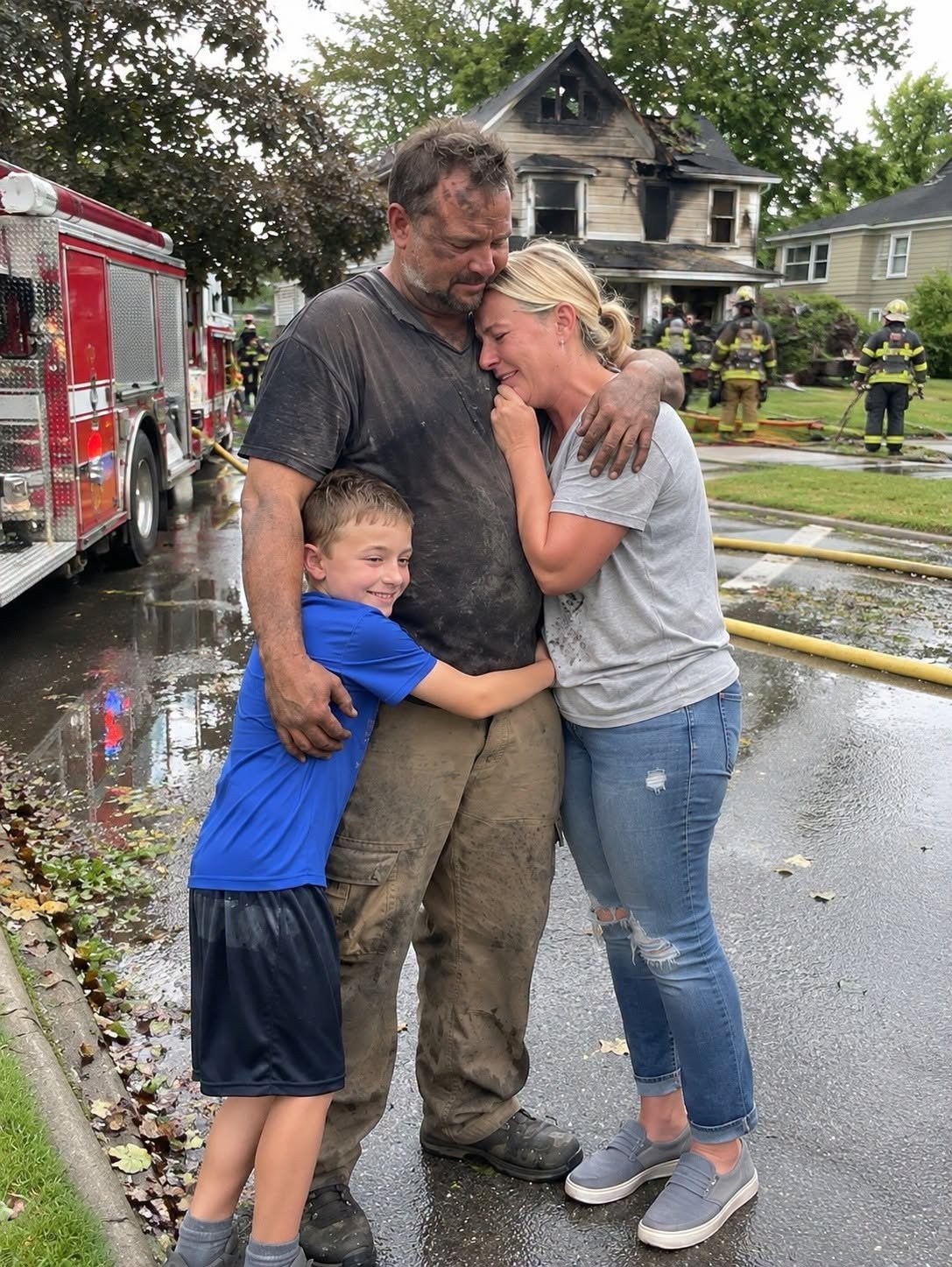
Neighbors stood on the sidewalk, firefighters gathered near a large red fire engine, and several people were carrying boxes and grocery bags.
Our small front yard was filled with supplies.
There were groceries, baby diapers, a stroller, and a new car seat.
Near the top of the steps sat a small white shoebox decorated with a red ribbon.
I stood there, completely speechless.
Emily put her arm around me.
“They started arriving early this morning,” she explained. “At first, there were only a few people. Then more neighbors came. Someone brought the fire department.”
“Why are they here?”
She pointed toward the sidewalk.
The woman from the apartment building was sitting on a folding chair. Her injured leg was supported by a brace, and her little boy was sitting beside her.
It was Nadia.
She had come to find me.
I quickly got dressed and went downstairs.
As soon as I opened the front door, several people began clapping.
I had never experienced anything like it.
The firefighters smiled and greeted me. Neighbors approached to shake my hand, and some offered their congratulations.
Nadia slowly stood with the help of a firefighter.
She walked toward me using her crutches.
“Tony,” she said, smiling through her tears. “You told me you didn’t need me to know your name. But I wanted to thank you properly.”
She introduced herself.
“My name is Nadia Haddad, and this is my son, Sami.”
The little boy looked up at me.
“Hello,” I said.
He smiled shyly and hid behind his mother’s dress.
Nadia explained that someone had recorded part of the emergency response from across the street. The video showed firefighters helping residents leave the building and the moment they brought her and Sami outside.
The video had been shared online, and several people had recognized me from the restaurant.
One customer had written that I was the waiter who always remembered how she liked her coffee.
Another person had explained that I had been dismissed after leaving work during the emergency.
Luis, our former busboy, had also commented that he witnessed what happened inside the restaurant.
By the following morning, many people in Elizabeth had heard about the incident.
The elderly gentleman I had helped direct the firefighters toward was there too.
His name was Eugene Price. He was eighty-four years old and had spent most of his working life in a local factory.
He was sitting in a wheelchair beside his granddaughter.
When he saw me, he extended his hand.
“Young man,” he said, “I wanted to thank you for taking the time to listen to me yesterday. I was frightened, and I didn’t know whether anyone would hear what I was saying.”
I shook his hand.
“I’m glad you’re doing better, Eugene.”
He smiled.
“Thanks to the people who helped us.”
A firefighter captain then approached.
His name was Frank Delvecchio, and he had been part of the crew that responded to the emergency.
He shook my hand.
“Tony, I want to thank you for helping us communicate with the residents. The information you provided was useful.”
I thanked him.
Then he became more serious.
“I also want to make something clear. You should never enter a burning building yourself. Smoke and fire can become dangerous extremely quickly, even for people who think they are prepared. You did the right thing by giving us the information and letting trained firefighters handle the rescue.”
I nodded.
I had already realized how important their training was.
Captain Delvecchio continued.
“Our department sometimes recruits new firefighters. If you’ve ever considered a career in public service, I would encourage you to learn more about the application process.”
He handed me a brochure.
“There is an upcoming recruitment period. The requirements include a written examination, physical testing, and a training academy. I can’t promise anything, but you may find the work meaningful.”
I looked at the brochure.
It was something I had never seriously considered.
Before I could respond, Nadia’s little boy approached me.
He was carrying the white shoebox with the red ribbon.
“This is for your son,” he said.
I looked at Nadia.
She smiled.
“When Emily and I spoke earlier, she mentioned that Kevin needed new shoes. Sami wanted to bring him something.”
I opened the box.
Inside was a beautiful pair of blue sneakers.
They had little dinosaurs on the sides, and they lit up when you stepped on them.
I couldn’t believe it.
They were almost identical to Kevin’s old favorite shoes.
I looked at Nadia, then at Sami.
“Thank you,” I said, struggling to find the right words.
Sami smiled.
“My mom said your boy needs them.”
I sat down on the front steps.
For the first time since losing my job, I felt that perhaps everything would work out.
Emily came outside and sat beside me.
She put her hand on my shoulder.
We were surrounded by people who had taken time out of their busy lives to help a family they barely knew.
It was an experience I would never forget.
Throughout the morning, more neighbors arrived with supplies.
A manager from the local grocery store explained that employees had organized a collection. They had purchased enough food to help us for several weeks.
A family-owned baby store had donated the stroller and car seat.
A local community group had organized the diaper collection.
People from a nearby church had also contributed.
Every small gesture meant something.
Then, around eight-thirty, a black car stopped near the fire engine.
An elegant woman with silver hair stepped out.
Emily immediately recognized her.
“Tony,” she whispered. “That’s Mrs. Castellano.”
Rosemary Castellano owned the Harbor Grill.
She had opened the restaurant with her late husband many years earlier and had spent decades building it into a successful local business.
She approached the steps and looked at me.
“Tony, I owe you an apology.”
I stood up.
She explained that her granddaughter had shown her the video early that morning. After watching it, she had learned what happened at the restaurant.
She had also read the comments from customers and employees.
“I should have known what was happening in my own business,” she said. “I trusted the wrong person to manage it.”
She handed me an envelope.
“Your wages and tips from yesterday are inside, along with additional compensation. I want to make sure you are paid for the work you completed.”
I thanked her.
Then she told me that Greg was no longer managing the restaurant.
She paused before continuing.
“If you want to return, I would like to offer you a different position. I believe you would make an excellent dining room manager.”
I was surprised.
The offer included a higher salary, regular hours, and a stable position.
For the first time in several days, I felt hopeful about our financial situation.
But Captain Delvecchio’s recruitment brochure was still in my hand.
I had two possible paths in front of me.
One was familiar and secure.
The other was something I had never imagined doing.
Before making a decision, I thanked everyone who had come to our home.
Three days later, Greg appeared at my front door.
He looked different from the confident manager I remembered.
His shoulders were lowered, and he seemed uncomfortable.
I stepped outside to speak with him.
“Tony, I wanted to apologize,” he began.
He explained that he had once owned a restaurant in Union. He had operated it for fourteen years before financial difficulties forced him to close.
The experience had affected him deeply.
He had lost much of his savings, and his personal life had become difficult afterward.
“When I started managing the Harbor Grill, I became obsessed with avoiding another financial disaster,” he explained. “I watched every expense and every table. I stopped seeing the people around me.”
He looked down.
“When you left the restaurant, all I thought about was the business. I didn’t stop to understand why you were going.”
He paused.
“I saw the video. I saw the family you helped us locate. And I realized how badly I had handled everything.”
I listened quietly.
“I know an apology doesn’t give you your job back,” he continued. “But I wanted you to hear it from me.”
I thought about what had happened.
Then I answered.
“Greg, I understand that life can be difficult. Everyone has problems. I have them too. I was worried about my rent, my wife, and my children. But sometimes we need to look beyond our own worries and recognize what someone else is going through.”
He nodded.
“I’m sorry, Tony.”
I accepted his apology.
He shook my hand and walked away.
I never saw him again.
Over the next week, Emily and I discussed the job offer and the possibility of applying to the fire department.
The restaurant position was attractive.
It offered a good salary, regular work, and a familiar environment.
The firefighter recruitment process, however, required considerable preparation.
There would be examinations, physical assessments, medical evaluations, and months of training.
I talked with Emily about it every evening.
One night, she asked me a simple question.
“What do you really want to do?”
I thought carefully.
“I’ve always wanted a job where I could make a difference in people’s lives,” I answered. “I never imagined becoming a firefighter, but now I want to learn more about it.”
Emily smiled.
“Then take the opportunity seriously. We can make a decision together.”
I was still worried about our children and the responsibilities waiting for us.
She understood.
“We need stability,” she said. “But we also need to build a life that makes us happy. Whatever you choose, we’ll work through it as a family.”
Her support meant everything.
The following Sunday, I visited Mrs. Castellano at the Harbor Grill.
She was sitting at her usual table near the window.
I thanked her for the offer and explained that I wanted to pursue the firefighter recruitment process.
She listened carefully.
Then she smiled.
“My late husband once wanted to become a firefighter,” she told me. “He took an examination when he was young, but he didn’t meet the physical requirements. He eventually became a cook and built this restaurant with me.”
She laughed softly.
“He always respected people who worked to protect their communities. I think he would have encouraged you.”
She also offered me temporary work at the restaurant while I prepared for the examination.
It was a generous arrangement, and I accepted.
For the next several weeks, I studied every evening after work.
Captain Delvecchio had given me information about the recruitment process and recommended official study materials.
Some firefighters also offered general advice about preparing for the physical assessment.
Eugene Price called regularly to ask how I was doing.
“Don’t give up, young man,” he would say.
I took the examination in June at a high school in Newark.
There were hundreds of candidates.
I had spent six weeks studying, reviewing the material whenever I found a spare moment.
When the results arrived, I discovered that I had passed with a score of ninety-one.
I was overjoyed.
The physical assessment came the following month.
I had to complete several challenging exercises that tested endurance, coordination, and strength.
My knee had bothered me after the April incident, so I had followed medical advice and completed physical therapy before taking the assessment.
After months of preparation, I passed.
Meanwhile, our daughter was born on June nineteenth at Trinitas Regional Medical Center.
She weighed six pounds and eleven ounces.
We named her Joy Nadia Russo.
Emily held her close, and Kevin was fascinated by his new baby sister.
Nadia visited us at the hospital the following day.
She arrived with Sami, who was carrying a stuffed fire truck.
When Nadia read the baby’s name on the hospital card, she looked at Emily and then at me.
“Joy Nadia Russo,” she whispered. “You named her after me?”
Emily smiled.
“We wanted her to grow up knowing the story of a mother who never gave up on protecting her child.”
Nadia became emotional.
She gently touched the baby’s blanket and thanked us.
Sami placed his toy fire truck beside the bassinet.
“She needs one too,” he said.
We all laughed.
A few months later, I began the firefighter training academy.
The program was demanding.
We studied emergency procedures, building construction, fire behavior, equipment operation, first aid, and teamwork.
We also completed supervised practical exercises using professional equipment.
Some evenings, I returned home exhausted.
Kevin thought it was funny when I fell asleep at the kitchen table after dinner.
But I kept going.
I remembered why I had started.
I wanted to build a stable future for my family while doing work that mattered to the community.
In December, I graduated.
The ceremony took place at Elizabeth High School.
Emily attended with Joy, who was sleeping peacefully in her carrier.
Kevin was there too, wearing a small clip-on tie and his blue dinosaur sneakers.
He had already outgrown them, but he insisted on wearing them for the occasion.
Nadia and Sami attended.
Eugene Price came with his granddaughter.
Mrs. Castellano was there as well.
Luis, the former busboy from the Harbor Grill, also attended.
And the crew from Engine 4 sat together near the front.
When my name was announced, I walked across the stage.
The fire chief presented me with my badge.
I looked toward my family.
Emily was smiling, and Kevin was clapping with all his strength.
I felt proud, grateful, and incredibly fortunate.
Captain Delvecchio approached afterward.
He handed me a firefighter helmet.
The front shield displayed the number of the station where I would begin my work.
“We’re glad to have you joining the team,” he said.
I shook his hand.
“Thank you, Captain.”
My first assignment came shortly afterward.
During one of my early shifts, our team responded to a residential emergency.
An elderly woman needed assistance leaving her home.
This time, I was wearing professional protective equipment and working alongside experienced firefighters.
We followed the team’s procedures and helped bring her safely outside.
Paramedics were waiting to examine her.
As she sat on the stretcher, she reached toward me.
“Thank you,” she said. “I don’t even know your name.”
I smiled and introduced myself.
“I’m Tony Russo. I’m with Engine 4.”
She thanked me again.
That evening, I returned home after my shift.
Kevin was waiting near the front door in his pajamas.
“Daddy, did you help somebody today?” he asked.
I smiled.
“Yes, I did.”
He looked at my uniform and then at my badge.
“Just like a real firefighter?”
I knelt beside him.
“Exactly like a real firefighter.”
He threw his arms around my neck.
Then he stomped his feet, making the little lights in his blue dinosaur sneakers flash red and green.
I looked at him and thought about everything that had happened.
Losing my job had been frightening. The uncertainty had been difficult, and there were moments when I wondered whether we would manage everything.
But the kindness of our neighbors, the support of my wife, and the encouragement of people I had barely known had helped us find a new direction.
I learned something important during that time.
A community becomes stronger when people look out for one another. Sometimes a small act of kindness can make an enormous difference in another family’s life.
And sometimes, when you think your world is falling apart, you discover that there are people ready to help you rebuild it.
I had started that spring as a tired waiter worried about paying rent.
I ended the year as a husband, father, and newly trained firefighter, surrounded by people who had become much more than neighbors.
And I never forgot the little blue sneakers with the dinosaurs.
They reminded me that kindness has a way of returning when you least expect it.