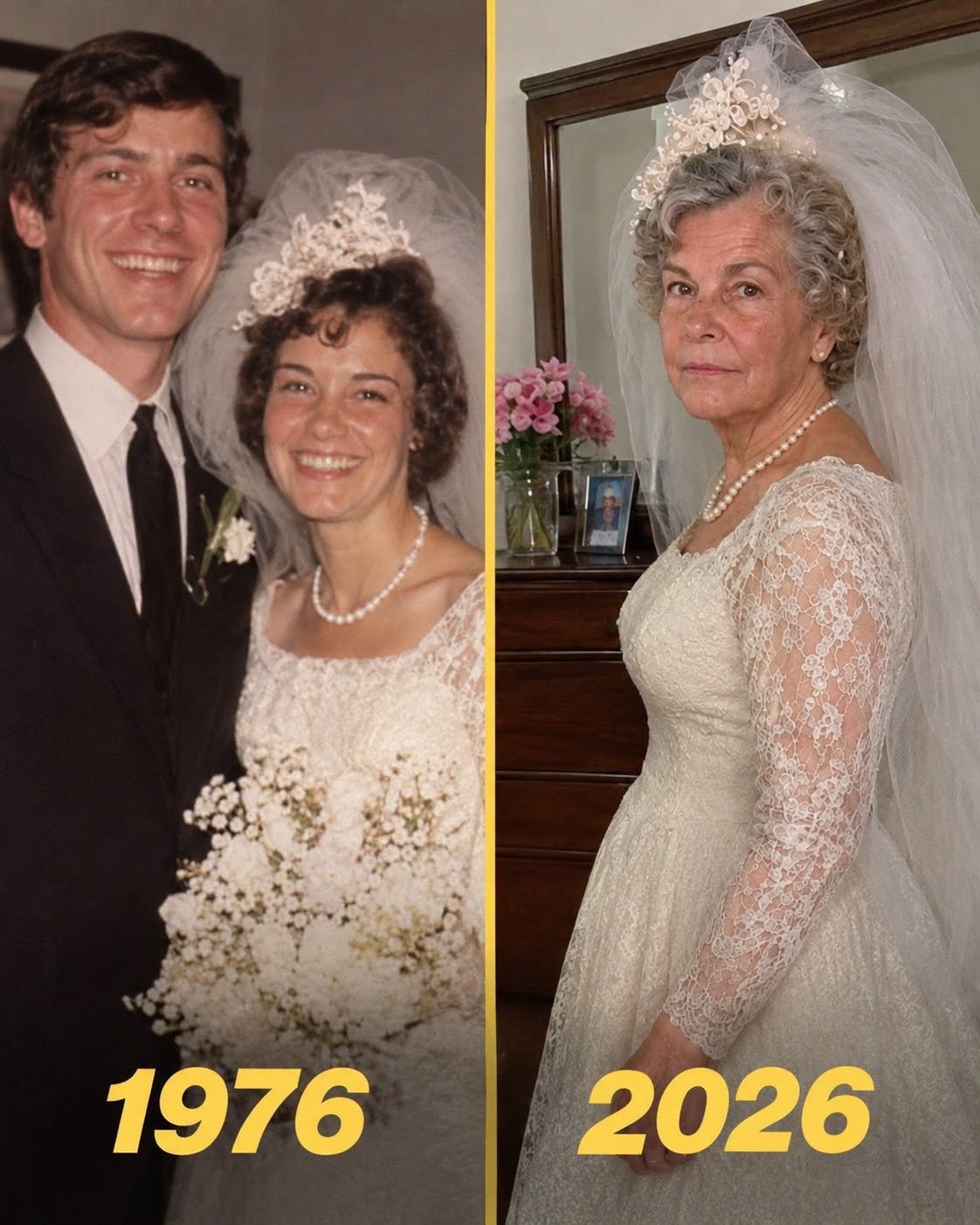
The first time Henry broke my heart, he was standing at the altar, just a few feet away from me. The second time happened fifty years later, when I finally discovered why he had walked away from our wedding.
I was twenty-two when Henry Ashford suddenly announced that he could not marry me. Eighty guests watched as he turned around and hurried out of the church. I spent decades wondering what had happened, but he never contacted me or offered an explanation.
I eventually built a happy life with another man, Robert, raised three children, and became a grandmother. I thought the painful memories belonged to another chapter of my life. Then, one Thursday afternoon, a young attorney appeared at my front door holding an old cardboard box.
“Mrs. Doyle? My name is Daniel Ashford. I’m Henry’s nephew. He’s very ill, and he asked me to bring something to you.”
I immediately recognized the name.
Henry had been part of my life for seven years before our wedding. We met when I was sixteen, and he used to walk me home from the library, even during the coldest winter evenings. His family was financially comfortable, while mine struggled to make ends meet, but Henry never made me feel that our different backgrounds mattered.
His mother, Evelyn, however, never approved of our relationship. She frequently made comments about my family’s circumstances and seemed convinced that her son deserved someone from a wealthier background.
Henry always defended me. When he proposed, he bought a small diamond ring with money he had saved himself. I treasured it because I knew how much it meant to him.
Our wedding was planned for May 8, 1976. My mother and I spent months sewing my dress at our kitchen table. We carefully attached hundreds of tiny decorative pearls, and I remember how excited we were as the ceremony approached.
The evening before the wedding, I stayed home with my mother, finishing the final details of my dress.
The following afternoon, I entered the church with my father. Henry stood at the altar wearing his dark suit. When he saw me, his eyes filled with tears.
For a moment, everything seemed perfect.
But when the minister asked whether he accepted me as his wife, Henry looked directly at me and said, “I don’t.”
He released my hand, turned around, and walked out.
I remained standing beside the minister, holding my bouquet while the guests watched in disbelief. I waited, hoping Henry would return and explain what had happened.
He never did.
For weeks, people asked whether I had done something wrong. Some even suggested that Henry must have discovered a secret about me. I had no answers because I genuinely did not understand his decision.
I eventually moved to Chicago with very little money and started working at a small diner. It was there that I met Robert Doyle, a kind English teacher who regularly visited for coffee and apple pie.
Robert never pressured me to discuss my past. He simply treated me with patience and kindness. Over time, I learned to trust him.
We married in 1979 and built a wonderful life together. We raised three children, bought a small house, celebrated family milestones, and faced ordinary challenges as a team.
Robert was not perfect, but he was dependable and thoughtful. He remembered little details, made me laugh, and always found ways to show that he cared.
We spent forty-two years together before he passed away.
Now, four years after his death, I was sitting at my kitchen table looking at a box connected to the most confusing day of my youth.
Daniel placed the box between us.
Inside was my original wedding invitation, several photographs, and an envelope containing a letter supposedly written by me.
I opened it carefully.
The letter claimed that I had never truly loved Henry. It suggested that I wanted to marry him because of his family’s financial position and that I had no intention of becoming a devoted wife.
My name appeared at the bottom.
I immediately shook my head.
“I never wrote this,” I said.
Daniel nodded.
“Henry knows that now.”
He explained that Henry’s mother had given him the letter on the morning of the wedding. She claimed she had discovered it inside a book I had returned to their house.
Henry believed the handwriting was mine.
Daniel then showed me another folder. Inside were several handwritten pages containing repeated attempts to imitate my writing. There were notes describing the shape of my letters, the way I crossed my T’s, and how I wrote my name.
The pages appeared to show that someone had carefully studied my old letters before creating the false message.
According to the documents, the person responsible was Evelyn.
She had apparently used the letters I had written Henry during his college years to copy my handwriting. A handwriting specialist later examined the documents and concluded that Evelyn had written both the practice pages and the false letter.
I sat quietly.
For fifty years, I had believed something about myself was responsible for losing Henry. Now I discovered that his mother had deliberately created a misunderstanding between us.
But another question immediately came to mind.
“When did Henry discover the truth?”
Daniel looked down.
“Twelve years ago.”
I could hardly believe it.
Henry had known for twelve years that I had never written the letter. He had even hired someone to locate me, but after discovering that I had built a happy family with Robert, he decided not to contact me.
I felt disappointed all over again.
Once more, someone had made an important decision about my life without giving me the opportunity to choose for myself.
After thinking about everything, I decided I needed to speak with Henry directly.
A few days later, I drove to the care facility where he was staying in Dixon.
When I entered his room, I barely recognized the man sitting beside the window. His hair was completely white, and he looked much older than the young man I remembered.
But his eyes were familiar.
“Margaret,” he whispered.
“Hello, Henry.”
We sat quietly for a moment before I asked the question I had carried for decades.
“Why didn’t you simply ask me whether I had written that letter?”
Henry lowered his eyes.
He explained that his mother had presented the letter as proof that I was not sincere. He had been deeply hurt and convinced himself that I had deceived him throughout our relationship.
Instead of speaking with me, he allowed his anger to make the decision.
“I wanted you to understand how I felt,” he admitted. “I thought you had made a fool of me.”
I listened carefully.
“You could have asked me one question,” I replied. “I would have told you the truth. I was home with my mother the entire evening before the wedding, finishing my dress.”
Henry began to cry.
He admitted that he had made a terrible mistake. He also explained that after discovering his mother’s deception twelve years earlier, he had been afraid to contact me.
He thought I might have moved on and that hearing from him would reopen old memories.
“You weren’t protecting me,” I told him gently. “You were protecting yourself from hearing what I might say.”
He nodded.
Then he told me something unexpected.
He had never married.
He had kept all the letters I had written him during his college years. More than two hundred letters were stored in a shoebox beside his chair.
He showed them to me.
I recognized my handwriting immediately.
He explained that he had reread them every year, especially around the anniversary of our wedding.
I looked at the letters and remembered the young woman who had written them. She had believed completely in the future she and Henry were planning.
But that young woman had grown older, built another life, and discovered happiness in unexpected places.
“Do you think you can forgive me?” Henry asked.
I considered his question.
“I forgive you for the mistake you made when you were young,” I said. “But I cannot pretend that the years of silence never happened. I have a family and a life that I love. I am not going to start again with the past.”
Henry understood.
Before leaving, I wished him comfort and peace.
I drove home that afternoon feeling emotional, but also relieved. For the first time in fifty years, I finally understood what had happened.
A few weeks later, Daniel called to tell me that Henry had passed away peacefully in his sleep.
I thanked him for letting me know.
Henry had apparently spent his final days looking out at the river near the care facility. Daniel told me that after my visit, he had seemed calmer and had slept better than he had in years.
I did not attend the funeral, but I sent white roses and baby’s breath.
That evening, I returned to my kitchen and took out Robert’s old recipe card.
It was the recipe he used for oatmeal-chocolate-chip cookies, with an extra pinch of cinnamon that he always insisted made them special.
My daughter and grandchildren were coming over on Sunday, so I began preparing the ingredients.
As I mixed everything together, I remembered the many years Robert and I had shared. Our children, our home, the family celebrations, and all the ordinary moments that had made our life meaningful.
For a long time, I had believed that the unanswered question from my wedding day would always remain with me.
Now I finally had an explanation.
It did not change the past, and it could not return the years I had spent wondering. But it allowed me to understand that the young woman standing at the altar had done nothing wrong.
I placed the cookies in the oven and smiled as I read Robert’s handwritten instructions one more time.
Some chapters of life close without giving us the answers we want. Others take many years to make sense.
But I had learned something important: the past deserves an honest explanation, yet it should never take away our appreciation for the life we have built.
My story with Henry had ended long ago.
My story with Robert, our children, and our grandchildren was the life I would always treasure.