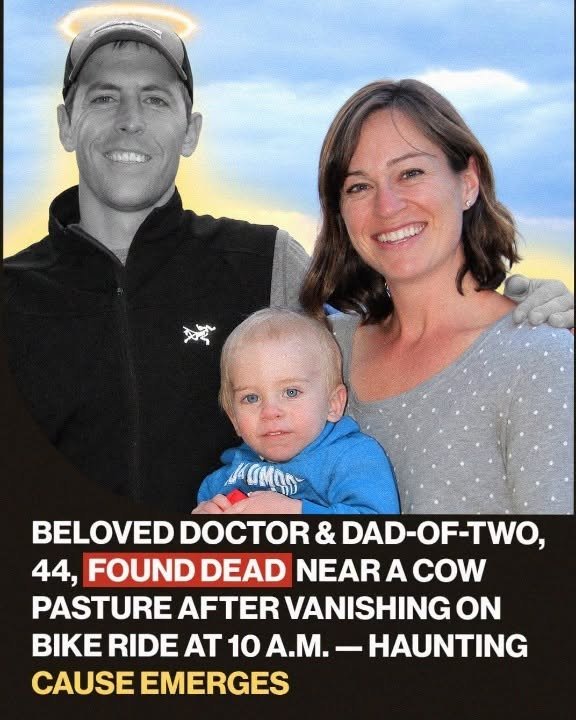
Doctor from Massachusetts disappeared without his mobile, his routine Saturday morning bike ride became a desperate quest.
The circumstances surrounding his death created unsettling suspicions when officials found his body the next day outside a rural cow pasture, but new information soon surfaced.

A Tragic Turn in a Morning Bike Ride
On Saturday, November 7, 2026, at around ten in the morning, Dr. Daniel Arnett, a 44-year-old cardiologist and father of two, was last observed riding his bicycle in Newbury, Massachusetts.
What at first seemed to be an overdue biker quickly turned into a missing-person case, prompting authorities to ask the public for help.
Arnett was allegedly seen near Colby Farm on Scotland Road, which is surrounded by rural roads and farms.
But there was no quick way to find out where his travels had taken him when he failed to return. Soon after, the local police made a request for information regarding Arnett’s location.
In an attempt to help witnesses identify him, they stated that he was last seen wearing a flannel shirt and dark trousers.
Additionally, police asked locals to watch security camera footage for any sightings. The search may have been more focused if there had been even a fleeting sighting of a bike riding along one of the nearby roads.
However, there were two major challenges facing investigators that made tracking his travels more challenging.
The fact that Arnett did not have his mobile with him when he vanished was among the most alarming details.
Additionally, police acknowledged that they were unaware of the bike path he had planned to follow that morning.
Authorities didn’t have a verified schedule or a phone to call him, so they didn’t know where to focus their search.
The doctor had last been seen in a region with lots of rural roads and fields, so the uncertainty was particularly concerning.
According to Boston 25 News, the search was centred on the doctor’s most recent known travels and the potential for locals to have recorded relevant evidence.
The activity itself was not exceptional, but the surroundings were. One of Arnett’s favourite activities was cycling, and his family would thereafter recall him as someone who truly enjoyed being outside.
Nevertheless, the search would take a disastrous turn by Sunday afternoon.
Authorities arrived in the vicinity of Tendercrop Farm in Newbury on Sunday, November 8, after a dead man was found next to a cow pasture.
Arnett had last been saw riding his bicycle a few miles away from this place. The body was discovered just after 2 p.m., roughly a day after the doctor vanished, according to the Essex County District Attorney’s Office.
Numerous agencies, including the Massachusetts State Police detectives attached to the district attorney’s office and the Newbury Police and Fire Departments, were brought to the scene by the finding.
The Massachusetts Office of the Chief Medical Examiner also responded. Arnett’s friends and family were reportedly there at the scene.
Their participation demonstrated how terrible the probe had become on a personal level for individuals who were acquainted with the missing doctor.
Officials confirmed the devastating news on Monday, November 9: the deceased man was Beverly, Massachusetts resident Dr. Daniel Arnett.
The circumstances behind the doctor’s death were first not disclosed, despite the fact that authorities had established his identification.
As a result, the confirmation ended one aspect of the search but left an important question unanswered. But from the start, the district attorney’s office was clear: investigators did not suspect foul play.
Because officials were looking into another death that same weekend in nearby Rowley, the distinction was very crucial.
Officials [did not link the instances], but the second case concerned a male found in the Mill River region. Investigators did not suggest that Arnett had been attacked or that another individual was accountable for his death, despite the media interest surrounding the two findings.
But the exact cause had not yet been disclosed.
Beyond the inquiry, Arnett was a reputable physician with a focus on cardiovascular health.
His area of expertise at Beth Israel Lahey Health was the diagnosis and treatment of disorders pertaining to the heart and circulatory system.
Cardiac imaging, heart failure, coronary artery disease, atrial fibrillation, and preventive cardiology were among the clinical interests of the doctor who had been employed by the health system since 2021.
His obituary described a profession in medicine that was developed by years of schooling and specialised training.
After graduating from the University of Colorado with a medical degree, Arnett trained as a cardiology fellow at the University of Utah and completed his internal medicine residency at the University of Washington.
He played football and received his bachelor’s degree from Colorado College before going into medicine.
His academic background went beyond clinical medicine, as evidenced by his subsequent master’s degree in chemistry from the University of Denver.
These accomplishments were the result of years of hard work in a challenging field.
However, his family’s homage also brought to light a different aspect of the physician, one that was characterised by strong interpersonal bonds and a profound love of nature.
Arnett was a cherished husband, father, son, and brother. He was born in Salida, Colorado.
According to his obituary, he loved hiking, fishing with friends and family, cycling, and cross-country and downhill skiing.
The circumstances surrounding his disappearance were especially tragic because of those interests. The doctor had disappeared while engaging in what had long been a significant and pleasurable aspect of his life.
Spencer David Arnett and Louis Bernard Arnett, Arnett’s two kids, and his wife, Anne Bernard Arnett, survive him.
In addition, he leaves behind his brother Scott Moore, sister Erin Arnett, parents David and Margaret Arnett, and numerous members of his extended family.
Legacy also released the family’s obituary, which paints a picture of a guy whose life was divided between outdoor activities, family, and medical. The events that led to his death are not explained.
New details regarding the doctor’s passing started to surface as family members got ready to pay tribute to him.
In addition to offering the solution that was absent from the original studies, the findings would highlight a more significant problem that affects medical practitioners across the United States.
Days after Arnett’s body was found on November 12, more information about the missing cardiologist was revealed.
According to the New York Post, which cited data from the Boston Office of the Chief Medical Examiner, Arnett had committed suicide.
The results supported the investigators’ earlier claim that there was no suspicion of foul play. Additionally, the finding gave a case that had been officially handled as a missing-cyclist investigation a terrible new dimension.
The cause of Arnett’s suicide death has not been publicly confirmed. The family’s obituary and the stated medical examiner’s conclusions do not identify a particular personal or professional cause that contributed to the tragedy.
His death should not be reduced to conjecture about what he could have been going through in private; it is a great loss for his family and community.
However, the tragedy highlights a problem that has long worried scholars and medical associations: the mental health issues that doctors face and the obstacles that could keep them from getting help.
Despite spending their professional lives treating patients and assisting others with medical issues, doctors are not exempt from psychological distress.
Concerns regarding burnout, depression, and suicide among physicians have been brought up time and time again by research.
According to studies presented at the 2018 American Psychiatric Association meeting, between 300 and 400 doctors in the US commit suicide each year, according to a December 2020 Good Morning America broadcast.
Additionally, compared to other occupations, doctors have remarkably high suicide rates, according to historical studies.
Nevertheless, the numbers are based on past projections rather than a conclusive evaluation of current occupational suicide rates.
The stigma associated with mental health therapy in the medical field is one of the issues brought up by researchers.
Some physicians have expressed concerns that getting treatment or revealing a mental health diagnosis could have an impact on their credentials, professional licenses, or employment prospects.
Psychiatrist Dr. Yalda Safai gave a firsthand example of how she was concerned about possible professional consequences when medical licensure applications asked about her mental health history.
Her story highlighted a larger issue: medical practitioners may recognise the value of mental health care while still being afraid of the repercussions of seeking it.
While talking about initiatives to provide psychological support for medical personnel, Dr. Angela Mills, chair of emergency medicine at Columbia University, addressed these issues.
“Health care professionals often forgo mental health treatment due to the significant stigma in both our society and the medical community, as well as due to the fear of professional repercussions,” Mills remarked to Newsweek.
In recent years, efforts to solve the problem have accelerated. The Dr. Lorna Breen Health Care Provider Protection Act, named for an emergency physician who committed suicide in 2020, was signed into law by President Joe Biden in 2022.
The law was created to address issues like burnout and job stress and to improve mental health services for healthcare professionals.
More recently, in November 2025, the American Medical Association stated that over 1,800 healthcare organisations and dozens of licensing boards have eliminated invasive mental health questions from their credentialing and licensing procedures.
The modifications were an attempt to facilitate medical professionals’ access to care without needless concerns about their careers.
These programs show that resilience on an individual basis is not the only factor in physician well-being. Access to private treatment, institutional support, and workplace culture can all be important in managing mental health issues.
However, there is no proof in the reporting that suggests Arnett’s death was caused by mental health stigma or professional fatigue.
The larger research does not explain his particular situation; rather, it offers a public health perspective.
The doctor’s family was getting ready to bid him farewell when the probe revealed details concerning his demise.
A memorial service for Arnett was slated for Saturday, November 14 at 10 a.m. at Cruiseport in Gloucester, Massachusetts, according to his obituary.
Friends and family were asked to get together in his honour. In keeping with Arnett’s love of the outdoors and the natural world, the family also asked individuals who would like to donate to the National Park Foundation.
His obituary honours a man whose life went well beyond his occupation. In addition to being a husband, a brother, a father of two sons, and an enthusiastic outdoor enthusiast, his loved ones are currently grieving a terrible loss.
Although his death’s circumstances have come to light, they do not fully capture his existence.
His relationships, accomplishments, and common experiences will continue to play a significant role in how others who knew him remember him.
People who are experiencing emotional pain, overpowering feelings, or suicidal thoughts can get support.
Suicide prevention is a major public health priority. The 988 Suicide & Crisis Lifeline in the US offers free, private assistance seven days a week, twenty-four hours a day.
Anyone can visit 988lifeline.org or call or text 988 if they are going through a mental health crisis or are worried about someone else.
Healthcare professionals should treat mental health issues as seriously as they do physical health issues. Getting expert assistance can be a crucial first step in getting the right care.
Even if a person is not contemplating suicide, they can still reach the 988 Lifeline. Its qualified counsellors are able to listen, offer assistance, and assist callers in locating options.
Arnett’s passing serves as a sobering reminder of how little is known about the personal hardships of others. 100vw, 1024px” data-lazy-src=”https://i0.wp.com/middleagedclub.com/wp-content/uploads/2026/11/4yrty56464.webp?resize=1024%2C767&ssl=1″ /></figure>
<p class=)
 100vw, 768px” data-lazy-src=”https://i0.wp.com/middleagedclub.com/wp-content/uploads/2026/11/56trty5646545.webp?resize=768%2C1024&ssl=1″ /></figure>
<p class=)
The Lost Phone That Made the Search More Difficult
 100vw, 1024px” data-lazy-src=”https://i0.wp.com/middleagedclub.com/wp-content/uploads/2026/11/54yrt4656454.webp?resize=1024%2C679&ssl=1″ /></figure>
<p class=)
An Unsettling Find Close to a Cow Pasture
 100vw, 1024px” data-lazy-src=”https://i0.wp.com/middleagedclub.com/wp-content/uploads/2026/11/try6456rtyrty.webp?resize=1024%2C682&ssl=1″ /></figure>
<p class=)
Investigators Respond to a Crucial Question
 100vw, 768px” data-lazy-src=”https://i0.wp.com/middleagedclub.com/wp-content/uploads/2026/11/56try456456.webp?resize=768%2C770&ssl=1″ /></figure>
<p class=)
Dr. Daniel Arnett: Who Was He?
 100vw, 768px” data-lazy-src=”https://i0.wp.com/middleagedclub.com/wp-content/uploads/2026/11/54yrty56464.webp?resize=768%2C815&ssl=1″ /></figure>
<p class=)
The Passions and Family He Leaves Behind
The Doctor’s Cause of Death Is Revealed by New Information
 100vw, 768px” data-lazy-src=”https://i0.wp.com/middleagedclub.com/wp-content/uploads/2026/11/54rty4564654.webp?resize=768%2C796&ssl=1″ /></figure>
<p class=)
A Crisis of Mental Health in the Medical Field
 100vw, 768px” data-lazy-src=”https://i0.wp.com/middleagedclub.com/wp-content/uploads/2026/11/546ty465454.webp?resize=768%2C770&ssl=1″ /></figure>
<p class=)
The Stigma That May Prevent Physicians from Speaking
 100vw, 1024px” data-lazy-src=”https://i0.wp.com/middleagedclub.com/wp-content/uploads/2026/11/3tert4535434.webp?resize=1024%2C683&ssl=1″ /></figure>
<p class=)
A Last Goodbye to a Father and Husband
 100vw, 1024px” data-lazy-src=”https://i0.wp.com/middleagedclub.com/wp-content/uploads/2026/11/43tert453453.webp?resize=1024%2C768&ssl=1″ /></figure>
<p class=)
Awareness of Suicide: You’re Not Alone