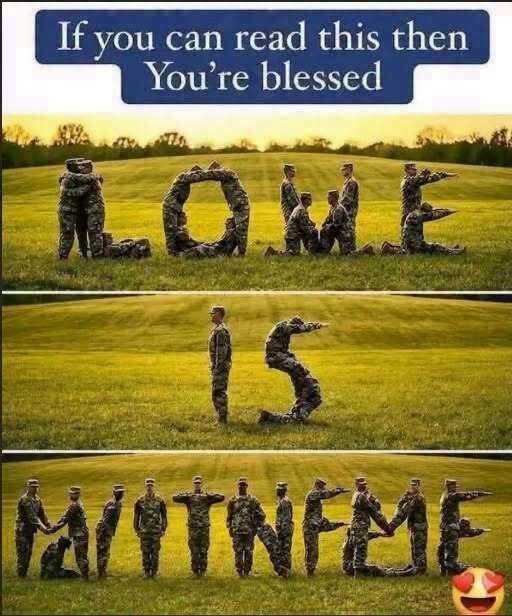
While preparing a special exhibition, Ruth discovered that a seemingly ordinary photograph contained a mystery that had been overlooked for years. The image showed several camouflaged soldiers carefully arranged across a wide grassy field. At first glance, it appeared to be a historical photograph with an unusual formation. However, a folded caption attached to the picture caught her attention.
Ruth examined the photograph more closely. The soldiers appeared to form several large words, with LOVE and IS clearly visible. The final part of the message, however, was difficult to understand. She wondered whether the original arrangement had been photographed from the correct angle or whether an important detail had been lost over time.
She immediately contacted Ellen, who was coordinating the exhibition. Ellen explained that the wording approved for the display was WITH ME. According to the existing preparation notes, that was the version the team had agreed to use. Ruth accepted the explanation but remained curious about how the original message had been established.
Later that afternoon, she searched through several historical references and discovered another possible interpretation. One version suggested that the final words might have been WITHIN ME rather than WITH ME. Although the difference appeared small, it changed the meaning of the entire message.
Ruth brought the discovery to Ellen, who advised her to examine Carl’s printing proofs before making any changes. She also reminded Ruth that the exhibition preparations needed to be completed before Thursday. Every display label, photograph, and supporting document had to be checked carefully.
As Ruth reviewed the paperwork, she noticed something unexpected. Her signature appeared on a Monday approval request confirming the wording for the exhibition. She remembered signing the document but had believed that the historical reference had already been verified by the appropriate team.
Ellen explained that the approval record was part of the official preparation process and could not simply be removed. Any correction would need to be documented properly. Ruth understood the importance of maintaining accurate records, but she began to worry that visitors might receive incomplete information if the wording remained uncertain.
At eleven o’clock, Carl arrived with the printing proofs. He placed several sheets on the table, showing the proposed four-inch label, the relevant dates, and the typography measurements. Ruth examined both sides of the document, hoping to find a reference to the original photograph or an explanation of how the wording had been confirmed.
There was nothing.
The proofs clearly demonstrated what would appear in the exhibition, but they did not identify the historical source behind the final phrase. Carl explained that his responsibility had been to prepare the wording and measurements supplied to him. He had not originally been asked to investigate the photograph’s background.
However, he mentioned finding an interesting handwritten notation while reviewing an older folder.
The notation referred to an earlier letter chart.
This immediately caught Ruth’s attention. She and Carl searched through the available documents, carefully arranging each paper according to its apparent connection with the exhibition. Eventually, they discovered two different label versions, several measurement notes, and a small torn fragment of paper.
Unfortunately, the letter chart mentioned in the handwritten notation was nowhere to be found.
Rather than making assumptions, Ruth decided that the available evidence should be preserved. She wanted the exhibition team to distinguish between confirmed information and details that still required verification. Even a small historical caption deserved the same attention as the larger displays.
To keep the preparation moving, Ruth personally paid three dollars for twenty additional copies of the proposed labels, each costing fifteen cents. She declined reimbursement because she did not want the printing arrangements delayed while waiting for Ellen’s approval.
By the end of the afternoon, the team had made progress, but the original wording remained unresolved. Ruth placed the photograph, printing proofs, handwritten notation, and torn fragment together in a clearly organized folder.
She knew that finding the missing letter chart might finally explain the mystery.
More importantly, she had learned an important lesson about historical displays: a printed statement is not necessarily proof of its origin. Sometimes, the smallest detail can raise the most important questions, and careful research is the best way to find reliable answers.