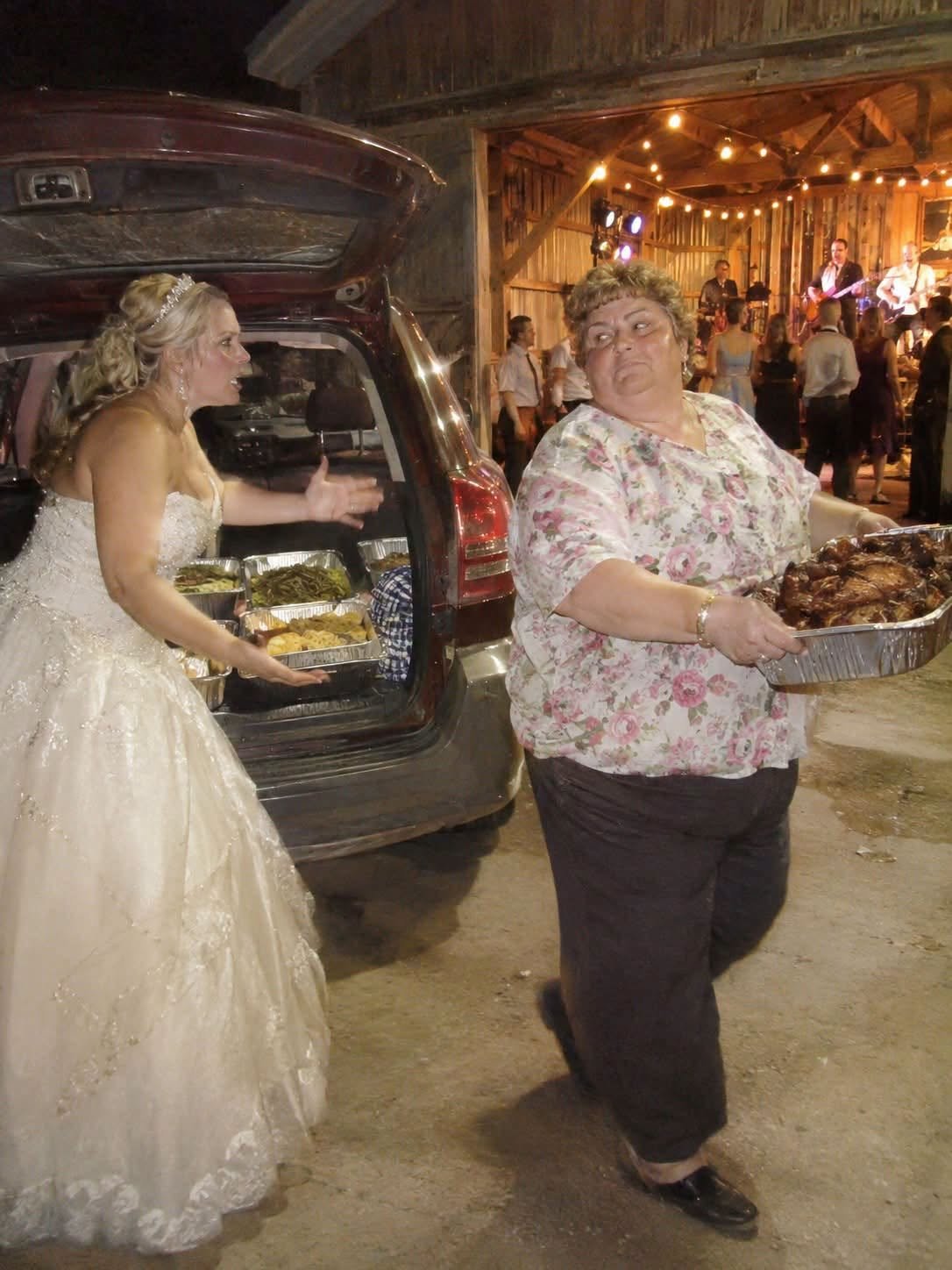
I found Aunt Verlene in the church parking lot at 9:15 on my wedding night. She was standing behind her SUV, holding a large covered pan of brisket. The back of her vehicle was already filled with food containers. There were pans of green beans, mashed potatoes, ham, pulled pork, macaroni and cheese, and several trays of homemade rolls.
Almost everything from our wedding dinner was in her vehicle.
“Verlene,” I called.
She turned around without looking particularly surprised.
“I’m just putting some things somewhere cooler, sweetheart,” she explained. “I don’t want all this wonderful food to go to waste.”
It was a warm June evening in Kentucky. Her vehicle certainly wasn’t a refrigerator, and I knew something wasn’t right.
My name is Carrie Anne Musgrave. I had married Reed Tolliver just six hours earlier. I was twenty-six years old, still wearing my mother’s wedding dress, and standing barefoot on the gravel outside the church.
Before explaining what happened next, I need to tell you about the wedding dinner.
My mother, Doreen, had worked in the Pineville Elementary School cafeteria for thirty-one years. Cooking for large groups was something she loved. She knew exactly how much food children needed, how to organize a busy kitchen, and how to prepare meals that made people feel welcome.
When Reed proposed, Mom immediately offered to prepare our wedding dinner.
We couldn’t afford professional catering. Our entire wedding budget was limited, so her offer meant more to us than she could imagine.
For five months, she planned everything on a yellow legal pad. She organized ingredients, assigned responsibilities, borrowed serving dishes, and arranged for several friends to help.
She began cooking three days before the wedding.
There were two large briskets, baked ham, pulled pork, green beans, mashed potatoes, macaroni and cheese, corn pudding, coleslaw, deviled eggs, homemade pies, and hundreds of dinner rolls.
She even stayed beside my uncle’s smoker for hours to make sure the brisket turned out perfectly.
The day before the wedding, I visited her in the church kitchen. Her glasses were fogged from the steam, and flour covered her apron.
She handed me a warm roll.
“Try this,” she said.
It was wonderful.
“People will know these are homemade,” she added proudly.
I hugged her, knowing how much effort she had put into making our day special.
Now, several hours later, I was watching much of that food disappear into Aunt Verlene’s vehicle.
“The musicians haven’t eaten yet,” I reminded her. “Neither have the young people helping with the tables.”
She shrugged.
“They can manage. There will be other food.”
I looked through the fellowship hall doors. My mother was dancing with my father beneath the paper decorations. She had finally taken off her shoes and was enjoying the celebration after several exhausting days.
I didn’t want to interrupt that moment.
Instead, I walked toward Verlene and reached for the brisket.
“What are you doing?” she asked.
“Making sure our musicians get dinner.”
I carried the heavy pan across the parking lot toward the band’s van.
The musicians had been playing since early evening. There were five of them, including a young woman named Lacey who played the upright bass.
They were sitting beside their van, drinking water during a short break.
“Have any of you eaten?” I asked.
Lacey shook her head.
“We thought we’d find somewhere afterward,” she answered.
“The nearest restaurant is quite a drive,” I said. “Please eat with us first.”
I placed the brisket on their tailgate and opened the cover.
The musicians smiled when they smelled the food.
Before anyone could say anything else, I heard footsteps behind me.
It was Reed.
My new husband looked toward the vehicle, then at the food in front of the musicians. His expression changed when he realized what had happened.
He walked toward his aunt.
Instead of shouting, he asked a simple question.
“Aunt Verlene, how many people are you feeding these days?”
Her expression immediately changed.
“Six,” she whispered.
Reed looked at her carefully.
“What do you mean?”
She lowered her eyes.
“Ray and I have the four children now. Tammy’s children. We’ve been caring for them since March.”
I stood quietly, trying to understand.
The children were nine, seven, four, and fourteen months old. Their mother was away dealing with serious personal difficulties, and Verlene and her husband had taken responsibility for raising them.
Uncle Ray had also been experiencing significant health difficulties. He depended on medical equipment and could no longer work as he once had.
Verlene explained that their household income was limited. Between their regular benefits and the assistance they received for caring for the children, managing everyday expenses had become increasingly difficult.
Food, clothing, school supplies, and other necessities added up quickly.
“I never thought we’d be in this situation,” she said. “I thought we could manage everything ourselves.”
She explained that she had noticed the leftover food being placed into containers earlier in the evening. She thought taking some home would help her family get through several weeks.
“I wasn’t thinking clearly,” she admitted. “I just saw all that food and thought about the children.”
Reed listened without interrupting.
Then he looked at the pans inside the vehicle.
“Aunt Verlene, we need to put everything back.”
She nodded slowly.
“The musicians and the young helpers haven’t eaten. They worked hard for us tonight.”
He paused before continuing.
“After everyone has had dinner, we’ll prepare a generous amount for you. We’ll bring it to your house tomorrow and help you organize everything.”
He placed a hand on her shoulder.
“You don’t have to take anything secretly. We’re family. Just talk to us.”
Verlene began crying.
“I didn’t want anyone to know,” she explained. “I was embarrassed to ask for help.”
Reed shook his head gently.
“You helped raise me when I was little. I haven’t forgotten that.”
The three of us returned the food to the church kitchen.
Aunt Nita was washing serving spoons when we arrived. She looked at the food, then at Verlene, but didn’t ask questions.
She simply turned on the stove to warm everything.
The musicians were the first to receive their plates. I served them brisket, ham, vegetables, potatoes, macaroni, and several homemade rolls.
Lacey tasted the brisket and smiled.
“Who made this?” she asked.
“My mother,” I answered.
“She should open a restaurant,” Lacey joked.
The young musicians enjoyed their dinner, and the evening became a little more relaxed.
Next, we invited the six teenagers who had been helping with the wedding. They had spent hours carrying trays, clearing tables, and serving drinks.
They had barely eaten anything.
I watched them sit together around the kitchen table, enjoying the meal.
One young man smiled and said, “Miss Carrie, your mother should cook for every wedding in town.”
I laughed.
“She probably would if everyone asked nicely.”
Verlene remained in the kitchen. She quietly helped Aunt Nita dry the serving spoons and stack the plates.
Nobody embarrassed her or made a scene.
Later, Reed and I returned to the reception and shared another dance beneath the paper lanterns.
“Thank you,” I whispered.
“For what?” he asked.
“For understanding what happened without making things worse.”
He explained that Verlene had cared for him during several summers when he was young. She had always made sure he had meals, clean clothes, and a place to stay.
He wasn’t willing to let her take food from people who still needed to eat, but he also didn’t want her family to go without necessities.
That was when I understood something important about the man I had married.
He could recognize a mistake without forgetting the person who made it.
Near the end of the evening, I found my mother in the kitchen cleaning the serving pans.
I explained what had happened.
She listened quietly.
When I finished, she asked one question.
“How much food is left?”
I looked around.
There was still plenty.
Mom opened a cabinet and took out several large freezer bags.
“Then let’s prepare some meals for them,” she said.
She began dividing the food into practical portions. We packed brisket, ham, pulled pork, vegetables, potatoes, macaroni, and rolls.
Reed helped label everything so Verlene could easily identify each container.
We worked together until late that night.
When we finished, there were several coolers filled with meals.
Mom carried one toward Verlene.
“Take these home,” she said. “There is enough for everyone.”
Verlene looked uncomfortable.
“I don’t want you to think I’m taking advantage of you.”
Mom smiled.
“You’re not. We prepared more food than we needed. That’s what happens when I cook for a big celebration.”
Then she added something I will never forget.
“You’ve spent years helping other people. Let somebody help you this time.”
Verlene finally accepted the food.
The following morning, Reed and I postponed our planned trip and drove to her house with the coolers.
Her home was small but tidy. Toys were arranged throughout the living room, and the children’s belongings occupied nearly every available corner.
The oldest granddaughter answered the door.
“Is Mamaw awake?” Reed asked.
“She is getting dressed,” the girl replied.
The children gathered around us when they noticed the coolers.
We brought everything into the kitchen and placed the meals in the freezer.
Uncle Ray greeted us from his chair near the window.
He smiled when he saw Reed.
“Congratulations on getting married, son,” he said.
“Thank you, Uncle Ray.”
We stayed for a while, helping organize the kitchen and preparing a simple breakfast for the children.
Verlene eventually came out of her bedroom.
She looked at the full freezer and became emotional again.
“Thank you,” she whispered.
Mom’s food had helped for the moment, but we knew the family needed more than one delivery.
Over the following days, Reed and I discussed ways to support them without making Verlene feel uncomfortable.
We also contacted several people we trusted who could explain what local family assistance programs and community resources were available.
Unfortunately, a few days later, a photograph from the wedding appeared on social media.
One of Reed’s younger relatives had taken a picture of Verlene standing beside her vehicle. The accompanying message suggested that she had tried to take the entire wedding dinner.
Several people began making unkind comments without knowing the circumstances.
Verlene was deeply upset.
When we visited her, she explained that she was worried people would misunderstand the situation.
“I made a mistake,” she said. “But I never wanted everybody talking about my family.”
I looked at Reed.
He suggested that I explain what had happened without sharing private details about the children or their mother.
So I wrote a message.
I explained that Verlene had made a poor decision, but that the situation was more complicated than a photograph could show. I also explained how my mother had prepared extra food and willingly shared the leftovers with the family.
I asked people to stop making assumptions about someone else’s circumstances.
I didn’t reveal the children’s personal information.
The response was encouraging. Several neighbors and longtime friends offered to help.
My mother’s friends from the local Homemakers Club were especially supportive.
A few days later, Mom visited Verlene with several friends. They brought casseroles, fresh bread, vegetables, and other homemade meals.
Verlene initially insisted that she didn’t need anything.
Mom smiled.
“We aren’t here because we feel sorry for you. We’re here because we care about you.”
She explained that everyone experiences difficult seasons in life, and accepting help doesn’t make someone less capable or less valuable.
Eventually, Verlene welcomed them into her kitchen.
The women spent the afternoon organizing food, sharing recipes, and talking about everyday life.
Something changed that day.
Verlene no longer felt that she had to hide her difficulties from everyone.
A few weeks later, she visited my mother at the church kitchen.
She arrived carrying an apron, a bag of flour, and several lemons.
“I heard you’re preparing for the community bake sale,” she said.
Mom looked up from her work.
“I could certainly use another pair of hands.”
Verlene smiled.
“I brought my grandmother’s lemon pie recipe. I thought you might like to try it.”
Mom pushed a rolling pin across the table.
“Then let’s get started.”
The two women began preparing pies together.
They had different methods, and they disagreed about the proper way to prepare the crust. But their conversations were filled with laughter.
Before long, they were working together every Wednesday.
Their friendship became one of the happiest parts of our family life.
Later that year, my mother suggested organizing a monthly community supper at Mt. Zion Baptist Church.
The idea was simple: prepare a warm meal and welcome anyone who wanted to attend.
There would be no complicated registration and no uncomfortable questions.
The Homemakers Club volunteered to help.
Verlene offered to organize the serving line.
The first supper attracted more people than anyone expected. Families, older residents, workers, and neighbors gathered around the tables.
Everyone was welcomed.
My mother prepared the food, and Verlene made sure every guest received a generous plate.
The children helped with simple tasks. Kaylee poured drinks, Brantley arranged napkins, and Destiny enjoyed spending time with my mother in the kitchen.
Even the musicians from our wedding returned to play.
It became a monthly tradition.
Over time, other neighbors began contributing meals and volunteering their time.
What started as one family’s difficult evening had grown into something that brought an entire community closer together.
Looking back, I still remember finding Aunt Verlene beside her vehicle on my wedding night.
She should not have taken food before everyone had eaten. She understood that, and she apologized.
But that evening also revealed how easily people can struggle quietly while trying to maintain their dignity.
My mother taught me that kindness is not simply about giving someone something they need. Sometimes it means making them feel welcome enough to accept it.
Reed taught me that standing up for what is right doesn’t require humiliating another person.
And Verlene taught me that accepting help can be the beginning of a new chapter.
Our wedding was supposed to celebrate the beginning of a marriage.
Instead, it also became the beginning of a wonderful community tradition.
Today, the monthly supper continues.
My mother still prepares homemade rolls, and Verlene still makes her famous lemon pie.
Sometimes I visit the church kitchen and find them standing beside each other, laughing about recipes and arguing over whose cooking method is better.
Last Sunday, I noticed something on the serving table.
There was a covered basket filled with fresh rolls. A small handwritten note rested beside it.
It read:
FOR ANYONE WHO NEEDS THEM. PLEASE TAKE SOME. THERE IS ALWAYS ENOUGH TO SHARE.
I smiled when I read it.
Because I finally understood what my mother had been teaching me all along.
A meal can fill an empty stomach, but kindness can make someone feel that they belong.