The terminal smelled like coffee, disinfectant, and impatience.
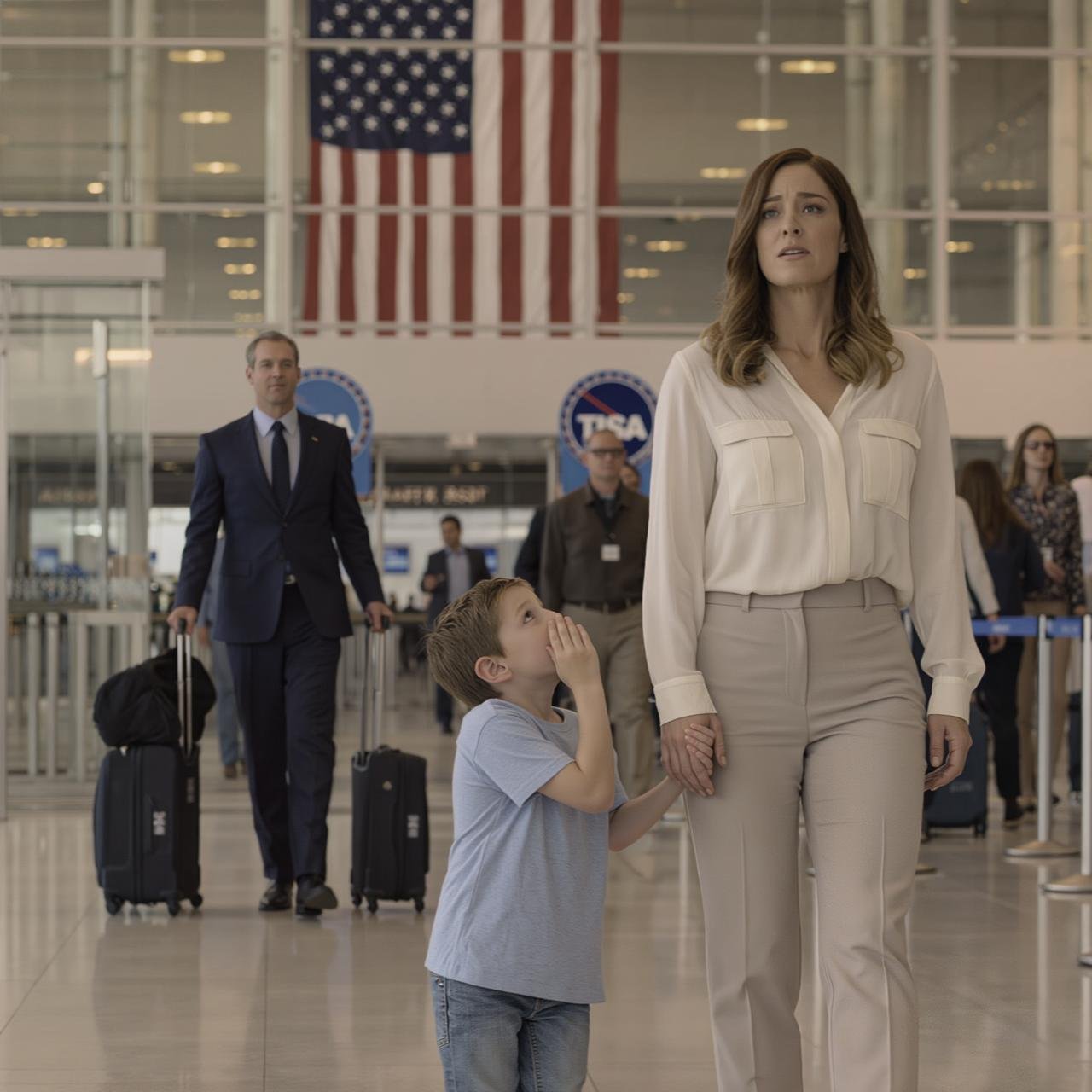
That was the first thing I noticed as we stood near the security checkpoint at Hartsfield–Jackson, watching people rush past us with rolling suitcases and half-finished drinks.
The fluorescent lights overhead were too bright, flattening everything into harsh clarity. A TV mounted near the ceiling murmured about traffic on I-85 and a stormsystem moving east, the volume just low enough to fade into background noise.
It should have been ordinary.
Just another Thursday night. Just another business trip.
I was exhausted in the quiet, dangerous way you don’t notice until it’s already taken root in your bones. The kind of tired that doesn’t come from lack of sleep but from holding everything together for too long without ever being asked how you’re doing.
My husband, Quasi, stood beside me, perfectly put together as always. Gray custom suit pressed sharp enough to cut, polished Italian shoes, leather briefcase hanging easily from his hand. He wore confidence like a second skin. The expensive cologne I’d bought him at Lenox Mall for his birthday clung faintly to the air around him.
To anyone watching, we were the picture of success. A polished Atlanta family. A Black executive on the rise, his loyal wife and well-dressed child seeing him off.
By my side was our son, Kenzo.
Six years old. Small hand tucked into mine, fingers damp with sweat. He wore his favorite Hawks hoodie and light-up sneakers that blinked red and blue when he shifted his weight. His dinosaur backpack hung crooked on one shoulder, stuffed with a coloring book and a plastic T-rex he took everywhere.
Kenzo was usually quiet, but this was different. He was too still. His body rigid, his eyes tracking everything around us instead of bouncing with curiosity like they usually did. It felt like he was holding something in, something too big for him.
“This meeting in Chicago is crucial, babe,” Quasi said, pulling me into a hug that felt practiced. Familiar. Almost hollow. “Three days tops. I’ll be back before you know it.”
I nodded and smiled because that’s what I’d learned to do. Because smiling kept things smooth.
“Of course,” I said. “We’ll be fine.”
Kenzo’s grip tightened around my hand.
Quasi crouched in front of him, placing both hands on Kenzo’s shoulders, angling his face just right, like he knew how this moment should look.
“You take care of Mama for me, all right?” he said warmly.
Kenzo didn’t answer. He just nodded, eyes locked on his father’s face with an intensity that made my stomach twist.
It was the kind of look you give when you’re afraid you won’t see someone again.
Quasi kissed Kenzo’s forehead, then my cheek.
“Love you both.”
Then he turned and walked toward the TSA line without looking back, blending into the river of travelers heading toward metal detectors and gates.
I watched until I couldn’t see him anymore.
Only then did I let out a breath I hadn’t realized I was holding.
“Okay, baby,” I said softly. “Let’s go home.”
We started walking toward the parking deck, our footsteps echoing against the polished floor. Stores were closing, metal grates half-pulled down. The flight boards flickered overhead with last-call announcements. People jogged past us clutching Chick-fil-A bags and backpacks.
Kenzo lagged behind, dragging his feet.
“You okay, sweetie?” I asked. “You’ve been really quiet.”
He didn’t answer.
We were almost at the glass doors when he stopped so suddenly I nearly stumbled.
“Mama.”
I turned, annoyed for half a second, then instantly alarmed by the sound of his voice.
“What is it?”
He looked up at me, and the fear in his eyes punched the air out of my chest.
“Mama,” he whispered, tugging my hand hard, “we can’t go back home.”
I crouched in front of him, trying to keep my voice calm. “What do you mean? Of course we’re going home. It’s late.”
He shook his head violently, tears already pooling. “No. Please. We can’t. Something bad is going to happen.”
A few people glanced our way. I gently pulled him closer.
“Kenzo, baby, listen to me. You’re safe. Daddy’s just on a trip. Nothing bad is going to happen.”
“Mama, please,” he said, his voice breaking. “This time you have to believe me.”
This time.
The words stung because they were deserved.
A few weeks earlier, he’d told me about a dark car parked in front of our Buckhead house late at night. I’d brushed it off. Another time, he mentioned hearing his dad talking in his office about “fixing things for good.” I’d told him grown-up conversations weren’t for kids.
Now he was shaking in front of me, begging.
I took a breath. “Okay,” I said quietly. “Tell me what you heard.”
He leaned close, lips brushing my ear.
“This morning,” he whispered, “I woke up early to get water. Daddy was in his office on the phone. He said tonight something bad was going to happen while we were sleeping. He said he needed to be far away. That we wouldn’t be in his way anymore.”
The world tilted.
I pulled back and searched his face. “Are you sure, baby?”
He nodded, frantic. “He said people were going to take care of it. His voice was scary, Mama. Not like Daddy.”
My first instinct was denial. To explain it away. To tell myself this was a misunderstanding.
But memories surfaced uninvited.
Quasi insisting everything be in his name.
Quasi increasing his life insurance policy.
Late-night calls behind locked doors.
That phrase I’d overheard once, half asleep: It has to look accidental.
I stood slowly.
“Okay,” I said. “I believe you.”
Relief flooded Kenzo’s face so fast it hurt to see.
We walked to the car in silence. I buckled him in, my hands shaking, then drove—past our usual route, circling wide, approaching our street from the back.
I parked on a side road, engine off, headlights dark.
Our house sat there like always. Porch light on. Curtains drawn. Quiet.
We waited.
Minutes passed.
Then a dark van turned onto our street.
It moved too slowly. Too deliberately.
It stopped in front of our house.
Two men stepped out.
They weren’t delivery drivers. They weren’t neighbors.
One of them reached into his pocket.
Not for a tool.
For a key.
He unlocked our front door.
The house swallowed them whole.
“Mama,” Kenzo whispered, gripping my arm. “How do they have a key?”
I couldn’t answer.
Then I smelled it.
Gasoline.
And a thin line of smoke curled from the window.
My heart seized.
Fire bloomed inside my home.
I lunged forward instinctively, then froze as flames swallowed the living room, climbing fast, merciless.
Sirens wailed in the distance.
The van sped away.
Kenzo wrapped his arms around me from behind as I collapsed onto the curb, staring at the inferno that used to be our life.
My phone vibrated in my hand.
A text from Quasi.
Just landed. Hope you and Kenzo are sleeping well. Love you.
I stared at the screen, then at the burning house.
And in that moment, I understood the truth.
If I hadn’t believed my son at the airport, we would have been inside.
Asleep.
And I realized, with sickening clarity, that the danger wasn’t over yet.
When a Text Arrived in the Middle of an Emergency
The firefighters arrived fast, red and blue lights strobing through the trees, sirens slicing the night open. Neighbors spilled onto porches in robes and slippers, hands covering mouths, phones held up like shields. Someone shouted my name once, like calling it loudly could pull me out of the flames.er_first_paragraph –>
I stayed hidden.
My body wouldn’t move. It was like my muscles had turned to stone, as if movement itself might make the scene real.
Kenzo pressed against my side, small and trembling, his face buried in my jacket. He was crying without noise, the way children do when they’re trying to be brave for an adult who looks like she’s about to fall apart.
I stared at the house, our house, and watched it change shape. The flames made it look alive, like a creature with a mouth that kept widening. The curtains went first, then the living room windows exploded outward with a sharp pop, heat rippling across the street even from where we were. The upstairs glowed and then caught, the fire climbing as if it knew exactly where to go.
Kenzo’s room was on that side.
My knees buckled. I sank down hard onto the curb, the concrete cold through my clothes. I heard myself breathing, fast and shallow, like I’d just run. The smell of smoke clung to the back of my throat.
My phone still sat open in my palm, Quasi’s text shining bright and cheerful.
Just landed. Hope you and Kenzo are sleeping well. Love you guys.
A poison lullaby.
He was building the alibi while the house burned. He was on the other end of the country making sure his timeline was clean, while men with a key walked through our front door.
My stomach rolled. I turned my head and vomited into the gutter, sharp and sour, the kind of sickness that comes from your body realizing the world is no longer safe.
Kenzo’s hands patted my back, uncertain. He was trying to comfort me like I was the child.
“I’m sorry, Mama,” he whispered. “I’m sorry.”
I wiped my mouth on my sleeve and pulled him into me, holding him tight enough to feel his heartbeat.
“No,” I said hoarsely. “No, baby. You saved us.”
He didn’t answer. He just clung to me, shaking.
Across the street, the fire chief barked orders. Hoses unfurled with a slap against pavement. Water hit the flames with a violent hiss, steam rising in thick waves. The night was full of noise, but the world inside me had gone eerily quiet.
I looked down at Kenzo’s face, wet with tears and shining under the faint streetlight.
“What are we going to do now, Mama?” he asked, voice barely above a breath.
I had no answer.
Because the question wasn’t just where we would sleep. It was who we could trust. Where we could go that Quasi couldn’t reach. How you survive the moment you realize the person you married is capable of erasing you with a smile on his face.
If I called the police right now, what would I say?
My husband tried to kill me.
He’s in Chicago.
He has an alibi.
I watched our house burn.
And I have a six-year-old as my witness.
In a city that loved Quasi, respected Quasi, admired Quasi, where he shook hands at charity events and posted perfect family photos that made older women comment things like, “Beautiful Black family,” and “God is good.”
They would look at me like I’d lost my mind.
They would tell me grief does strange things to people. Trauma makes people confused.
They would tell me to rest.
They would call Quasi.
The thought made my skin go cold.
I forced myself to breathe. In. Out. Slow enough to keep from hyperventilating, even though panic clawed at my ribs.
Outside his world. I needed help from outside his world.
That’s when my father’s voice returned to me, vivid as if he were in the passenger seat.
A father sees things a daughter in love doesn’t want to see.
Two years earlier, Dad had been in a hospital room at Emory, Braves game murmuring on the TV, the air smelling like antiseptic and stale coffee. His skin had been thinner then, stretched tight over bones, but his eyes had still been sharp.
“Ayira,” he’d said, gripping my hand. “I don’t trust that husband of yours.”
I had laughed, offended. “Daddy, stop. Quasi takes care of us.”
Dad had stared at me for a long time. “Love is what a man does when no one’s watching,” he’d said finally. “If you ever need real help, call this person.”
He’d pressed a card into my palm.
ZUNARA OKAFOR, Attorney at Law.
On the back, in his shaky handwriting: KEEP THIS.
I’d tucked the card into my wallet and tried to forget the conversation. It felt like betrayal to even consider my father might be right.
Now my wallet was probably burning in the remains of a house that used to feel like security.
But the number was in my phone, saved in a note I’d typed months ago, just in case.
My hands shook as I pulled the screen up and tapped the digits.
Kenzo watched me, eyes wide and trusting in a way that made my throat ache.
One ring.
Two.
I could barely hear it over the distant sirens.
On the third ring, a woman answered.
“Attorney Okafor.”
Her voice was firm, low, and tired, like she’d been awake too long and had no patience for nonsense. It was exactly what I needed.
“Ms. Okafor,” I blurted, words tumbling out. “My name is Ayira Vance. My father was Langston Vance. He gave me your number. I need help. I think my husband tried to kill me and my son.”
Silence.
Then, softer: “Langston’s girl.”
My eyes stung. Hearing my father named like that, in that moment, felt like a hand reaching across the distance between life and death.
“Where are you?” she asked.
I looked around at the neighborhood, the street signs I couldn’t see clearly in the dark, the chaos near the burning house. I realized with sudden humiliation that I didn’t even know how to describe where I was.
“My house is burning,” I said. “Buckhead. I’m on a side street behind it. We’re safe for the moment.”
“Can you drive?” she asked.
“Yes.”
“Then listen carefully,” she said. “Get in your car right now. Do not talk to neighbors. Do not talk to police. Do not answer your husband. Drive to this address.”
She gave me a location in Sweet Auburn, her words crisp, as if she’d given directions to frightened women before.
“Come now,” she added. “And Ayira. If anyone calls you, you do not pick up. Not even family. Understand?”
My stomach knotted, but I nodded anyway, even though she couldn’t see me.
“Yes.”
“Good. Go.”
I hung up and sat for half a second, letting the phone drop into my lap like it weighed a hundred pounds.
Kenzo’s voice came small from beside me. “Mama?”
I looked at him. “We’re leaving,” I said. “We’re going somewhere safe.”
His shoulders sagged in relief, and I hated myself for every time I’d brushed him off before. For every time I’d treated his fear like imagination.
I started the SUV and drove away from the burning street without looking back.
The city felt different after midnight. Atlanta still glowed, but in a quieter way. Streetlights blurred past, orange and soft. The freeway was emptier, the sound of tires on asphalt a steady hiss. Kenzo fell asleep in the back seat, his dinosaur backpack hugged tight against his chest like armor.
I kept checking my mirrors, paranoid, expecting headlights to follow. Every car that merged behind me felt like a threat.
When I reached Sweet Auburn, the neighborhood was mostly dark. A single streetlamp flickered, casting weak light on brick buildings and quiet sidewalks. A 24-hour diner glowed at the corner, a few cars parked outside like little islands of safety.
Attorney Okafor’s office was in a narrow brick building with a plain door and a small buzzer.
Before I could press it, the door opened.
She stood there in jeans and a simple blouse, gray locs pulled back, reading glasses hanging on a chain around her neck. Her eyes were sharp enough to cut through lies.
“Ayira?” she asked.
“Yes.”
“Come in,” she said. “Quickly.”
The moment we stepped inside, she locked the door.
One deadbolt.
Then another.
Then another.
The sound of those locks clicking into place did something to my nervous system. Not relief exactly, but a small loosening. Like my body had been braced for impact and finally found a wall that might hold.
The office smelled like paper and coffee. File boxes stacked against metal cabinets. Framed degrees from Howard and Emory lined the walls, and photos of civil rights marches hung beside them. The building felt like history and grit, a place where people fought to be believed.
She nodded toward a worn couch. “Put the boy there. Blanket’s on the chair.”
I lifted Kenzo gently. He stirred but didn’t wake fully. When I laid him down, his fingers curled around the edge of the blanket like he was grabbing onto something solid.
Attorney Okafor poured coffee into chipped mugs without asking if I wanted any. She handed one to me and pointed to the chair across from her desk.
“Sit,” she said. “Tell me everything. Start at the airport.”
So I did.
The words came out in jagged pieces at first. The brightness of the terminal. Quasi’s smile. Kenzo’s whisper. The van. The key. The gasoline. The fire climbing up the walls.
I showed her the text from Quasi, my hands shaking so badly I almost dropped my phone.
She listened without interrupting, her gaze steady, her face unreadable.
When I finished, I sat there breathing hard, like I’d run a mile.
The room hummed with the old air conditioner. Somewhere outside, a car passed slowly, bass thumping faintly.
Attorney Okafor leaned back in her chair.
“Your father asked me to watch out for you,” she said quietly.
My throat tightened. “He thought something like this would happen?”
“He didn’t know the details,” she said. “But he knew your husband wasn’t what he pretended to be.”
She stood and walked to a tall metal filing cabinet, unlocked the bottom drawer, and pulled out a thick folder worn at the edges.
She set it on the desk like she was laying down a weapon.
“Three years ago, your father hired a private investigator,” she said. “He wanted Quasi looked into. Quietly.”
My stomach dropped. “What did they find?”
Attorney Okafor opened the folder, flipping through pages with practiced precision.
“Debt,” she said. “A lot of it. Your husband has a gambling problem. Underground games. Dangerous lenders. The kind of people who don’t accept apologies, only payments.”
She slid papers toward me. Grainy photos. Bank statements. Notes.
“His businesses have been effectively bankrupt for two years,” she continued. “He’s been patching holes with money that should never have been his.”
My mouth went dry. “What money?”
She met my eyes. “Your mother’s inheritance.”
The room swayed. I gripped the mug hard enough to hurt.
My mother had left me one hundred fifty thousand dollars. Not wealth, but security. A buffer. I’d put it in a joint account because we were married, because Quasi had smiled and said, “What’s mine is yours, babe.”
He’d taken it.
“All of it,” Attorney Okafor said gently, as if she knew how hard the words would land. “Every cent.”
Something hot moved through me. Rage, sharp and clean.
“And now?” I asked, voice thin.
“Now he owes close to half a million,” she said. “And the people he owes want payment.”
I stared down at the papers like they might rearrange themselves into a different reality.
“How does burning the house help him?” I whispered.
Attorney Okafor didn’t blink. “Life insurance.”
My stomach turned.
“You have a policy for two and a half million, correct?” she asked.
I nodded, barely able to speak. “Yes.”
“And the beneficiary?” she pressed.
“Quasi.”
She nodded once. “There it is. He dies your life, he collects, he pays his debts, he starts fresh. He’s ‘free.’”
Kenzo’s whisper at the airport echoed in my head.
He said he was finally going to be free.
I looked over at my sleeping child on the couch and felt something in me fracture and fuse at the same time. Love and fury braided together.
“But we didn’t die,” I said.
Attorney Okafor’s expression sharpened. “No. And he doesn’t know that yet.”
A wave of cold moved over my skin.
“What happens when he finds out?” I asked.
“He panics,” she said. “Or he tries again.”
My chest tightened. “We can’t go to the police?”
“We can,” she said, choosing her words carefully. “But not yet, and not just anywhere. Quasi has influence. He has charm. And he has time to spin this into a story where you’re unstable and he’s the grieving husband.”
Her gaze flicked toward Kenzo. “And you have a child who already knows too much.”
I swallowed. “So what do we do?”
“We build a case,” she said simply. “We stay alive long enough to do it right.”
She stood and motioned toward a small back room. “You’ll stay here tonight. It’s not fancy. But it’s locked, and it’s safe.”
I hesitated at the doorway. “Why are you helping us like this?”
Attorney Okafor’s face softened, and for the first time I saw something behind her steel.
“Because your father saved my life once,” she said quietly. “A long time ago. When my own husband tried to kill me.”
The words landed in my bones.
She looked at me with a kind of understanding I’d never seen in anyone’s eyes before. Not sympathy. Recognition.
“I know exactly what this feels like,” she said. “The disbelief, the shame, the way your mind keeps trying to rewrite the truth because the truth is too big.”
My eyes burned.
“I promised Langston if you ever needed me, I’d be here,” she continued. “So yes. I’m here.”
She gave me a small, fierce smile.
“But don’t confuse shelter with victory,” she said. “The game has just begun.”
I lay awake in the back room with Kenzo curled against me, listening to the building settle. The blanket smelled like laundry detergent and old fabric. Kenzo’s breathing was uneven, as if his sleep kept catching on fear.
I watched the ceiling until my eyes ached.
Every time I closed them, I saw the fire.
I saw the key turning in the lock.
And I saw Quasi’s text, bright and casual, as if he hadn’t just tried to erase us.
Around dawn, Kenzo stirred. “Mama,” he whispered, confused, blinking in the dim light. “Where are we?”
I kissed his forehead. “Somewhere safe,” I whispered back. “Go back to sleep.”
At seven, Attorney Okafor knocked once and opened the door.
“Turn on the TV,” she said.
We watched the news footage in silence.
Our house was a blackened shell. Smoke still curled from the ruins. Firefighters stepped over charred beams. The reporter’s voice was solemn.
Then the camera cut to Quasi.
He stood in front of the wreckage, face arranged into horror, wrinkled shirt like he’d been up all night grieving.
“My wife,” he cried. “My son. Somebody tell me they weren’t in there!”
I watched his hands clutch the fire chief’s jacket.
Then Quasi said it, and my skin crawled.
“Did you find the bodies yet?”
Not, did you find them.
The bodies.
Attorney Okafor clicked the TV off.
“He’s performing,” she said. “And he’ll keep performing until he realizes there’s no audience that can save him.”
She sat across from me, expression hard again.
“Ayira,” she said, “does Quasi have a safe in his home office?”
My heart lurched. “Yes.”
“Do you know the combination?”
I hesitated, ashamed by how easily the answer came. “His birthday.”
Attorney Okafor nodded once, like that confirmed something she already believed. “We need what’s in it.”
“The police are at the house,” I said. “It’s a crime scene.”
“They’ll secure it today,” she replied. “Tonight, it’s mostly tape and tired patrol passes. And Quasi will be somewhere else, pretending to grieve.”
My stomach tightened. “You’re suggesting we go back.”
“I’m not suggesting,” she said. “I’m telling you the truth. The evidence you need is in that safe. If we wait, it disappears.”
I looked toward Kenzo. He had heard everything. He sat up on the bed, face pale but steady, like he’d been forced to grow up overnight.
“I’m going with you,” he said.
“No,” I snapped automatically, panic rising. “Absolutely not.”
Kenzo’s chin lifted, stubborn and terrified at the same time. “Mama, I know where Daddy hides things. I watch. I always watch.”
The words made my throat close.
Attorney Okafor watched him for a long moment, then looked at me.
“He’s right,” she said quietly. “And we don’t have time to pretend he isn’t.”
I pressed my hand to my mouth, trying to keep my breathing steady.
Going back to that house, that burned shell, felt like stepping into the mouth of a monster.
But staying passive felt worse.
Because Quasi had already made his move.
And if we didn’t move next, he would.
I looked at Kenzo, this brave, shaken child who had saved our lives with a whisper in an airport.
“Okay,” I said, voice barely holding. “But you stay with me every second. You hear me? Every second.”
Kenzo nodded once.
Attorney Okafor stood. “Good,” she said. “Then we leave after dark.”
And as the day crawled forward, heavy with dread, I realized something else that made my stomach drop even harder.
If Quasi had hired men once, he could hire them again.
Which meant tonight, when we walked back into the remains of our home, we wouldn’t just be searching for evidence.
We’d be racing the people who were sent to make sure there were no loose ends.
Returning Home After Everything Changed
We left after sunset.
Atlanta wore a different face at night, softer at the edges, shadows pooling where certainty used to live. Attorney Okafor drove without music, both hands steady on the wheel, eyes flicking to the mirrors every few seconds. Kenzo sat in the back seat in borrowed clothes, his dinosaur backpack clutched tight against his chest like a promise he intended to keep.
No one spoke.
Every sound felt too loud. Tires on asphalt. A distant siren. The low hum of the engine.
When we turned into our neighborhood, the streetlights cast long, broken shadows across the pavement. The caution tape was still up, fluttering lazily, yellow against black. The smell hit first. Smoke, wet and bitter, clinging to the air like it refused to leave.
Attorney Okafor parked two blocks away.
“Twenty minutes,” she said quietly. “I stay outside. If I make noise, you run. No hesitation.”
I nodded, my throat too tight for words.
Kenzo slipped his hand into mine. It was warm. Solid. Real.
We moved through the narrow path behind the houses, over the low wall, our shoes crunching softly on gravel. The backyard looked smaller than I remembered, scorched patches of grass lit faintly by moonlight.
The back door hung crooked, blackened by fire. When I pushed it, it opened with a long, exhausted groan.
Inside, the house was unrecognizable.
Walls were charred to bone. The ceiling sagged, heavy with water. Ash coated everything, turning familiar spaces into ghosts. The kitchen island where Kenzo used to do homework was warped and split, metal appliances blistered like they’d been burned alive.
I didn’t let myself stop.
“Daddy’s office,” Kenzo whispered, tugging me forward.
The stairs creaked under our weight, soaked and unstable. Halfway up, the railing gave way where fire had eaten through it. I pressed Kenzo close, my heart pounding so hard it felt like it might crack my ribs.
The office door was swollen but intact. I shoved, shoulder screaming in protest, until it gave.
The smell inside was different. Smoke mixed with cologne and something metallic.
The painting that hid the safe was gone, burned to nothing.
The safe stood exposed.
I punched in Quasi’s birthday.
Beep.
Green light.
The door swung open.
Inside were stacks of cash, rubber-banded and careless. Passports. A cheap burner phone. A slim black notebook.
“Take everything,” I whispered.
Kenzo moved to the far corner, kneeling beside a loose floorboard. He pried it up with practiced fingers.
“There,” he breathed.
Another phone. Sleek. New. And a sealed envelope.
I stuffed it all into the backpack.
That’s when we heard voices downstairs.
“Police said the site was clear,” a man said. His voice was low, irritated.
“Boss wanted it checked,” another answered. “Just in case.”
My blood went cold.
Kenzo’s eyes met mine.
Closet.
We slipped inside, barely pulling the door shut as flashlight beams swept across the office. Heavy footsteps creaked closer. One of them laughed softly.
“Safe’s open,” he said. “That ain’t right.”
Another pause.
“And these?” the second man said, his light dropping to the floor. “Footprints. Too small.”
A breath held too long.
“A kid?” the first voice said.
“Call Quasi,” the second snapped.
From outside, a scream tore through the night.
Raw. Terrified. Female.
The men cursed and ran.
I didn’t wait.
We bolted down the stairs, out the back door, into the yard. Attorney Okafor was pale, breathing hard, one hand pressed to her chest.
“Did you get it?” she hissed.
I nodded, swinging the backpack onto my shoulder.
We ran until our lungs burned, didn’t stop until the car doors slammed shut and the engine roared to life.
Only then did I let myself breathe.
Back at her office, we emptied the backpack onto the desk.
The notebook fell open.
Dates. Amounts. Names. Due lines. And then the words that made my stomach turn.
Final solution.
Ayira’s life insurance.
Has to look accidental.
Fire.
Service fee paid.
He had written it down.
Attorney Okafor exhaled slowly. “People like him think planning makes them untouchable.”
The phones were unlocked by dawn. Messages spilled out, cold and precise.
Fire is clean.
Kid can’t be left behind.
Alibi solid.
I felt something inside me harden into steel.
By morning, Detective Hightower had everything.
By midmorning, Quasi was calling. Texting. Panicking.
I sent one message.
Centennial Olympic Park. Ten a.m. Come alone.
He replied instantly.
Things aren’t how you think.
The park was full of sunlight and children and laughter. Officers blended into the crowd like they belonged there. I sat on a bench near the fountain, wire taped to my chest, hands steady in my lap.
Quasi approached fast, eyes wild, relief breaking across his face when he saw me alive.
“Thank God,” he said, reaching for me.
I stepped back.
He started talking. Explaining. Lying.
Debt. Pressure. Accidents.
Then he asked for the notebook.
That was when I stood.
“You tried to kill us,” I said calmly. “And you failed.”
Something in him snapped.
He ran.
Then he grabbed me.
Knife. Cold. Sharp. Pressed to my throat.
The park went silent.
“You ruined everything,” he hissed.
“You were never in control,” I said softly. “You just pretended you were.”
The shot echoed.
He went down.
It was over.
The trial followed. Guilty on all counts. No confusion. No mercy.
Kenzo slept through the night again eventually. So did I.
Years later, our house is small. Ordinary. Safe.
Kenzo laughs easily now. He still watches everything, but he smiles more than he scans.
Sometimes he asks if I believed him that day.
I always answer the same way.
“I believed you. And I always will.”
Because that whisper in the airport saved our lives.
And because sometimes, the bravest voice in the room belongs to the smallest person who refuses to stay silent.