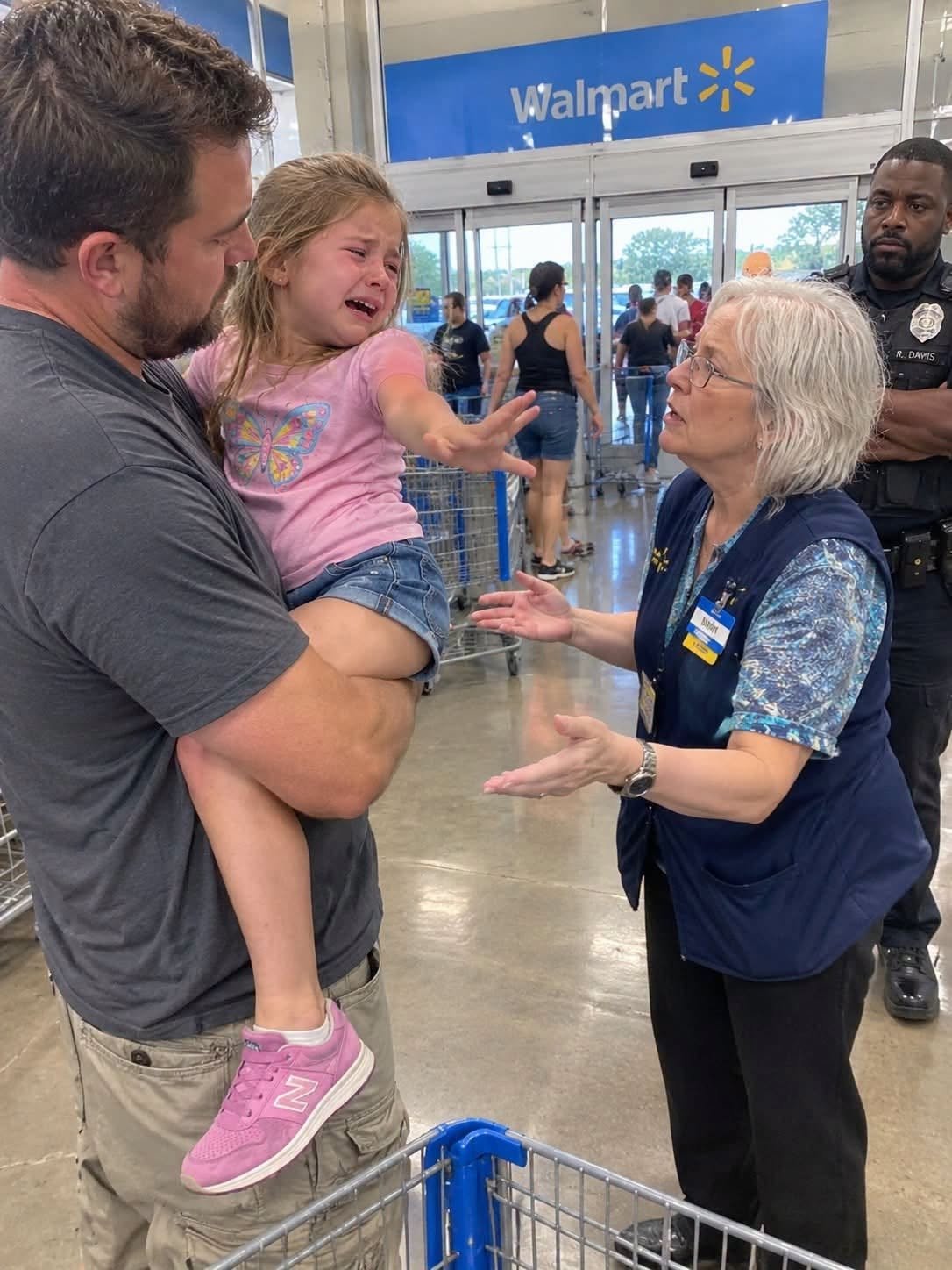
“He’s not my daddy! I want my mommy!”
The little girl looked no older than three. Her cheeks were wet with tears, and she was holding tightly to the blue vest of a store greeter. The man carrying her insisted that he was her father and that the child was simply tired. But something about the little girl’s reaction made the older woman pause.
My name is Mavis Keller. I was sixty-seven years old, and I had worked as a greeter at a large retail store in Fort Smith, Arkansas, for nine years. Before that, I spent thirty-one years working for the United States Postal Service. I had always enjoyed helping people, especially families with young children.
One of my favorite traditions was giving children small yellow smiley-face stickers. I kept a roll in my vest pocket and offered one to nearly every little visitor who came through the doors.
Most days were ordinary and pleasant. But one rainy Tuesday afternoon changed everything.
I was cleaning near the entrance when I noticed a man carrying a little girl toward the exit. She had curly brown hair, a purple raincoat, and bright pink boots decorated with white hearts.
She was crying and repeatedly asking for her mother.
At first, I assumed she was having a difficult afternoon. Young children sometimes become overwhelmed in busy places. However, when she reached toward me and held my vest, I realized that something about the situation needed attention.
“Hello, sweetheart,” I said gently. “Would you like a smiley-face sticker?”
She didn’t reach for the sticker. Instead, she held on more tightly.
The man explained that he was her father and asked me to let them pass. I remained calm and asked whether he could tell me the child’s name.
“Quinn,” he replied.
I gently asked the little girl whether she knew him. She shook her head and said she wanted to go back to someone named Miss Corliss.
I knew I couldn’t establish what was happening on my own, so I contacted the store manager.
A few moments later, the assistant manager, Kyle Darby, arrived. The man showed him identification and a photograph of himself holding a newborn baby. He explained that I was unnecessarily delaying his departure.
I tried to explain that the child appeared frightened and had mentioned another caregiver.
But Kyle looked uncomfortable.
“Mavis, please step aside,” he said. “We need to handle this properly.”
Reluctantly, I moved away from the entrance. The man carried Quinn outside and headed toward a silver car.
I watched the little girl look back through the glass doors. Her expression stayed with me.
I couldn’t simply forget what I had witnessed.
I followed at a distance, noted the vehicle’s registration number, and called the police. I explained exactly what I had seen and heard, without making assumptions about the man’s relationship to the child.
An officer later contacted me, collected my statement, and received the photographs I had taken of the vehicle.
The following morning, my manager called me into his office.
The man had contacted corporate headquarters and complained about my actions. He claimed I had interfered with his departure and made an unfair report.
The company reviewed the security footage and decided that I had failed to follow its procedures.
After nine years of welcoming customers, I was dismissed.
I removed my blue vest, folded it carefully, and placed it on the manager’s desk. Before leaving, I took my roll of smiley-face stickers from the pocket.
They belonged to me.
But my biggest concern wasn’t the job I had lost.
“Did they find the little girl?” I asked.
My manager looked down.
“I don’t know,” he replied.
That night, I sat at my kitchen table thinking about Quinn. I remembered her pink boots, her little hands holding my vest, and the worried expression on her face.
Two days later, a detective from the local police department called.
She couldn’t share many details because the situation involved a young child, but she confirmed that Quinn was safe and had been reunited with her mother.
I finally felt able to breathe again.
My job was gone, but the little girl was safe. That was what mattered most.
Three weeks later, another unexpected event arrived at my doorstep.
A delivery worker handed me a thick envelope containing legal documents. The man from the store had filed a lawsuit against me, requesting $250,000 in compensation.
I had never faced anything like that before. I was a retired postal worker living on a modest income, and the possibility of a lengthy legal dispute frightened me.
I called my son, Ray, who lived in Denver.
“Mama, you need someone to help you understand those papers,” he said.
I agreed.
Fortunately, an old family acquaintance named Harold Vaughn had practiced law in Fort Smith for many years. He was retired but still maintained his professional qualifications.
When he heard what had happened, he offered to review the documents.
At his kitchen table, Harold listened carefully as I explained everything.
He asked whether I had physically touched the man, whether I had made accusations without evidence, and exactly what I had told the police.
I answered every question honestly.
“Reporting what you genuinely witnessed is important,” he explained. “We’ll review the facts and respond appropriately.”
Harold agreed to represent me.
The months that followed were difficult. There were meetings, paperwork, and questions about what had happened at the store. I tried to remain patient and let the legal process take its course.
During this period, I continued wondering about Quinn.
The detective had confirmed that she was safe, but I knew very little else.
One afternoon, I decided to visit the daycare mentioned by the little girl. With some help from my granddaughter, I found a local childcare center run by a woman named Corliss Washington.
When I arrived, Corliss recognized me immediately.
“You’re the woman from the store,” she said.
She invited me to sit on the porch while the children played nearby.
She explained that the man had arrived at the daycare claiming he was Quinn’s father and had permission to collect her. He had presented documents, and the situation had developed quickly.
Corliss had become concerned when Quinn appeared uncomfortable. She contacted the child’s mother shortly afterward.
When she learned that another person had also contacted the police with information about the vehicle, she realized it had been my call.
“Is Quinn doing well?” I asked.
Corliss assured me that the little girl was with her mother and that the family was receiving support.
I felt relieved.
Before leaving, I asked Corliss for a piece of yellow construction paper and a crayon. I wrote a short message for Quinn’s mother.
I told her that I was the woman from the store, that I often thought about her little girl, and that I hoped they were both doing well.
Then I placed one of my yellow smiley-face stickers on the folded paper.
I handed the letter to Corliss in case she had an opportunity to pass it along.
I didn’t expect anything in return.
Meanwhile, the legal proceedings continued.
In August, I answered questions during a formal deposition. Harold sat beside me and reminded me to remain calm, answer honestly, and avoid guessing.
The other lawyer asked about my work responsibilities, store procedures, and what I had observed that afternoon.
He also asked whether a young child might simply have been upset about leaving a store.
I explained that I couldn’t know exactly what the child was thinking. I could only describe what I had witnessed.
Across the table, the man listened quietly.
When the meeting ended, Harold and I left together.
I was exhausted, but I knew I had told the truth.
In October, the case finally reached the courtroom.
My son traveled from Denver to support me. Several friends from church and former customers also came to show their encouragement.
Harold sat beside me at the defense table with his familiar yellow legal pad.
The other side presented its version of the events. Their lawyer described a father who believed he had been unfairly treated by a store employee.
Then Harold prepared to present our response.
Just as he began, a young woman stood up in the back of the courtroom.
She was in her late twenties and wore a simple black dress. She held a manila folder against her chest.
A yellow smiley-face sticker was attached to the front of her dress.
The judge asked her to identify herself.
“My name is Kendra Lowe,” she said. “I’m Quinn’s mother.”
The courtroom became quiet.
Kendra explained that she had important documents she wanted the court to consider. The judge called for a recess so the attorneys could review the information properly.
I sat at the table, looking at the young woman.
I recognized the yellow sticker.
It was the same kind I had placed on the letter for Quinn’s mother.
Later that evening, Harold explained what had happened during the meeting with the judge.
Kendra had brought official custody documents showing that she had primary legal and physical custody of Quinn. The documents also explained the arrangements that had been established for the child’s father.
She had additional records and messages that helped explain why she had been concerned about the situation.
Most importantly, she was finally prepared to speak openly about what had happened.
Harold told me that Kendra had received my letter through Corliss. She had kept it because the simple message had reminded her that someone outside her family cared about her daughter’s well-being.
She had read it many times.
According to Harold, Kendra told the court that seeing an older woman stand up for her child had encouraged her to find the strength to speak for herself.
The following morning, the other lawyer requested that the lawsuit be dismissed.
The judge approved the request, bringing the case to an end.
I felt an enormous weight lift from my shoulders.
The matter involving Quinn’s family continued through the appropriate legal channels, and Kendra was able to provide further information to the authorities.
A few weeks later, I received another unexpected phone call.
It was someone from the store’s corporate office.
The company had reviewed the circumstances again and reconsidered my dismissal. They offered me my position back, including compensation for the time I had been away.
I was grateful, but I had one request.
“I would like the company to improve its procedures,” I said. “If an employee sees a child who appears frightened and asks for help, they should know how to respond safely. They should be able to contact a manager and the proper authorities without worrying about losing their job for making a good-faith report.”
The representative listened carefully and promised to review the suggestion.
Not long afterward, Kyle Darby visited my home.
He apologized for how he had handled the situation. He admitted that he had been too focused on following ordinary store procedures and had not fully considered the child’s distress.
I accepted his apology.
People make mistakes, and sometimes the important thing is what they learn afterward.
In December, I returned to work.
The automatic doors were still there. The familiar coffee customers were still coming through every morning. My blue vest had a new name tag, and my yellow smiley-face stickers were back in my pocket.
There was also a new notice in the employee break room explaining how staff should respond when a child appears distressed or asks for help.
It emphasized contacting management and the appropriate authorities while following established safety procedures.
The policy had been created to help employees handle similar situations responsibly.
I read it several times before returning to my usual place near the entrance.
A few weeks before Christmas, a young woman walked through the doors holding a little girl’s hand.
The child wore a red winter coat and a knitted hat. Her curly brown hair was gathered into two little puffs.
And on her feet were bright pink boots decorated with white hearts.
I recognized her immediately.
My hand reached into my vest pocket.
“Hello, sweetheart,” I said. “Would you like a smiley-face sticker?”
The little girl looked at me, then turned toward the woman beside her.
“Mommy, is that the sticker lady?”
Kendra smiled and nodded.
“That’s her, sweetheart.”
Quinn walked toward me with a big smile.
“Mommy says you helped me,” she said.
I felt my eyes fill with tears.
Then she reached into her coat pocket and pulled out a small sheet of gold star stickers. Carefully, she peeled one away and placed it on my blue vest, right beside my name tag.
“That one’s for you,” she said.
I smiled and placed a yellow smiley face on her red coat.
“And this one is for you.”
Kendra and I exchanged a few kind words while Quinn happily talked about her new preschool and the things she was learning.
Before leaving, the little girl waved at me from the end of the aisle.
I waved back.
I still keep that gold star on my vest.
Whenever a new employee asks about it, I tell them the story of a little girl in pink boots, a rainy afternoon, and a simple yellow sticker that became something much more meaningful.
I also remind them that helping others begins with paying attention, staying calm, and knowing when to ask for assistance.
Sometimes, a small act of kindness can make a lasting difference.
And sometimes, the smallest people teach us the biggest lessons.