Part 1: The Call No Parent Should Ignore
I made the call at exactly 10:47 p.m., holding my phone in my left hand because my right arm was trapped in a heavy cast. Every breath hurt my ribs, and dried blood still stained the sweatshirt the paramedics had cut off after the crash. Down the hall, my newborn son, Mason, cried in the nursery because I was not strong enough to hold him.
“Dad,” I whispered when he answered. “Please… can you and Mom take Mason for one night?”
Music, laughter, clinking glasses, and champagne echoed behind him. “What is it now, Laura?” he asked impatiently.
“I’m at St. Agnes Hospital. A delivery truck hit my car. My arm is broken, I needed stitches, and I can’t care for Mason by myself tonight.”
The silence that followed was not worry. It was annoyance. “Tonight is Brielle’s engagement dinner,” he said. “Your mother and I are hosting everyone.”
Brielle had always been the favorite. When she made mistakes, she was overwhelmed. When I struggled, I was irresponsible.
“Dad, I’m not asking you to cancel the party. I’m asking you to help your grandson.”
“And ruin Brielle’s celebration?”
“I was in a car accident.”
“And she is finally having the evening she deserves.”
Tears blurred my vision. “I can’t even lift my baby,” I whispered.
His voice turned colder than I had ever heard it. “You chose to have that baby without a husband. You chose this life. You made your own bed, Laura. Now lie in it.”
Then he hung up.
I stared at the dark screen until my bruised reflection stared back. For years, I had defended my parents and convinced myself they loved me in their own way. That night, I finally understood. They were not unable to help. They chose not to.
A nurse named Marissa adjusted my blanket and brought Mason back. She showed me how to rest one hand gently on his tiny chest without lifting him. “You have nothing to apologize for,” she said after I whispered, “I’m so sorry.”
Three hours crawled by. The medication softened the pain but not the fear. I kept imagining dropping my son because I had only one usable arm.
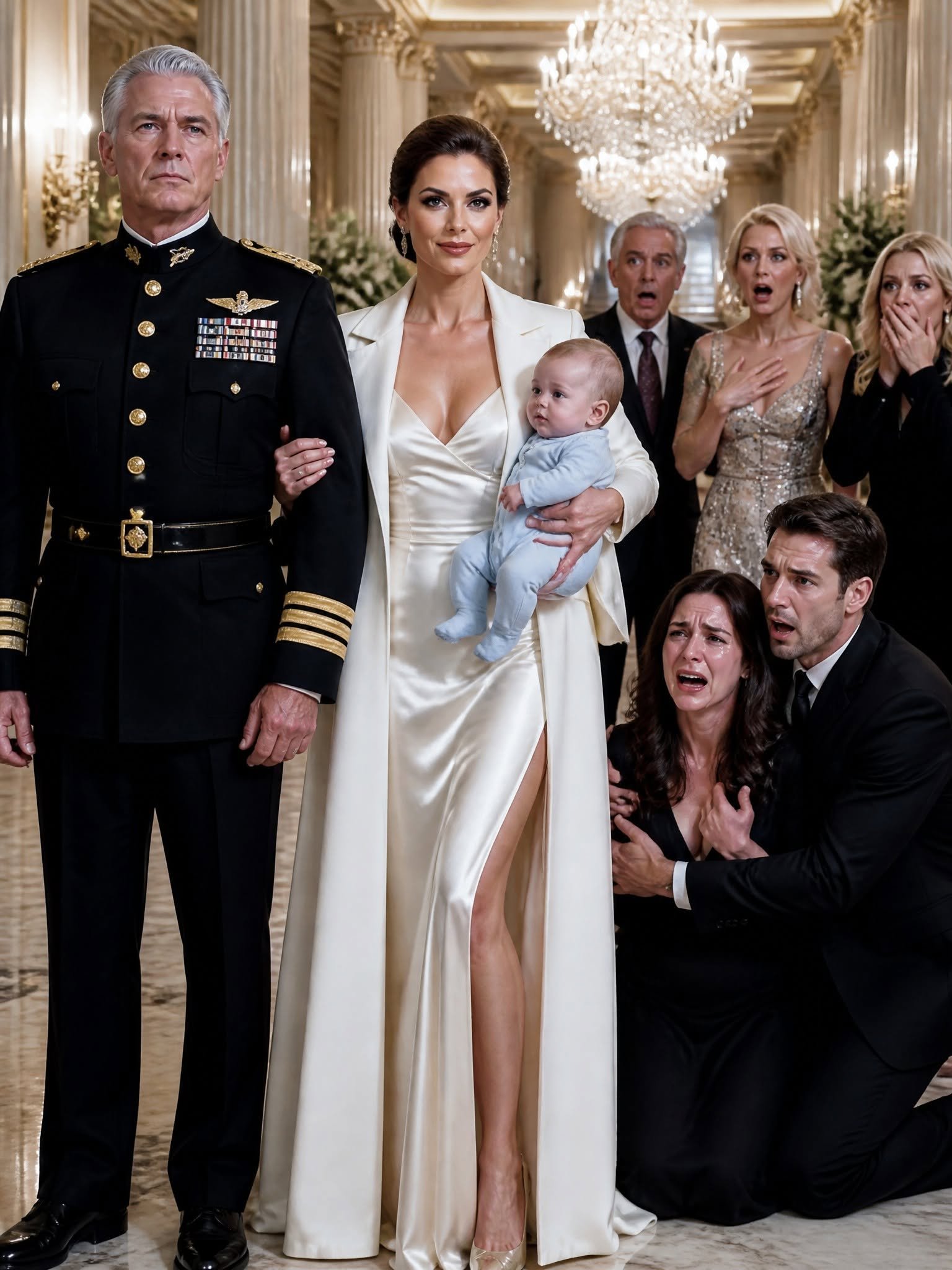
At exactly 2:03 a.m., the door opened. I expected another nurse. Instead, my Uncle Graham walked in wearing a rain-soaked charcoal coat over a dark suit. Behind him stood my Aunt Elise, cradling Mason against her shoulder while he slept beneath his blue hospital blanket.
“Uncle Graham?”
His eyes moved across my cast, my bruised face, and the bandage above my eyebrow. His expression did not show shock. It showed recognition. The calm look of a man assessing damage.
“I just found out,” he said quietly.
“The charge nurse called us,” Aunt Elise explained. “Your emergency contact still listed Graham.”
I had forgotten that years earlier, when I moved out of my parents’ house, Uncle Graham made me promise to keep his number. “If no one else answers,” he had said, “call me.”
Graham stepped closer. “Your father’s party is over.”
My stomach tightened. “What did you do?”
“I called him.”
My parents had spent years calling Graham a failure because he lived quietly outside Washington, Virginia, and rarely attended family events. They never knew he had spent more than thirty years as a respected colonel in elite U.S. military operations, leading people whose lives depended on whether he answered the call.
Graham looked me in the eyes. “I put your father on speaker,” he said. “Everyone at Brielle’s engagement dinner heard him tell his injured daughter she was not worth leaving the party for.”

Part 2: The Truth on Speaker
For a few seconds, all I heard was Mason’s soft breathing against Elise’s shoulder. “You put him on speaker?” I whispered. Graham pulled a chair beside my bed, rain still darkening his coat. “After he told me you were exaggerating, I asked him to repeat himself.” “Brielle’s fiancé heard it,” Elise added softly. “So did his parents.” I closed my eyes. Part of me wanted to feel satisfied. Another part felt ashamed, as if my father’s cruelty still somehow belonged to me. “I didn’t want a scene,” I said.
Graham leaned forward. “Laura, you didn’t create the scene. You asked for help.” The words were simple, but something inside me loosened. In my parents’ house, need had always been treated like failure. Pain was drama. Asking for help meant I had mismanaged my life. “I thought maybe because it was Mason…” My throat closed. Elise moved closer. “Honey, they should have come because it was you.” That softness broke me. Tears slipped into my hairline and stung near the stitches. Graham simply moved the tissue box within reach of my good hand. No lecture. No disappointed sigh. Just kindness. “What happened after you called him?” I asked. “Your father said family obligations had to be respected.” Despite everything, I laughed once. “Family obligations.” “Yes,” Graham said. “That was his phrase.” Elise adjusted Mason gently. “Your mother tried to take the phone once she realized everyone could hear, but by then the room had gone quiet.”
I pictured my parents’ dining room, the candles, the silver, the polished faces turning toward my father as his words filled the space: You made your own bed, Laura. For years, I had protected them. If my mother forgot my birthday, I said she was busy. If my father missed my graduation lunch, I said work ran late. If Brielle borrowed money and never paid it back, I called it a misunderstanding. That night, I was finally too injured to cover for anyone. “What did Brielle say?” “Nothing at first,” Graham said. Of course. Brielle had always understood silence as protection when the story benefited her. “Then her fiancé asked whether Mason was safe.” That surprised me. “Evan?” Graham nodded. “He wanted the hospital name. Your father refused to give it. So I gave it to him.”
I turned toward the rain-streaked window. I had met Evan only a few times. He was polite and quiet, the kind of man my family mistook for dull because he did not perform for attention. “I don’t want him involved,” I said, though I was not sure I meant it. Graham studied me. “You don’t have to manage everyone else tonight.” Marissa returned to check my pain level and help with Mason. Elise placed him carefully against my uninjured side while Graham turned toward the window to give me privacy. Mason fussed at first, and panic hit me. “I can’t do it,” I whispered. “You are doing it,” Elise said. “He’s crying.” “He’s four weeks old. Crying is one of his main skills.” Marissa smiled. “She’s right.” Mason finally settled, his tiny fingers opening against my gown. His small weight anchored me to the world.
“What happens when I go home?” I asked. No one answered too quickly, and I appreciated that. Graham turned from the window. “You and Mason come home with us for a while.” “Uncle Graham—” “No debate tonight.” “I can’t just move in.” “It’s not moving in. It’s recovering.” “I have rent. Mason’s things. Work. I have—” “You have a broken arm, cracked ribs, stitches, and a newborn,” Elise said gently. “That is enough to have.” My first instinct was to refuse. My parents had trained me to believe help always came with an invoice. Favors became weapons. Shelter had strings. Graham seemed to understand. “No conditions,” he said. “No speeches. No keeping score.” “Why?” I asked. His face softened. “Because when you were seven, you used to wait on the porch with your backpack when your mother forgot pickup. You pretended you liked watching the streetlights come on.” I remembered the cold porch step. I remembered telling myself Mom would arrive any minute. I remembered Graham’s old truck pulling up one evening with hot chocolate. “I thought you didn’t notice,” I whispered. “I noticed everything.” Elise brushed Mason’s blanket smooth. “We both did.”
Then came a hesitant knock. Evan stood outside in a navy overcoat, damp from the rain, holding white tulips wrapped in brown paper. “I’m sorry,” he said. “I know it’s late. The front desk said I could come up for a few minutes.” Graham waited for my answer. “It’s okay,” I said. Evan entered slowly, first looking at Mason, then my cast, then the bruising along my cheek. “I’m so sorry, Laura.” “Thank you.” He placed the tulips awkwardly on the windowsill. “I heard what happened,” he said. “I’m sure everyone did.” “Not everyone understood what they were hearing.” “What does that mean?” “It means your father tried to explain afterward. He said you have a history of turning inconveniences into emergencies.” Of course he had. “And you believed him?” “No.” The answer came without hesitation.
Then Evan said something stranger. “I asked Brielle why she never told me you had a baby.” My stomach tightened. “She never mentioned Mason?” “She said you wanted privacy.” Brielle had visited once after Mason was born, stayed thirteen minutes, took one photo she never posted, and said motherhood looked exhausting. Evan reached into his coat and pulled out a sealed cream envelope with my mother’s handwriting on the front. “I found this tonight in the entry table drawer under Brielle’s gloves.” My name was written across it: Laura Elise Hayes. Not Laura Bennett. Hayes. My mother’s maiden name. “Why would she write Hayes?” I whispered. Something passed between Graham and Elise. A warning.
I opened the envelope with my left hand. Inside was an old legal document and a photograph. The photo showed my mother much younger, sitting on my grandparents’ farmhouse porch, holding a baby in a yellow blanket. Beside her stood Graham in uniform, one hand resting protectively on the railing. The date on the back was my birth year. The document read: Guardianship Appointment and Family Trust Addendum. My own name appeared below: Laura Elise Hayes. Beneficiary. Guardianship provision. Educational trust. Medical authority in the event of parental incapacity or neglect.
“What is this?” I asked. Graham looked pale. Elise closed her eyes. “When your grandparents died, they left provisions for you and Brielle,” Graham said. “Separate ones.” “I’ve never heard of a trust.” “I know.” “My parents kept it from me?” “They controlled it while you were a minor. After you turned twenty-five, you were supposed to receive full access to the records.” I was twenty-nine. “Did they take it?” “I don’t know,” Graham said carefully. “I suspected irregularities years ago, but I couldn’t prove it. Your father blocked every inquiry. Your mother said you had asked not to involve me.” “I never knew.” “I believe you.”
The document shook in my hand. Memories rearranged themselves: college loans my father said would build character, my mother claiming there was no money after Mason was born, Brielle receiving help for her condo because she was “starting properly,” and every conversation about my grandparents being changed too quickly. Graham studied the document again. “This copy has a notary stamp from six weeks ago.” Six weeks ago. Mason was four weeks old. “Where exactly did you find this?” Graham asked Evan. “In the entry table,” Evan said. “Under Brielle’s gloves and a folder with wedding vendor contracts.” “Wedding contracts?” “The venue deposit was paid yesterday,” Evan said quietly. “A very large deposit.” The room seemed to tilt.
Then Evan’s phone rang. Brielle. He answered on speaker. “Where are you?” she demanded. “My parents are furious. Please tell me you didn’t actually go to the hospital.” “I did.” “Evan, this is exactly what I warned you about. Laura always finds a way to make things about her.” “She was hit by a truck.” “And that’s terrible, obviously. But tonight was important too.” Evan’s voice stayed calm. “Why didn’t you tell me she had a son?” Silence. Then Brielle laughed lightly. “Because it wasn’t relevant.” “To our engagement?” “To us.” Evan said, “I found the envelope.” The silence changed. Not confusion. Fear. “What envelope?” Brielle asked. “The one with Laura’s name on it.” When she spoke again, the brightness was gone. “Evan, listen carefully. That is a private family matter.” “It concerns Laura.” “Bring it back.” Graham leaned forward. “What has he done, Brielle?” The line went dead.
I stared at the phone. “She knew,” I whispered. Then I looked at Graham. “What aren’t you telling me?” For the first time that night, he looked uncertain. Elise touched his sleeve. “She deserves to know.” Graham looked at Mason, then at the closed door. “Your grandparents didn’t name your father as trustee,” he said. I waited. “They named me.” “Then how did my parents control it?” Graham’s face tightened. “That is the question.” He turned the old photograph over again. Beneath the date, written in faded pencil, were four words: Tell Laura the truth. My breath caught. Then my phone rang. My mother’s name lit up the screen.

Part 3: The Truth Behind the Envelope
My mother’s name glowed on the screen like something alive. For years, that name was enough to make me sit straighter, fix my voice, and prepare to explain myself. Even with a newborn beside me, a broken arm, and cracked ribs, the old reflex still waited.
The phone rang again.
“Do you want me to answer?” Graham asked.
I almost said yes. Then Mason sighed in his bassinet, his tiny mouth forming a little bow. I looked at my son and thought of the years ahead. I did not want him to inherit my fear.
“No,” I said. “I’ll answer.”
I picked up. “Mom.”
For half a second, there was only breathing.
Then she said, “Laura, where is Graham?”
“He’s here.”
“I need to speak with him.”
“You called my phone.”
“That envelope belongs to me.”
I looked at the cream paper in Graham’s hand. “It has my name on it.”
“You don’t understand what you’re looking at.”
“Then explain it.”A sound moved through the line, like a door closing.
“You should not have involved outsiders,” she said.
“Outsiders?” I repeated. “Evan found it. Graham was named trustee. I’m listed in the document. Which outsider are you talking about?”
My mother inhaled sharply. “You always do this. You take pieces of things and build stories around them.”
The old script did not work this time.
“I was in a hospital bed asking for help,” I said. “Dad hung up on me.”
“That was unfortunate.”
Unfortunate. Not wrong. Not heartbreaking. Not inexcusable.
Across the room, Graham’s jaw tightened.
“He’s four weeks old,” I said, looking at Mason. “Your grandson needed someone tonight. I needed someone.”
Her voice softened carefully. “Laura, sweetheart, of course we care about Mason.”
Some tired part of me still wanted to believe her.
“Then why didn’t you come?” I asked.
Silence.
The answer was inside it.
When she spoke again, the softness had vanished. “Give the envelope back to Graham. Tell him I’ll speak to him tomorrow.”
“No.”
The word left my mouth before fear could stop it.
“What did you say?”
“I said no. I’m keeping a copy. Tomorrow, I’m speaking to an attorney.”
Her voice dropped. “You have no idea what you might destroy.”
“I’m starting to think that’s the first honest thing you’ve said tonight.”
Then I ended the call.
My hand began to shake. Graham gently took the phone before it slipped.
“You did well,” he said.
“I don’t feel well.”
“That’s not always the same thing.”
I leaned back, exhausted. “What did she mean?” I whispered.
Graham looked at the photograph. “I don’t know yet.”
“But you suspect something.”
His silence was careful.
Elise sat beside me. “There were things from that time that were never clear. Your grandparents’ estate. Your mother’s choices. The way your father suddenly had influence over papers he should not have controlled.”
“And the photograph?”
Graham’s eyes met mine. “That picture was taken two days after you came home from the hospital.”
“You were there?”
“I was there for three weeks.”
“No one ever told me that.”
“They wouldn’t.”
“Why?”
“Because when you were born, your mother asked me to be your legal guardian if anything happened to her.”
That landed differently from the trust. The trust was money. This was a promise.
“My mother asked you?”
“Yes.”
“But she acts like she barely tolerates you.”
“That came later.”
Elise held his hand. “When your mother was young, she depended on Graham more than she has ever admitted. Your father didn’t like that.”
“He didn’t like anyone she listened to besides him,” I said.
Graham did not deny it.
Marissa returned, checked my pain, and adjusted Mason’s bassinet closer to the bed.
“You need sleep,” she said.
Evelyn and Graham stayed anyway, one near the bassinet, one near the door. The last thing I saw before sleep took me was my uncle sitting upright in the dim room like a guard at a gate.
Morning came silver through the rain. A doctor reviewed my injuries: no surgery for the arm, but follow-up appointments, physical therapy, slow-healing ribs, and stitches out in several days. I was told not to lift anything heavier than five pounds.
Mason weighed nearly nine.
Panic rose.
Elise covered my hand with hers. “We will help you.”
Not criticism. Not warning. Just help.
At 10:30, Graham’s attorney arrived. Her name was Maren Cole, and she had kind eyes that missed nothing. She listened as I explained the call, the envelope, the trust document, the photograph, and my mother’s reaction.Maren studied the papers carefully. “This is part of a larger estate structure,” she said. “There should be bank statements, trustee reports, annual notices, and tax filings.”
“I’ve never received anything.”
Her pen stopped. “Nothing?”
“Nothing.”
Graham said he had received two summaries through his attorney before communication stopped. My father had claimed my mother assumed administrative control under a family agreement.
“Was there such an agreement?” Maren asked.
“No,” Graham said.
Maren noted the drafting firm: Benton, Vale & Harrow in Richmond. Then she looked up.
“That firm dissolved years ago. One partner died, one retired, and one was disbarred for mishandling estate funds.”
The room cooled.
“What happens now?” I asked.
“I’ll locate the successor custodian of the files,” Maren said. “I’ll also draft preservation letters for any documents in your parents’ possession.”
“I don’t want to hurt anyone.”
Her gaze softened. “Seeking the truth is not the same as seeking harm.”
Daniel—Evan—returned that afternoon with the tulips arranged properly in a vase. He had changed out of his engagement dinner clothes and looked tired.
“I spoke with my parents,” he said. “They’re postponing wedding discussions.”
“I’m sorry.”
“Don’t be. Last night showed me how many things I didn’t know.”
“And Brielle?”
“She says this is a misunderstanding.”
“Is that what you believe?”
He looked toward Mason. “I believe people can be scared and still choose to hurt others,” he said. “But hiding a baby from the person you plan to marry is not a small misunderstanding.”
Then he handed me a small pale pink envelope from Brielle’s car. It had my name on it and had already been opened.
Inside was a photograph of Mason in the hospital nursery, asleep in his blue cap beside a card that read his name and date of birth.
My breath stopped. “I didn’t give this to her.”
On the back, Brielle had written one line: He looks like her.
Not he looks like Laura.
Her.
Marissa later confirmed someone claiming to be my sister had called the maternity desk the day after Mason was born, asking whether a baby boy had been delivered to Laura Bennett, whether he was healthy, and whether a birth announcement had been filed.
There was also a visitor entry under Brielle’s name. She had come to the hospital. She had not visited me. She had looked at Mason.
Evan grew pale.
“My family has a genetic condition,” he said quietly. “Nothing dangerous in most cases, but visible. A distinctive gray-green eye pattern that usually appears in infancy. My mother joked about future grandchildren having the Harrow eyes, and Brielle got upset.”
“Harrow?” Graham repeated.
Maren’s words returned. Benton, Vale & Harrow.
Evan nodded. “My mother’s family name. My grandfather was Edward Harrow.”
Graham went still. “Edward Harrow drafted Laura’s grandparents’ trust.”
Evan stared. “My grandfather?”
The coincidence felt too precise to be coincidence.
By evening, I was discharged into Graham and Elise’s care. Their white farmhouse sat at the end of a gravel drive, warm with light and surrounded by winter fields. The guest room had a bassinet, diapers, a moon-shaped night-light, and a soft blue blanket on the pillow.
I touched it with my good hand. “This was mine.”
“Your grandmother made it,” Elise said.
“My mother said it was lost.”
“No,” Graham said. “She gave it to me after an argument. Said she didn’t want reminders.”
“Reminders of what?”
He looked at the blanket. “Of who she used to be.”
Later, after Mason settled and the house quieted, my phone buzzed from an unknown number. It was a photograph of a handwritten note.
Ask Graham about the day your mother tried to leave.
Below it was another line:
And ask why Mason looks like the baby in the yellow blanket.
I stared until the words blurred.
Graham’s footsteps approached. He appeared in the doorway with a glass of water.
“You should try to sleep,” he said.
I looked at the man who had crossed a storm to reach me, the man named in a trust I had never seen, the man standing beside my mother in a photograph marked by the past.
“Uncle Graham,” I said slowly, “what happened the day my mother tried to leave?”
The glass in his hand went perfectly still.
THE END