I never imagined that an envelope could feel heavier than a lifetime of memories, yet that was exactly what happened on a quiet Wednesday morning in Asheville, North Carolina. The letter rested on my kitchen table beside a chipped mug of reheated coffee, its ivory paper glowing with a confidence that did not belong in my small apartment. The lettering was elegant, deliberate, and undeniably expensive, which already told me everything I needed to know about who had sent it.
The name printed at the center tightened my chest before I even opened it.
Ronan Fletcher.
My former partner. The man who once promised permanence and delivered abandonment with a polished apology. Beneath his name was another, written in graceful script, belonging to a woman I had never met but had long imagined in moments of quiet resentment.
Madeira Knox.
They were getting married.
Four years had passed since the night Ronan sat across from me in a cramped living room that smelled faintly of rain and regret. The storm outside rattled the windows while he avoided my eyes, his hands clasped together like he was preparing to defend himself against something inevitable.
“I cannot keep fighting my family,” he said back then, his voice low and strained. “They built the life I am supposed to live, and I do not know how to leave it behind.”
I remember how calm he sounded while dismantling everything we had built together. He spoke of duty and legacy as if love were an optional inconvenience. When he stood to leave, he did not look back, and I understood in that moment that he had chosen comfort over courage.
Three weeks later, my body told me the truth before my mind was ready to accept it. I tried to call him. I tried again. Every attempt was blocked, filtered, erased by walls I could not climb. His mother, Vivian Crowell, made sure of that. Her message arrived through an assistant, delivered with polite cruelty.
“He has moved on. Do not contact him again.”
I raised my sons alone.
Maxwell and Isaac grew up in a home that lacked luxury but overflowed with certainty. They learned early what consistency looked like and what promises meant when they were honored through action rather than words. I worked relentlessly, building a legal consulting practice that specialized in corporate compliance, not because I wanted power, but because I wanted leverage in a world that had once tried to erase me.
The invitation remained on the table as the sound of soft footsteps approached from the hallway.
“Mom,” Maxwell murmured, rubbing his eyes as he stepped into the kitchen, with Isaac trailing close behind him.
I knelt to their level, smoothing their hair and steadying my breath.
“We have somewhere to go,” I said quietly.
The wedding took place at the Fletcher estate, a sprawling property nestled beyond manicured iron gates that looked more like a fortress than a home. Luxury cars lined the drive, their polished surfaces reflecting a version of reality I had once been told was not meant for me.
Inside, Vivian Crowell moved through the crowd like a monarch surveying her kingdom. Her silver gown shimmered under crystal chandeliers, and her smile carried the assurance of someone who believed control was permanent.
“I want everything flawless,” she said to a nearby planner. “Nothing unpredictable.”
Her satisfaction did not last long.

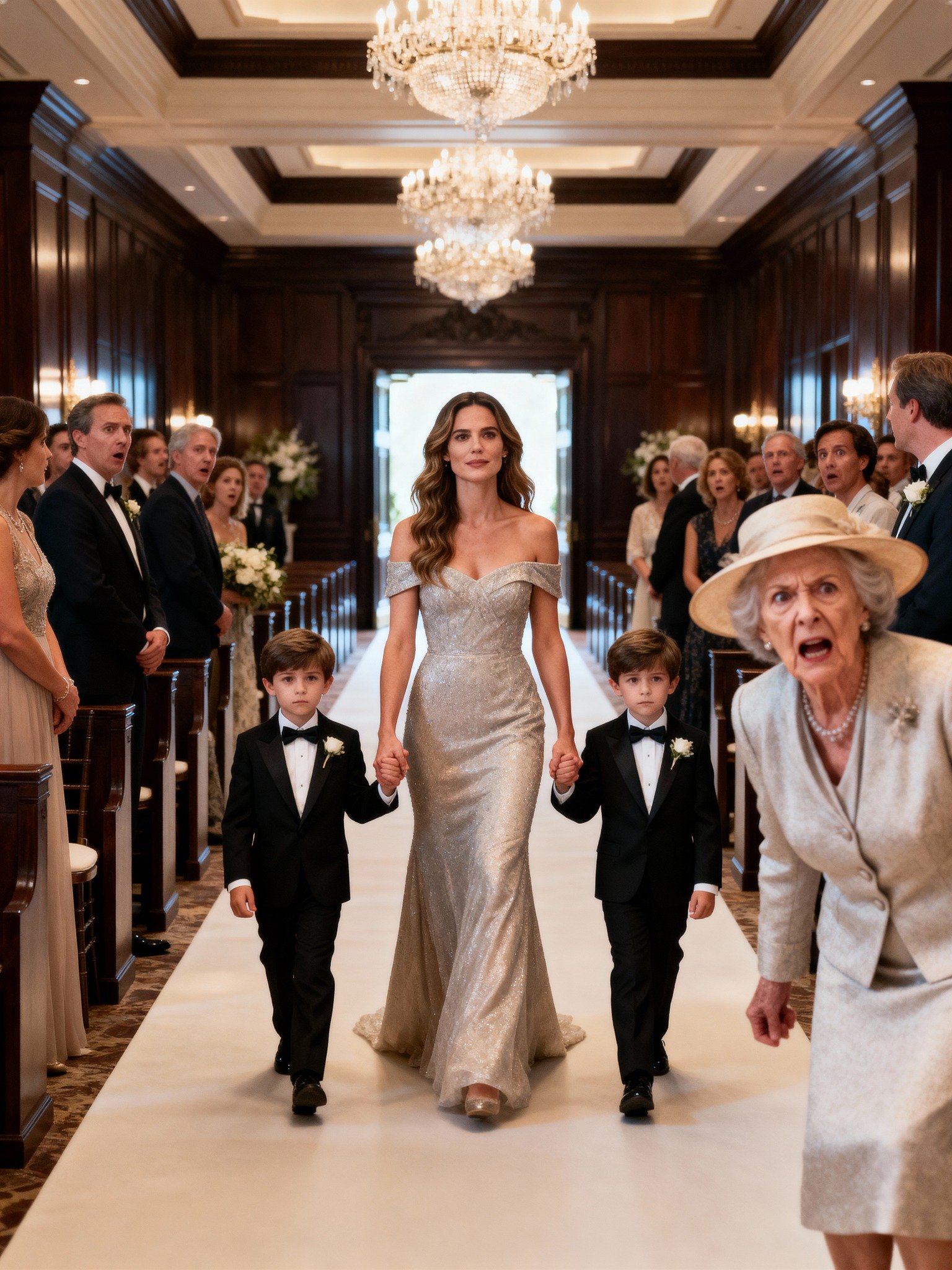
The doors opened, and the room shifted. I walked in holding Maxwell’s hand, with Isaac close on my other side. Their tailored suits matched in understated elegance, and their expressions were calm but curious. Conversations stalled. Heads turned. Recognition rippled outward like a wave.
Ronan stood near the altar, adjusting his cufflinks, until his gaze met mine.
Color drained from his face.
His eyes dropped to the boys, and I saw the moment when memory collided with reality. The resemblance was undeniable. The same sharp gaze. The same thoughtful stillness. The same inherited presence that no amount of money could disguise.
Vivian’s glass slipped from her fingers and shattered against the marble floor.
I stopped several rows from the front, meeting her stare with unwavering composure.
“You invited me,” I said evenly. “I assumed introductions were appropriate.”
The word sons did not need to be spoken aloud. It echoed through the room on its own.
Ronan stepped forward, his voice unsteady. “Eliza. Why did you not tell me.”
I looked at him with a clarity forged through years of solitude and resolve.
“I tried,” I replied. “Your family made sure you never heard me.”
Madeira Knox stood frozen at the aisle entrance, her bouquet trembling in her grasp. She looked between Ronan and the boys, understanding dawning with devastating speed.
“I cannot do this,” she whispered, setting the flowers down as she turned away.
The ceremony dissolved into chaos, but I did not stay to witness the fallout. I led my sons outside, breathing deeply as the cool air grounded me.
A black sedan idled near the gate.
Before I could react, the rear window lowered, revealing a glowing tablet displaying a cartoon Isaac loved. A voice drifted out, falsely warm and dangerously calm.
“Would you like to see more.”
Isaac took a step forward.
I moved instantly, pulling him back into my arms as Ronan rushed toward us, panic etched across his face.
“They are escalating,” he said hoarsely. “This is my mother.”
I met his gaze with hardened resolve.
“Then we end this,” I replied.
The days that followed unfolded like a strategic campaign. Documents surfaced. Communications were traced. Financial irregularities once hidden behind shell corporations emerged into daylight. Vivian Crowell’s empire relied on silence and fear, and both began to crumble under scrutiny.
The courtroom was packed when the custody hearing began. Cameras flashed as I entered, my sons seated behind me, calm and steady.
Vivian watched from across the room, her confidence finally fractured.
Ronan testified without excuse or evasion.
“I failed,” he said. “I allowed power to replace responsibility.”
When my name was called, I rose slowly, feeling the weight of the room settle onto my shoulders, not as fear but as responsibility. I did not dramatize what had happened, and I did not soften it either. I spoke plainly, carefully, and with intent, guiding the court through a timeline that had taken years of my life to survive. I presented the intercepted correspondence that had never reached its recipient, the financial records altered to erase my presence, and the legal filings delayed or buried with calculated precision. Each document was placed before the judge with methodical clarity, not as an act of revenge, but as proof of a pattern that could no longer be ignored.
The courtroom remained silent as I spoke. No whispers followed. No objections interrupted. The judge leaned forward, reading every page, asking pointed questions, allowing the truth to unfold at its own pace rather than forcing it into spectacle. I answered calmly, even when my chest tightened, because this was not about my pain. This was about my children and the deliberate attempts to control their lives without ever knowing them.
When the ruling was delivered, it did not come with drama or raised voices. It came with finality. Custody would remain with me. The court recognized continuity, stability, and intent, and it acknowledged that motherhood was proven through presence rather than bloodline claims made too late.
As we stepped outside, the afternoon sun warmed the stone steps, and only then did I allow myself to breathe fully. Maxwell and Isaac held my hands tightly, their fingers small but steady, as if they understood that something important had just been secured. Their laughter returned quickly, light and unburdened, and I realized how deeply they trusted the ground beneath them because it had never shifted without warning.

Ronan stood a short distance away, no longer shielded by confidence or entitlement. He looked smaller than I remembered, not diminished, but stripped of illusion. When he spoke, his voice carried neither defense nor expectation.
“I will not disappear again,” he said quietly, as if making the promise to himself before offering it to me.
I met his gaze without anger and without comfort, because neither belonged in that moment.
“Time will decide that,” I answered, not as a threat, but as a boundary.
That evening, after the house had settled into silence and my sons slept curled safely in their beds, I sat alone in the living room and allowed the day to finally reach me. I understood then that winning had never meant humiliating someone else or watching an empire fall. Victory meant safeguarding what had been built quietly, day after day, without witnesses. It meant restoring my name to my own story and refusing to let it be edited out again.
The future had not been secured through confrontation or spectacle, but through patience, truth, and an unwillingness to vanish.
And this time, I knew with certainty that no one could take it from us.