My wedding night was supposed to be the quietest moment of my life. After months of planning, smiling, greeting strangers, and surviving expectations that were never really mine, I believed that night would finally belong to me. I imagined silence that felt earned, a room where my shoulders could relax, and a bed where I would not have to perform anything for anyone. I expected nervous laughter, whispered jokes, and the strange intimacy of two people realizing that something irreversible had just begun. What I did not expect was to learn how quickly privacy can be stolen and how easily fear can be disguised as tradition.
The hotel overlooked the river in Clearwater Bay, Wisconsin, and the room smelled faintly of fresh linen and polished wood. I remember setting my bag down and sitting on the edge of the bed, feeling the weight of the day leave my body little by little. My husband, Caleb Morgan, loosened his collar and smiled at me with tired affection. He looked relieved, like someone who believed the hardest part was over.
“We made it,” he said, laughing softly.
I smiled back, believing him without hesitation.
That belief lasted less than a minute.
The door opened without warning, the latch clicking sharply against the wall, and the hallway light poured in with no regard for the intimacy we had not yet even touched. Standing there was Franklin Morgan, Caleb’s father, holding a pillow and a neatly folded blanket as if he were checking into a room he had reserved in advance. His posture was stiff, his expression unreadable, and his presence filled the space in a way that made my chest tighten immediately.
“I will sleep here tonight,” Franklin said calmly, as if announcing the weather.
For a moment, my mind refused to process his words. I waited for him to smile, to laugh, to explain that this was some strange joke. I looked at Caleb, expecting him to step forward, to block the doorway, to say something firm and final. Instead, he hesitated, his eyes flickering with discomfort rather than outrage.
“It is a family custom,” Caleb said carefully. “It is meant to protect the marriage.”

Franklin placed the pillow directly in the center of the bed, marking the space with unsettling confidence. I felt something shift inside me, a warning that arrived fully formed before logic could interfere. I wanted to speak, to object, to say no with the clarity I felt in my bones, but I heard all the voices I had been conditioned to obey.
Do not make a scene.
Do not disrespect elders.
Do not ruin the first night.
So I stayed silent, and silence became my first mistake.
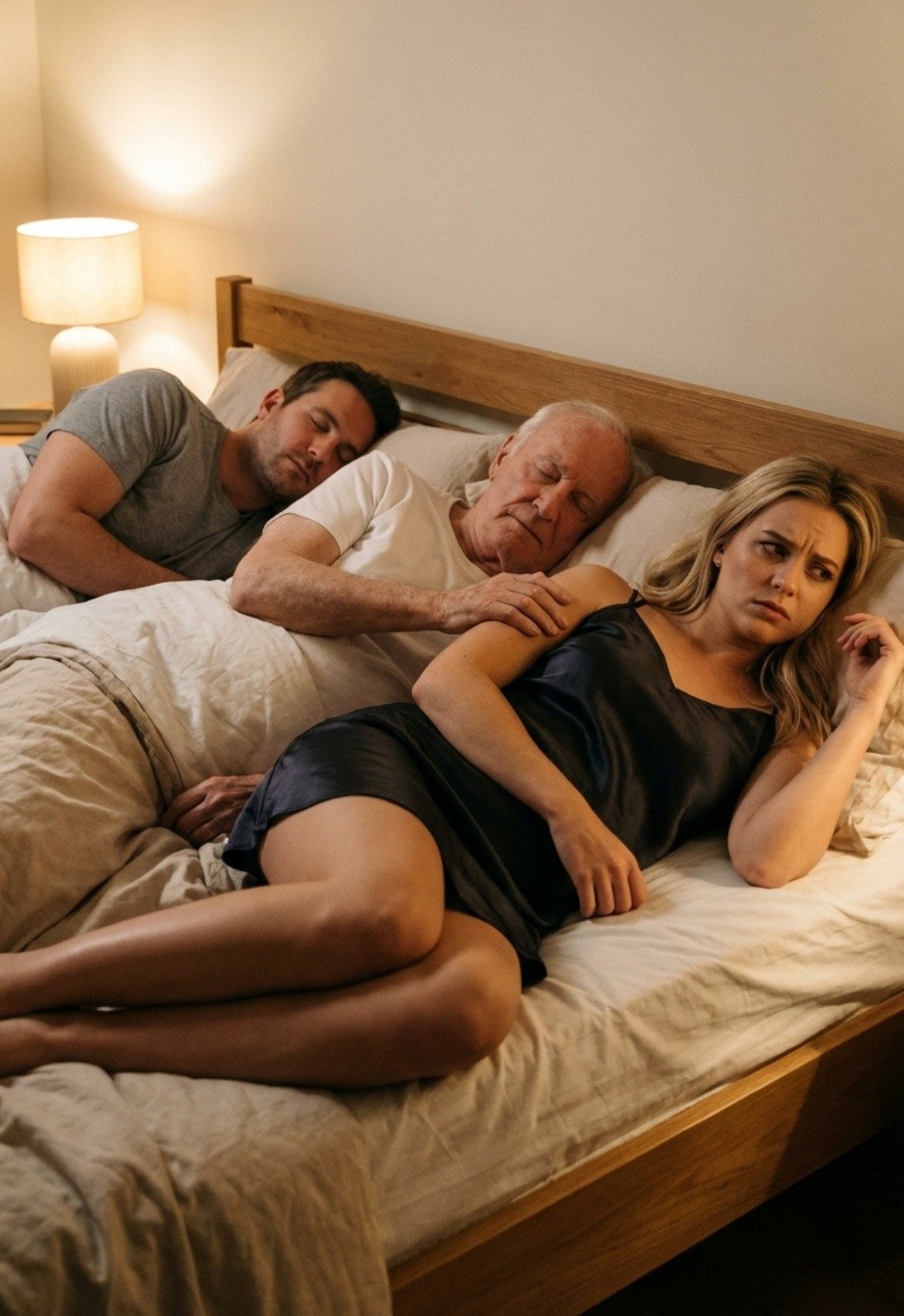
We lay down without ceremony. I pressed myself to the far edge of the bed, my body tense, my senses alert. Franklin lay between us, his hands folded on his chest, his breathing shallow and controlled. Caleb turned toward me briefly, his fingers brushing my arm in what he probably believed was reassurance, and then he closed his eyes.
Sleep did not come to me. The digital clock glowed in the darkness, each minute stretching longer than the last. Caleb’s breathing settled into an easy rhythm, the sound of a man who trusted that things would resolve themselves without effort. Franklin remained unnervingly awake, his breaths uneven, as though he were listening for something I could not hear.
I stared at the ceiling and tried to convince myself that morning would make everything normal again. I told myself I could endure one night, that endurance was not surrender, and that nothing truly bad would happen because surely someone would stop it if it did. My body did not believe any of that, and my body refused to rest.
The first touch was so light that I almost convinced myself it was accidental. A shift of weight. A brush against my back. I froze, my heart beginning to pound. Then it happened again, firmer this time, deliberate enough to erase doubt. My throat tightened, and my hands curled into fists beneath the sheets.
I whispered, barely louder than my own breathing, “This is not okay.”
The clock changed, the numbers sharp and exact, and the precision of the moment made my fear feel inevitable. Another touch followed, slow and unmistakable, moving along my side with intent. Panic surged through me, cold and heavy, and I turned abruptly, driven by the need to see what I was being asked to tolerate.
Franklin was sitting upright, his face pale, his eyes wide with something that looked like terror rather than desire. His hands clutched a string of prayer beads, and his lips moved in frantic murmurs. He was not looking at me. He was staring past me, toward the corner of the room, as if something invisible demanded his attention.
“I saw it,” he whispered, his voice shaking. “I saw the sign.”

Confusion and fear collided inside me. I followed his gaze, but the corner was empty. Then I noticed that Caleb had shifted in his sleep, his arm extended across the bed. His hand rested against my leg, heavy and slack, the unconscious movement of someone seeking comfort without awareness.
The realization settled slowly and horribly. The violation of my space was already being rewritten into a story where I was not a person but a symbol. Franklin’s fear did not excuse what had happened. It reframed it, sanctified it, and turned my body into an object within his belief system.
“The blessing passed through you,” Franklin whispered. “I had to protect it.”
Something inside me went completely still.
I did not scream. I did not argue. I moved carefully, deliberately, as if every motion mattered. I slid out of the bed, gathered my clothes, my bag, my phone, and dressed with shaking hands. I looked once at Caleb, still asleep, still protected by his comfort, and understood with devastating clarity that he had already chosen tradition over me.
I walked out.
The hallway was bright and cold, the carpet rough beneath my bare feet. I leaned against the wall, breathing through the shock, letting reality settle. I thought of my mother, of my sister, of the certainty that I would be believed. I understood then that staying would mean teaching myself to accept fear as normal, and I refused to do that.
“This ends here,” I whispered to myself.

Morning brought no regret. Caleb knocked on my door, his expression confused, then offended, then wounded as I told him everything. He called it misunderstanding. He called it tradition. He did not call it wrong.
That was all I needed to know. I called my family. I packed my things. I left.
Weeks later, I signed the annulment papers with a steady hand. The relief that followed was quiet but profound, like finally setting down a weight I had been carrying without realizing it. I did not feel weak for leaving. I felt alive.
When people asked what happened, I told them the truth without drama.
“I chose safety over tradition.”
And that choice saved my life in ways no wedding ever could.
THE END