PART 1
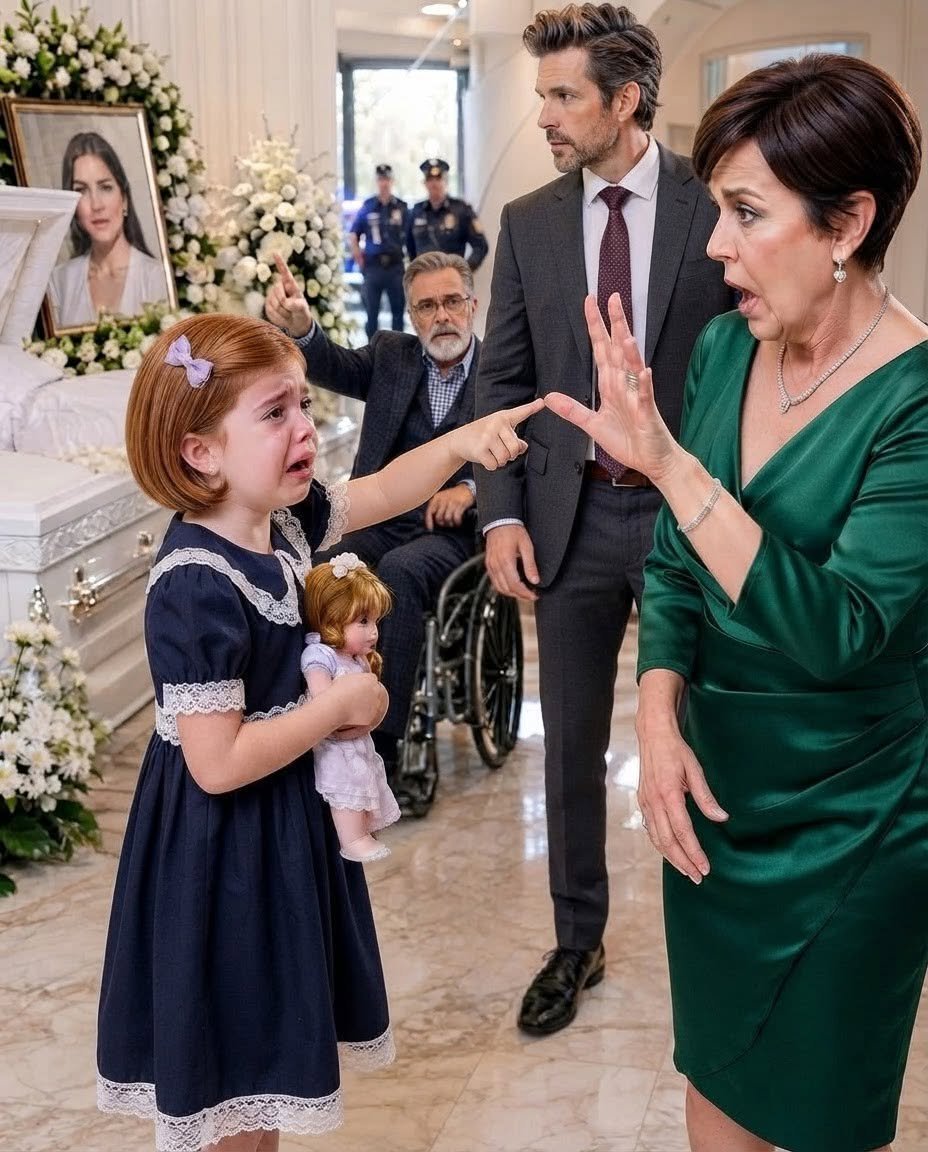
“Grandma is lying! Mommy didn’t just die for no reason!” my six-year-old daughter, Lily, screamed beside her mother’s casket.
Everyone froze.
I had just returned to Silver Creek, Ohio, after three days away on a security assignment. In my bag were two gifts: a green silk scarf for my wife, Clara, and a doll for Lily.
Instead of finding my family waiting for me, I found funeral flowers covering our yard.
My mother, Teresa, rushed toward me.
“You’re too late, Alex. Clara died almost three days ago.”
I couldn’t understand.
“Why didn’t anyone call me?”
My aunt Beatrice quickly interrupted.
“Clara had been struggling emotionally. We need to bury her and move on.”
But my father, Arthur, who had suffered a stroke and could barely speak, began desperately pointing toward the third floor.
Then Lily pulled away from her grandmother.
“Uncle Derek broke Mommy’s door! Mommy screamed! Grandma took her phone! They locked us inside!”
My brother Derek went pale.
Teresa immediately claimed Lily was traumatized and confused.
I knelt beside my daughter.
“Tell me what happened.”
“Mommy wanted to call you. Uncle Derek wouldn’t let her leave. Grandma took the phone. Mommy kept asking for help.”
My father suddenly pointed beneath his wheelchair cushion.
Beatrice shouted, “Alex, stop this! Bury your wife first!”

That was when I knew something was terribly wrong.
I called 911.
Police arrived and immediately stopped the funeral. The third floor became a crime scene.
As officers entered, I saw Beatrice secretly typing on her phone.
The message said:
He is getting suspicious.
Derek tried to go upstairs.
I blocked him.
“No one goes anywhere.”
For the first time, my brother looked terrified.
PART 2
Investigators found Clara’s bedroom door damaged, broken glass on the floor, and signs that someone had tried to clean the room.
Lily repeated the same story to a child specialist.
Derek had forced his way into the room.
Clara had screamed.
Teresa had taken her phone.
And someone had locked the door from outside.
Medical evidence showed Clara had been injured before her death and had not received the emergency help she had requested.
Then my father asked for his communication board.
Slowly, he spelled:
DEREK. DOOR. SCREAMS. TERESA. PHONE. BEATRICE. BLACK BAG.
Police searched beneath his wheelchair cushion and discovered an SD card taped underneath it.
The files were devastating.
There was a photograph of Derek trying to open my home safe and an audio recording about his gambling debts.
Then investigators found a message from my supervisor, Arthur Vance:
“Get the black ledger and security card before Alex returns. If Clara knows anything, take her phone.”
The ledger contained confidential transportation schedules connected to a shipment worth more than ten million dollars. The security card gave access to the company’s tracking network.
Derek owed around $20,000 to dangerous lenders. A man known as “The Fixer” had offered to erase his debt if Derek stole the information.

But Clara had discovered everything.
She had secretly rented a townhouse near Lily’s school and planned to take Lily and my father somewhere safe.
Her coworker Patricia gave police an envelope Clara had left behind.
Inside were copies of messages, the rental agreement, and a letter addressed to me.
Clara wrote that she wasn’t trying to destroy my family.
She was trying to protect us.
Then I read the sentence that destroyed me:
**Last night I told you I was afraid. You told me to wait until you came home.**
I remembered that call.
She had warned me.
And I had told her to wait.
Investigators also recovered a recording hidden behind our bathroom mirror. Teresa could be heard threatening Clara if she exposed Derek.
Clara then begged for medical help.
Instead, the bedroom door was secured from outside.
A detective looked at me.
“Your brother started this. But other people helped cover it up.”
Then another officer rushed in.
Aunt Beatrice was gone.
She had escaped in a funeral home van carrying two large bags of evidence from upstairs.
She was desperate to destroy whatever was inside.
PART 3
State police eventually found Beatrice’s van behind her funeral home.
Inside were damaged clothing, bedding, hardware matching Clara’s broken bedroom door, and other evidence someone had tried to destroy.
Security footage showed Beatrice arriving before sunrise while Derek watched the entrance.
One employee confessed that Beatrice had ordered him to destroy evidence, erase security footage, and rush the funeral before anyone could ask questions.
The truth finally came out.
Derek had gone upstairs searching for the black ledger and security card. When Clara refused to give him access and wouldn’t surrender her phone, the confrontation became violent.
Lily witnessed enough to know her mother was in danger.
Teresa entered afterward and saw Clara injured and Lily crying.
Clara begged her to call for help.
Teresa chose Derek instead.
She took Clara’s backup phone and insisted they handle the situation privately.
When Clara refused to stay silent, Teresa threatened her.
Then Clara and Lily were locked inside the bedroom.
Clara had secretly recorded what happened and tried to send me an emergency message, but help never came.
By morning, Clara had died from her injuries and the deliberate refusal to get her medical assistance.
Instead of calling police, Teresa contacted Beatrice.
Beatrice created a false story portraying Clara as emotionally unstable and troubled.
But the conspiracy went even further.
My supervisor, Vance, had deliberately kept me isolated during my assignment because he needed my credentials. His plan was to steal the multimillion-dollar shipment and make it appear that I had leaked the route information.

Derek was only one part of the scheme.
Police later recovered the stolen ledger and security card and arrested Vance. His office contained route maps, false documents, cash, and plans for the robbery.
Eventually, everyone turned against everyone else.
Derek blamed Teresa.
Teresa blamed Beatrice.
Beatrice claimed she had been protecting the family.
Vance denied knowing Derek.
But none of them seemed to understand what they had taken from us.
Clara wasn’t an obstacle.
She was a wife, a mother, a daughter, and a human being who had begged the people around her to help.
My father later gave his own statement.
He revealed that months earlier, he had noticed Derek acting suspiciously around Clara and stealing a spare key. He had tried to warn everyone, but Teresa had hidden his communication board and convinced others that his stroke had made him confused.
He slowly spelled one final message:
MY SILENCE PROTECTED HIM.
At the county jail, Teresa still begged me to save Derek.
“Clara is already gone,” she cried. “He’s your brother. He’s your blood.”
I looked at her.
“Clara was my wife. She was Lily’s mother. She asked you for help, and you chose him.”
Months later, Derek, Teresa, Beatrice, Vance, and the others received lengthy prison sentences for their roles in the violence, confinement, cover-up, evidence destruction, theft conspiracy, and attempted robbery.
Justice couldn’t bring Clara back.
I left my security job and moved with Lily and my father into the townhouse Clara had rented before she died.
It had three bedrooms, a fenced yard, and a large oak tree near the porch.
It was the home she had chosen because she believed we would finally be safe.
Lily began therapy.
For months, she was frightened whenever she heard a door lock.
So whenever I closed a door, I reminded her:
“You can always open this door.”
Slowly, she began to heal.
One afternoon, Lily drew three people beneath a field of sunflowers.
The woman in the middle wore a green scarf.
“That’s Mommy,” she said. “She’s somewhere nobody can lock her away.”
On the anniversary of Clara’s death, we visited her grave.
Lily placed a letter beside the flowers.
**Mommy, we live in the new house. Grandpa is here. Daddy comes home early now.**
I placed the green silk scarf I had bought for Clara beside it.
For years, I thought being a good husband meant earning money, solving problems, and protecting my family from the outside world.
But Clara had needed something simpler.
She needed me to believe her when she said she was afraid.
My greatest mistake was believing there would always be time to listen later.
There wasn’t.
And Lily will grow up knowing one truth:
Protecting someone from the consequences of cruelty is not love.
A family isn’t made safe simply because people share the same blood.
A home becomes a home when nobody inside has to beg to be believed.